
ASP's Nikhil Murgude on Building Healthcare Systems That Quietly Build the Nation
28.01.2026 - 13:27:48As India marks another Republic Day, conversations around nation-building often focus on visible achievements - economic growth, infrastructure development, and technological progress. Yet, some of the most critical contributions to national strength happen quietly, through systems that function consistently and protect lives every day. Healthcare is one such system.
In a recent leadership conversation as part of the What You Don’t See Matters series, Mr. Nikhil Murgude, Vice President Commercial, ASP Emerging Asia, reflected on why this moment felt right for reflection. Republic Day, he noted, is not only a celebration, but also a moment of recommitment - to responsibility, belief, and long-term contribution to the nation.
According to Mr. Murgude, nation-building does not always happen through visible or dramatic interventions. Often, it takes place silently - through reliable systems, disciplined processes, and people working behind the scenes to ensure safety and continuity. These systems rarely draw attention when they function well, but their absence would be immediately felt.
Responsibility Beyond Symbolism
Reflecting on the meaning of Vande Mataram today, Mr. Murgude emphasized that it represents responsibility more than symbolism. It serves as a reminder of the duty to build systems that can be trusted, particularly in sectors like healthcare, where outcomes directly affect lives.
Republic Day, in this sense, becomes an opportunity to reaffirm commitment not just to national pride, but to the values that sustain progress. For healthcare leaders and professionals, this responsibility translates into maintaining standards, following disciplined processes, and ensuring patient safety without compromise.
Healthcare’s Silent Role in Nation-Building
Healthcare plays a silent yet indispensable role in the country’s growth. Efficient healthcare systems reduce disruption to families, shorten recovery times, and allow individuals to return to their daily lives and productive roles. In doing so, healthcare supports not only individual well-being, but also social and economic continuity.
Despite its significance, healthcare often remains unseen in broader nation-building narratives. When systems function as intended, their impact is indirect - felt through stability, confidence, and trust. It is only when systems fail that their importance becomes visible. In this context, healthcare professionals and systems can rightly be described as “silent contributors” to the nation’s progress.
ASP’s Journey in India: Belief Over Short-Term Strategy
Reflecting on ASP’s journey in India, Mr. Murgude spoke of a commitment built over years. From pioneering high-level disinfection solutions to introducing advanced low-temperature plasma sterilization technology, ASP’s presence has evolved alongside India’s growing healthcare ecosystem.
What distinguishes the organisation, he noted, is its belief-driven approach. Rather than focusing on short-term outcomes, ASP has consistently invested in long-term capability building - strengthening education, awareness, and service infrastructure across the healthcare ecosystem. This philosophy has positioned ASP as a trusted advisor to hospitals across the country, with an emphasis on partnership and responsibility rather than transactional engagement.
Ecosystem Thinking and System Reliability
Modern healthcare environments are increasingly complex, involving multiple stakeholders, processes, and technologies. In such settings, reliability cannot be achieved through isolated solutions alone. It requires ecosystem thinking where people, processes, and technology work together in alignment.
Mr. Murgude highlighted that coordinated systems are essential to ensuring continuity of care, particularly in large and complex healthcare institutions. Fragmented approaches often lead to inconsistency, whereas integrated systems create resilience, predictability, and trust. For example, to solve a complex problem like reducing HAIs, a collaborative ecosystem of hospitals, vendors and industry partners is needed to work together.
Looking Ahead: Building for the Future
Looking ahead, Mr. Murgude pointed to a continued focus on expanding capabilities to broaden access to advanced healthcare technologies beyond metropolitan centres. The emphasis, he noted, is on extending reliable systems into tier-two and tier-three regions, supported by education and awareness initiatives.
underscoring a commitment rooted not in short-term strategy, but in belief, responsibility, and trust.As India celebrates Republic Day, the message from the healthcare sector is clear. Nation-building is not always loud or visible. Often, it is the result of quiet, disciplined work - systems that function seamlessly, professionals who uphold standards, and organisations that commit to the long term. These unseen efforts are what quietly build the nation.
Click here to watch the full episode - https://youtu.be/WCAw6iT9dIU?si=uMlOkTvr6o6IcRCC

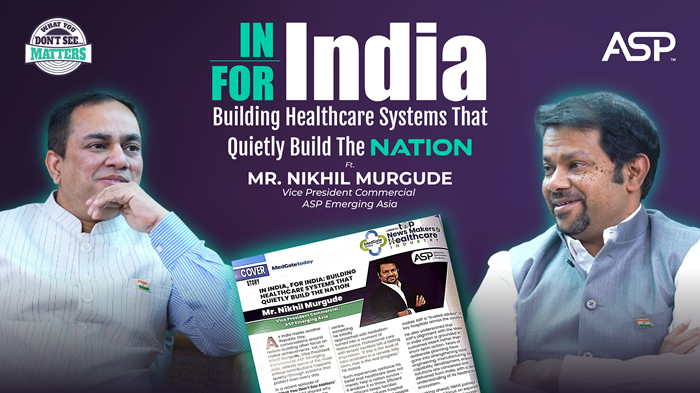 |
| In India. For India. Forever in India: Quietly building trusted healthcare systems. |
About Advanced Sterilization Products
Advanced Sterilization Products (ASP) is a global leader in infection prevention and control solutions dedicated to protecting patients during their most critical moments. ASP develops and delivers proven low temperature plasma sterilization and high-level disinfection technologies, digital compliance tools, and process solutions that healthcare professionals depend on to elevate the standard of care. With a deep commitment to patient safety and long-term healthcare resilience, ASP’s mission is to create products and systems that practitioners can trust.


