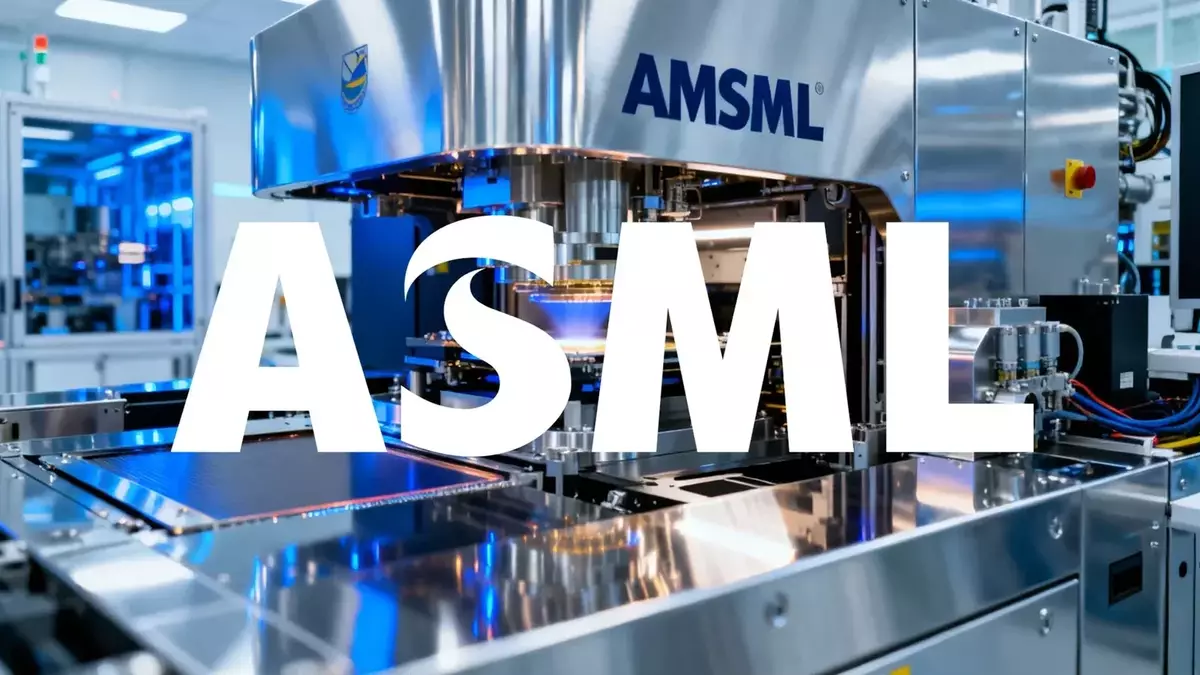
ASML's High-NA Milestone Sets Stage for Crucial Order Book Verdict
26.06.2026 - 03:53:25 | boerse-global.de
ASML has begun commercial shipments of its next-generation High-NA EUV lithography systems, a move that thrusts the $400 million-per-machine technology into the spotlight just weeks before the Dutch chip equipment giant reports second-quarter results. The stock, already up 62% year-to-date, closed Thursday at €1,601.80 after gaining 3.5%, recouping most of the prior week's 5% slide tied to geopolitical jitters. That leaves the 52-week high of €1,710 — touched only three days earlier — within striking distance.
The immediate catalyst for Thursday's rally came from memory maker Micron, which posted record third-quarter revenue of $13.77 billion, representing a 307% surge year-over-year. Cloud-memory demand from hyperscalers and data centers remains insatiable, and that bodes well for ASML. But the real inflection point, analysts say, will come in July when ASML reports its quarterly numbers. The headline revenue figure matters less than a single question: can the management confirm that the entire 2027 production capacity is already spoken for?
BofA strategists believe the answer is yes. If ASML declares its 2027 order book fully booked during the July call, the valuation framework shifts from 2027 earnings visibility to 2028 expectations — a structural re-rating that could justify the stock's current premium. The company's performance obligations stood at €46.5 billion at the end of 2025, with roughly 65% of that sum expected to convert into revenue within twelve months.
The High-NA rollout adds a new dimension to the growth picture. ASML's Twinscan EXE series scanners deliver a resolution of around 8 nanometers, enabling chip features up to 66% smaller than current-generation systems. Intel has taken the most aggressive early-adopter stance, already integrating the first tools and planning to use them for processes beyond 18A. SK Hynix and Samsung are lining up for the next DRAM generation. TSMC, by contrast, is dragging its feet, arguing that High-NA EUV is not yet economical for mass production and preferring to squeeze more from existing 0.33-NA machines through multi-patterning.
Should investors sell immediately? Or is it worth buying Asml?
This divergence in customer strategy works in ASML's favor: it reduces dependence on any single buyer and spreads adoption risk across multiple roadmaps. On the memory side, the industry's shift to 4F² DRAM structures dramatically increases lithography complexity, requiring more EUV and immersion layers. ASML plans to deliver at least 60 Low-NA EUV systems in 2026 and at least 80 in 2027, a 33% ramp if demand holds. The High-NA pipeline is also building: Intel and ASML recently completed acceptance tests for the second unit, the TWINSCAN EXE:5200B, which processes 175 wafers per hour with an overlay accuracy of 0.7 nanometers.
Financially, the outlook has already been upgraded. ASML now projects 2026 revenue in a range of €36 billion to €40 billion, up from the prior €34 billion-to-€39 billion corridor. Gross margin is expected to hold steady between 51% and 53%, though the second quarter will see a dip to 51%–52% from 53% in Q1 — a decline management has flagged as temporary.
Not everything is rosy. The stock trades 43.7% above its 200-day moving average and 15.9% above its 50-day average, a stretched valuation that leaves little room for disappointment. TSMC's reluctance to embrace High-NA limits the top-line contribution from the highest-margin systems. And geopolitical risks remain acute: a bipartisan group of US lawmakers has introduced legislation that would ban ASML from selling DUV systems to Chinese chipmakers. The China share of system revenue has already fallen from 36% in the December quarter to 19% in the first quarter of 2026, and another leg lower would accelerate if the bill passes Congress. ASML has never shipped EUV to China, but DUV restrictions would carve deeper into available market.
Asml at a turning point? This analysis reveals what investors need to know now.
July's earnings call will therefore determine whether the stock can hold its premium. A clear confirmation that 2027 capacity is fully booked would give investors the confidence to look through to 2028 estimates, potentially lifting the stock past the €1,710 record. Any equivocation — or an escalation of US export controls — could trigger a sharp correction toward the 200-day average, a level that sits roughly 44% below the current price.
Ad
Asml Stock: New Analysis - 26 June
Fresh Asml information released. What's the impact for investors? Our latest independent report examines recent figures and market trends.