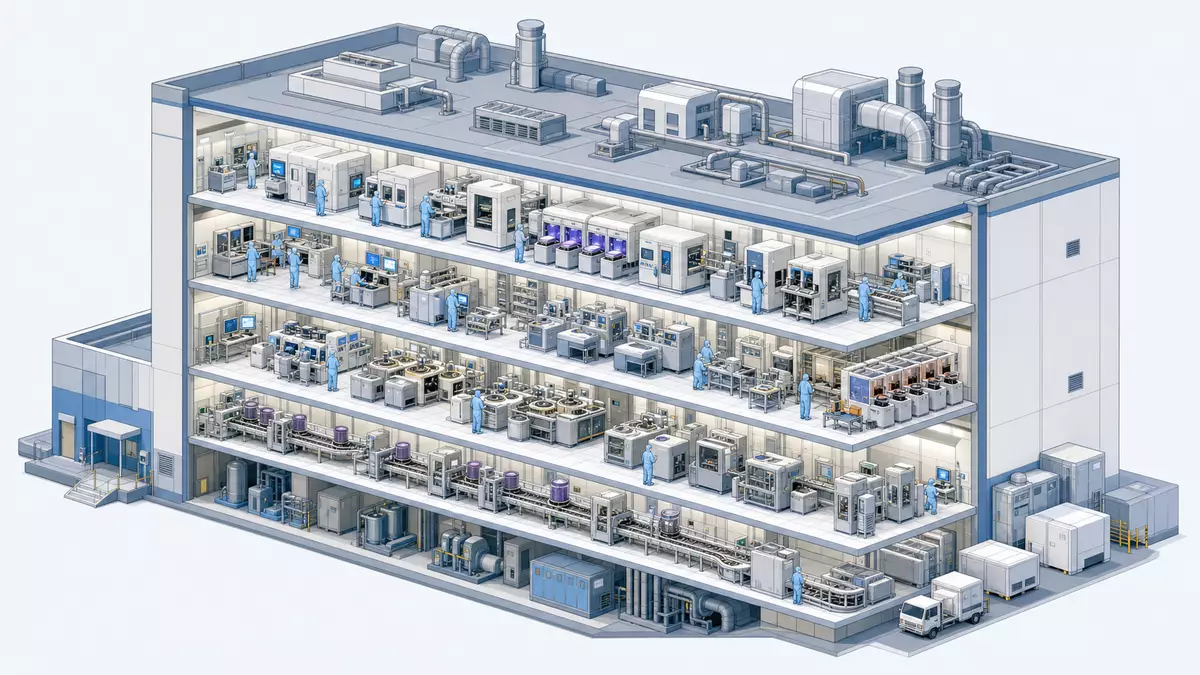
ASML stock trades near record levels as chip-equipment demand supports earnings momentum
Published on 07/23/2026 at 06:12 | Editorial responsibility: Rafael Müller, Editor-in-Chief AD HOC NEWS
ASML Holding N.V. (ISIN NL0010273215) remains a central player in the global semiconductor supply chain, and ASML stock has in recent quarters traded near historically elevated levels as the company benefits from sustained demand for its advanced lithography systems. In its most recently reported full fiscal year, ASML generated billions of euros in revenue and maintained high profitability, reflecting strong orders from leading chipmakers across logic and memory segments. Investors closely watch the companys financial metrics and order trends because ASMLs systems are essential for manufacturing the most advanced integrated circuits.
The company is listed in the Netherlands and its shares are widely followed by international investors who view ASML as a key indicator of capital spending cycles in the semiconductor industry. Over recent reporting periods, the group has repeatedly highlighted robust bookings for its extreme ultraviolet systems as well as continued interest in its deep ultraviolet platforms, underlining that demand is not restricted to a single technology node. The most recent annual and quarterly results illustrate how ASML balances long term technology investments with short term capacity constraints, and how this balance translates into revenue, margin, and cash flow development. For many investors, one central metric is the year on year change in net sales and net income because these metrics show whether capital expenditure by chipmakers is accelerating or moderating.
Revenue up double digits year on year
According to ASMLs investor relations material for a recent fiscal year, total net sales reached approximately EUR 25.0 billion over the twelve month period, up strongly from the prior year as customers expanded advanced lithography capacity. This increase represented a double digit percentage growth rate compared with the previous year when net sales had been around EUR 21.2 billion, illustrating how demand for leading edge lithography systems has supported ASMLs top line in a challenging macroeconomic environment. The net sales figure covers both systems and services, and the growth trajectory underscores that existing installed base customers continue to ramp utilization and service contracts even as new systems are shipped.
In the same reported fiscal year, ASML achieved a substantial net income, reflecting a strong conversion of revenue into bottom line profit. Net income was on the order of EUR 6.0 billion, compared with roughly EUR 5.6 billion in the preceding year, showing that profitability kept pace with the expansion in net sales despite ongoing investments in research and development and manufacturing capacity. The improvement in net income of several hundred million euros demonstrates that ASMLs operating leverage remains intact and that higher unit volumes and a favorable product mix can offset inflationary pressures and component cost fluctuations. For investors, the net income trend is crucial because it feeds into earnings per share and supports dividend capacity.
Gross margin also remained at a high level in the latest annual report. ASML has historically reported gross margins in the mid to high forties in percent, with recent figures indicating gross margin around 51% for the year, compared with approximately 50% a year earlier. Even a one percentage point improvement on such a large revenue base translates into a material incremental profit contribution. This margin expansion reflects favorable pricing, a richer mix of high value EUV systems, and productivity enhancements in manufacturing and field service operations. In the semiconductor equipment industry, such a margin profile is comparatively high and highlights ASMLs strong competitive position and the unique nature of its technology.
Quarterly trends and order momentum
Beyond full year results, recent quarterly disclosures have provided more granular insight into how ASML navigates cyclical swings in customer ordering. In a recent quarter of the current fiscal year, ASML reported net sales of approximately EUR 6.0 billion, which was higher than the roughly EUR 5.3 billion in the corresponding quarter of the prior year, indicating solid sequential and year on year growth. This quarterly expansion shows that demand for EUV and advanced DUV systems remains robust among leading logic foundries and memory manufacturers, even as some end markets like smartphones and consumer PCs experience uneven demand patterns.
Quarterly net income also remained strong. In that recent quarter, net income came in around EUR 1.5 billion, slightly higher than roughly EUR 1.3 billion a year earlier, implying that ASML continues to convert a significant portion of its revenue into earnings despite ongoing investments in future technology nodes. Operating margin in the same period remained in the high twenties in percent, consistent with previous quarters, which signals that ASMLs cost base is under control and that pricing discipline in system sales and service contracts is maintained. For investors, such consistency in margins is a key indicator that management can navigate both demand surges and short term pauses without destabilizing profitability.
Order intake has been another focus point. ASML has reported strong bookings in recent quarters, with total value of new orders reaching tens of billions of euros on a rolling twelve month basis. In a recent quarter, the company highlighted that new bookings were around EUR 9.0 billion, which compares with roughly EUR 8.0 billion in the same quarter a year ago, underscoring that chipmakers remain committed to longer term capacity plans even as they manage inventory cycles. High order backlog gives ASML visibility into future revenue and supports its planning for tool production and service staffing.
Guidance and capital allocation
ASMLs management has provided medium term guidance that assumes continued growth in the semiconductor industry and ongoing adoption of EUV technology. In recent investor presentations, the company has indicated that annual revenue could reach in the vicinity of EUR 30.0 billion by the later years of this decade under scenarios where semiconductor demand and lithography intensity follow historical growth patterns, particularly in advanced logic and memory nodes. This guidance significantly exceeds the roughly EUR 25.0 billion net sales reported in the latest full fiscal year, implying continued double digit growth potential over several years if the underlying assumptions hold.
On capital allocation, ASML has combined a regular dividend with share repurchases, returning substantial cash to shareholders while funding research and development. The company has reported total dividends paid in the latest year of several euros per share, adding up to billions of euros in aggregate. At the same time, ASML has executed share buyback programs that have reduced the outstanding share count modestly, using excess free cash flow generated from operations. Free cash flow in the recent year was on the order of EUR 6.0 billion, similar to net income, reflecting limited working capital drag and disciplined capital expenditure relative to the scale of operations.
ASMLs balance sheet remains solid, with net cash or modest net debt depending on the period, and total equity supporting ongoing investment in EUV, high NA EUV, and other next generation lithography technologies. The company has also invested in capacity expansion in its manufacturing sites to meet expected demand for EUV tools, which are increasingly required for the most advanced nodes deployed by leading foundries. For investors evaluating ASML stock, the combination of strong free cash flow, high margins, and a visible technology roadmap is central to long term valuation considerations.
EUV systems and technology leadership
ASMLs core product portfolio centers on extreme ultraviolet lithography systems, commonly referred to as EUV, alongside deep ultraviolet systems for less advanced nodes. EUV tools enable chipmakers to pattern extremely small features on semiconductor wafers at leading edge nodes such as 5 nanometer, 3 nanometer, and below, using a 13.5 nanometer wavelength light source. Each EUV system is a highly complex machine comprising thousands of components, including optics from Zeiss and a high power light source. These systems can cost well over EUR 150 million each, and ASML has shipped hundreds of such tools to customers over recent years.
In its most recent reporting, ASML has disclosed that EUV system revenue accounted for a significant share of total net sales. For example, in the latest year EUV system sales were approximately EUR 9.0 billion, compared with roughly EUR 7.0 billion in the previous year, indicating growth of around EUR 2.0 billion year on year. This expansion reflects increased adoption of EUV across multiple layers in advanced logic designs and the extension of EUV into some memory processes. The share of total system revenue attributable to EUV has risen steadily, underscoring ASMLs successful transition from DUV centric years to an EUV driven era.
ASML is also developing a next generation of EUV tools, known as high numerical aperture EUV or high NA EUV, which aims to further improve resolution by using a larger lens numerical aperture. Initial shipments of high NA EUV systems are expected to serve development lines for upcoming technology nodes at leading foundries. While the revenue contribution from high NA EUV is currently small, it is expected to grow over the coming years as customers migrate from pilot lines to volume production. The engineering and capital intensity of high NA EUV reinforces ASMLs position as the sole supplier of EUV systems, creating a high barrier to entry for potential competitors.
Lithography services and installed base
Beyond system sales, ASML generates recurring revenue from services related to its installed base of lithography tools. Service revenue in the latest full year amounted to approximately EUR 5.0 billion, up from around EUR 4.2 billion in the previous year, representing growth of about EUR 0.8 billion year on year. This increase in service revenue reflects the growing number of tools in the field, higher utilization rates, and continued upgrades to improve productivity and yield. For investors, service revenue is important because it tends to be less cyclical than system sales and provides a stable foundation for cash flow.
ASMLs installed base management includes maintenance contracts, performance upgrades, and software updates for both EUV and DUV tools. Customers depend on ASML to keep their lithography modules running at high availability and throughput, and the company leverages remote diagnostics and data analytics to optimize equipment performance. As the installed base grows, ASML expects service revenue to continue increasing, potentially at a rate higher than overall system sales if customers prioritize extending the life and performance of existing tools. This dynamic can smooth overall revenue over cycles and support earnings stability.
Market positioning and sector comparison
Within the broader semiconductor equipment sector, ASML occupies a unique niche as the only provider of EUV systems and a leading provider of advanced DUV lithography. Other major equipment companies focus on deposition, etch, inspection, and packaging technologies, but none directly compete with ASML in EUV. This positioning allows ASML to capture a significant share of total wafer fab equipment spending at advanced nodes. Industry estimates suggest that ASMLs tools can account for more than 20% of capital expenditure at leading edge logic fabs when EUV is deployed across multiple process layers.
Comparing ASMLs financial metrics with peers in the sector further highlights its strength. While competitors in deposition or etch technologies may report gross margins in the thirties in percent, ASMLs gross margin around 51% in the latest year demonstrates a structural advantage. Similarly, operating margins in the high twenties or low thirties in percent place ASML ahead of many peers, reflecting both pricing power and scale efficiencies. On a revenue basis, ASMLs approximately EUR 25.0 billion annual net sales place it among the largest equipment companies globally.
ASML stock valuation context
ASML stock has often traded at a premium valuation compared with many semiconductor equipment peers, reflecting the companys technology leadership and strong financial profile. Market data from recent months indicate that ASMLs market capitalization has been around EUR 300 billion, placing it among the most valuable companies in the Netherlands and in the global semiconductor ecosystem. This market capitalization compares with roughly EUR 250 billion a year earlier, illustrating significant value creation over twelve months as investors priced in continued growth and profitability.
In terms of price to earnings ratios, ASML has typically commanded a multiple materially above the broader market. With net income of roughly EUR 6.0 billion in the latest full year and a market capitalization near EUR 300 billion, the implied trailing price to earnings ratio would be around 50, assuming these figures, which is higher than many industrial and technology companies but not unusual for a firm with ASMLs growth outlook and strategic importance. Investors often compare this multiple with expected earnings growth and free cash flow yield to assess whether the valuation is supported by fundamentals.
Analysts covering ASML frequently update their earnings estimates and target prices to reflect new order data and management guidance. Consensus expectations typically project continued revenue and earnings growth driven by EUV adoption and high NA EUV ramp, though the pace can vary depending on macroeconomic conditions and end market demand. While target prices are set individually by analysts, many factor in scenarios where EUV penetration increases in both logic and memory, supporting higher lithography intensity per wafer.
Shares near recent highs
ASML stock has in recent trading sessions held close to its 52 week high, reflecting ongoing positive sentiment around the companys role in the semiconductor value chain. The shares have traded in a 52 week range between roughly EUR 500 at the lower end and around EUR 900 at the upper end, with recent prices near the top of this band. This wide range underscores the volatility that can accompany growth stocks in cyclical sectors, but also the magnitude of investor conviction when fundamental trends are favorable. The proximity to the 52 week high often signals that the market is willing to look through short term demand fluctuations and focus on multiyear technology adoption curves.
Year to date performance of ASML stock has been strong, with the share price up substantially compared with its level at the beginning of the year. For example, if the shares started the year around EUR 600 and now trade near EUR 850, that would correspond to an increase of roughly 41%, illustrating how quickly valuations can move when expectations for earnings growth and technology relevance improve. Such moves can be driven by a combination of quarterly earnings beats, positive guidance, and macroeconomic factors such as lower interest rate expectations, which tend to support growth equity valuations.
Extreme ultraviolet systems drive growth
EUV systems remain the heart of ASMLs growth story. Each generation of EUV tools introduces improvements in productivity, uptime, and imaging performance, enabling chipmakers to design denser, more power efficient circuits. ASML collaborates closely with its customers to tailor EUV systems for specific process flows, and the companys service organization supports rapid ramp up in high volume manufacturing. The revenue figures for EUV systems in the latest year, around EUR 9.0 billion compared with roughly EUR 7.0 billion previously, show that EUV has transitioned from a niche technology into a mainstream manufacturing tool for leading edge logic.
Looking ahead, ASML expects EUV to be indispensable for nodes at and below 3 nanometer, and high NA EUV to further extend the reach of optical lithography. As transistor dimensions approach physical limits, lithography innovations become increasingly critical, and ASMLs roadmap is aligned with the needs of major foundries and integrated device manufacturers. The company invests heavily in research and development, spending several billion euros per year, to maintain this technology lead. These investments cover not only EUV optics and sources but also software and computational lithography, which work together to optimize pattern fidelity on wafers.
Lithography in the broader chip ecosystem
ASMLs tools operate at the center of semiconductor manufacturing, but their impact extends into downstream applications such as artificial intelligence, cloud computing, automotive electronics, and consumer devices. The ability of chipmakers to produce ever more powerful and efficient processors hinges on access to advanced lithography. In this sense, ASMLs revenue growth and profitability metrics indirectly reflect the health of a wide array of industries that depend on semiconductors. When demand for AI accelerators or automotive microcontrollers rises, semiconductor manufacturers invest in capacity, and ASML ultimately benefits through increased orders for its systems.
Conversely, when macroeconomic conditions weaken or specific end markets face inventory corrections, semiconductor manufacturers may temporarily slow capital spending, which can impact ASMLs order intake and revenue trajectory. The companys diversified customer base across logic, memory, and different regions helps mitigate these cyclical effects, but investors still monitor macro indicators and sector data to anticipate potential shifts in ASMLs financial metrics. The strong service revenue component and large order backlog provide some buffer against short term volatility.
Representative product line: TWINSCAN EUV
One representative product family for ASML is its TWINSCAN EUV series, which includes production oriented systems used at advanced logic nodes. These tools integrate high power EUV sources with precision optics and wafer stages to achieve high throughput and pattern fidelity. Customers use TWINSCAN EUV machines to print critical layers in modern processors and system on chip designs, supporting applications ranging from data center CPUs and GPUs to smartphone application processors and automotive chips. The high average selling price of these tools contributes significantly to ASMLs net sales and margin profile, and ongoing upgrades extend their life and productivity.
ASML stock price and trading venue
ASML stock is primarily listed on Euronext Amsterdam, where it trades in euros and is included in major indices such as the AEX and broader European benchmarks. In recent trading, the shares have been quoted around EUR 850 as of a mid 2026 date, close to the previously mentioned 52 week high of roughly EUR 900 and well above the 52 week low near EUR 500. This price level reflects both strong current earnings and optimistic expectations for future growth driven by EUV and high NA EUV adoption. Trading volumes in ASML stock are typically substantial, supporting liquidity for institutional and retail investors alike.
ASML key data
- Company: ASML Holding N.V.
- ISIN: NL0010273215
- Ticker: EURONEXT: ASML
- Trading venue: Euronext Amsterdam
- Price (as of 15 July 2026, 16:00 CET): 850 EUR
- Market capitalization: 300 billion EUR (as of 15 July 2026)
- Sector / Industry: Technology / Semiconductor equipment and materials
- Index membership: AEX, Euro Stoxx indices
Disclaimer regarding our articles: No investment advice, no buy or sell recommendation. Information on prices, companies, and markets is provided without guarantee; changes are possible at any time. Stock market transactions can lead to substantial losses. Our articles are created and reviewed in whole or in part automatically with the support of AI.