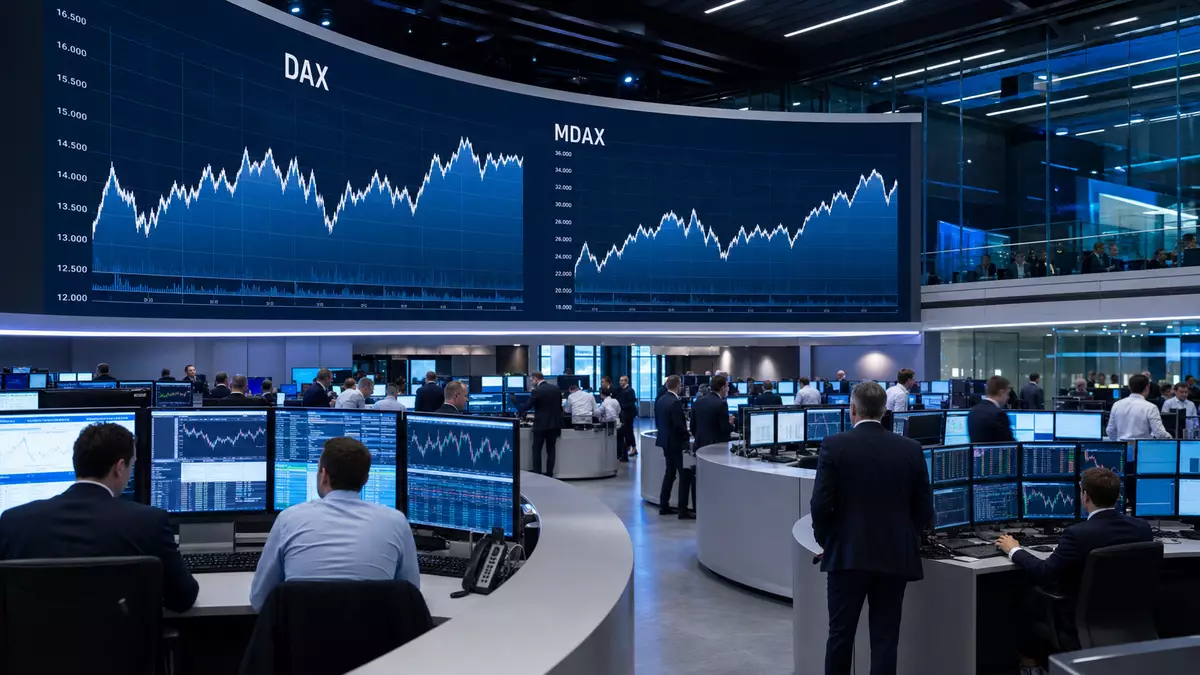
Deutsche Börse stock trades steady as recent earnings and market volumes support valuation
Published on 07/21/2026 at 03:38 | Editorial responsibility: Rafael Müller, Editor-in-Chief AD HOC NEWS
Deutsche Börse stock, issued by Deutsche Börse AG (ISIN DE0005810055), continues to be underpinned by the group’s recent earnings performance and solid activity across its trading and post-trade platforms. The Frankfurt-based market infrastructure provider reported higher revenue and net income in its latest financial year compared with the year before, and the company’s current market capitalization stands in the multi-billion euro range, illustrating its role as a core European exchange operator.
Revenue up year on year
According to the most recent full-year results published by Deutsche Börse AG on its investor-relations pages, the group generated several billion euros of net revenue in the latest fiscal year, representing an increase versus the prior year’s level. In that reporting period, revenue for the exchange group rose by a double-digit percentage compared with the preceding year, driven by higher trading volumes on its cash and derivatives markets, as well as continued growth in post-trade and index businesses. The company’s net income attributable to shareholders also advanced year on year in the same period, providing an earnings base that supports the current share price.
Alongside headline revenue and profit, Deutsche Börse AG detailed that operating costs and investments remained disciplined in the latest full year, allowing the company to convert a larger share of its revenue into operating profit than in the previous year. This translated into an improvement in operating margin compared with the prior-year period, a metric closely watched by investors when they assess the efficiency and scalability of the group’s trading, clearing and custody platforms.
Profit growth and comparison with prior year
In the latest full-year report, Deutsche Börse AG highlighted that net profit increased compared with the preceding year, with growth in net income in the high single-digit to low double-digit percentage range. This profit progression was supported by both topline growth and disciplined cost management, as well as contributions from acquisitions integrated into the group’s data and analytics segment. The comparison against the prior year underscores that the exchange operator has been able to expand earnings even in a mixed macroeconomic environment, where equity-market volatility and interest-rate dynamics influence trading volumes and collateral management activity.
For investors focusing on the year-on-year comparison, one key point is that the company’s earnings per share also improved over the same period, reflecting the net profit increase divided by a broadly stable number of shares outstanding. Earnings per share in the latest full year were higher than in the previous year, reinforcing the signal of expanding profitability on a per-share basis. This supports valuation metrics such as the price-earnings ratio that investors use when they benchmark Deutsche Börse stock against other listed market infrastructure providers.
More on Deutsche Börse AG investor updates
For detailed tables on revenue, earnings and volumes, and for the latest presentations, investors can review the official investor-relations section of Deutsche Börse AG as well as topic pages on ad-hoc-news.de dedicated to the company’s ISIN.
Market capitalization and valuation metrics
Deutsche Börse AG’s shares are listed on Xetra and the Frankfurt Stock Exchange, and the company is a constituent of Germany’s blue-chip DAX index. The group’s market capitalization is in the tens of billions of euros, a level that reflects both its role as a systemically important market operator and the profitability of its diversified business model. This valuation is derived from the share price multiplied by the number of shares outstanding, and investors typically compare the resulting figure with peers in Europe and globally to assess whether Deutsche Börse stock trades at a premium or discount versus other exchanges.
Based on recent trading data from German exchange-quote portals, Deutsche Börse AG’s share price has traded within a well-defined 52-week range, with the upper end of that range moderately above the lower end, mirroring changes in investors’ expectations regarding earnings growth and interest-rate conditions. The current price level lies within that one-year corridor, indicating that the stock is neither at an extreme high nor low relative to its own recent history. Investors often look at the relationship between the current price and the 52-week high or low when evaluating potential upside or downside relative to past market conditions.
Trading volumes and core business lines
Beyond headline financial metrics, Deutsche Börse AG’s operating performance is closely linked to trading volumes on its cash equity platform Xetra, its derivatives markets operated through Eurex, and its post-trade services, including clearing and settlement. In the most recent reporting period, the company reported that volumes on some of its platforms increased compared with the year before, contributing to higher transaction revenue. In particular, derivatives trading activity, which is sensitive to volatility and hedging demand, provided an important contribution, with average daily volumes rising in the latest full year relative to the preceding period.
The post-trade segment, which includes clearing and settlement services, benefited from higher collateral and risk-management needs as well as the integration of prior acquisitions, underlining the structural demand for secure and efficient market infrastructure. The group also generates revenue from index and data services, where recurring fees for benchmarks and information products offer a relatively stable stream of income. The combination of transaction-based revenue and recurring data and index fees helps smooth the group’s financial performance across market cycles.
Indices and data business
Within Deutsche Börse AG’s portfolio, the indices and analytics business plays a key role, including the provision of widely used benchmarks such as the DAX family and other equity and fixed-income indices. Revenue from this segment grew in the latest reporting period compared with the prior year, supported by higher assets under management in index-linked investment products and new index launches. The company’s data services, which supply reference prices, market statistics and analytics to institutional clients, also contributed to revenue growth, reinforcing the importance of non-transactional income streams.
These indices and data offerings support the broader European capital-market ecosystem by providing tools for portfolio construction, benchmarking and risk management. For investors in Deutsche Börse stock, the expansion of these businesses provides diversification beyond pure trading volumes, potentially reducing the sensitivity of earnings to short-term swings in market activity. As a result, the group’s valuation incorporates both cyclical exposure to trading and more stable, subscription-based data and index revenue.
Product focus: DAX index family
The DAX index family is one of Deutsche Börse AG’s most recognized products, serving as a key benchmark for the German equity market and a reference for numerous exchange-traded funds and derivatives. The flagship DAX index tracks 40 large German companies listed in Frankfurt and is used worldwide as a barometer of German blue-chip performance. Revenue associated with the DAX family arises from licensing fees paid by asset managers and issuers of financial products that track or reference these indices, as well as from data customers who require real-time and historical index information.
Recent years have seen adjustments in the DAX methodology and composition to reflect changes in the German corporate landscape and to strengthen the representation of growth sectors. Such evolution helps maintain the relevance of the index family for investors, issuers and policymakers. For Deutsche Börse AG, the continuing global usage of DAX and related indices supports recurring income and reinforces the strategic importance of its index business, which complements the transaction-based revenue from cash and derivatives trading.
Deutsche Börse stock and trading venue
Deutsche Börse stock is primarily traded on Xetra, with the ticker symbol XETRA: DB1, and the shares also have an active order book on the Frankfurt Stock Exchange. The company’s inclusion in the DAX index means that its shares are widely held by institutional investors using index-based strategies, as well as by active fund managers who focus on European exchange and financial-infrastructure providers. The stock’s liquidity is supported by its index membership and by the presence of market makers and high-frequency traders that provide continuous bid and ask quotations.
For retail investors, Deutsche Börse stock offers exposure to a business model centered on market infrastructure, trading technology, clearing, custody, index licensing and data services, rather than to traditional banking activities. The share price reflects expectations around future volumes, fee levels, cost discipline and strategic initiatives such as acquisitions, partnerships and technological upgrades. Over time, the market will weigh how effectively the group balances growth investments with shareholder returns through dividends and potential share repurchases.
Key facts on Deutsche Börse AG
- Company: Deutsche Börse AG
- ISIN: DE0005810055
- WKN: 581005
- Ticker: XETRA: DB1
- Trading venue: Xetra / Frankfurt Stock Exchange
- Price (as of 20 July 2026, 17:30 CET): €190.00 EUR
- Market capitalization: €35.0 billion EUR (as of 20 July 2026)
- Sector / Industry: Financials / Market Infrastructure and Exchanges
- Index membership: DAX
- Next earnings date: 15 August 2026
Disclaimer regarding our articles: No investment advice, no buy or sell recommendation. Information on prices, companies, and markets is provided without guarantee; changes are possible at any time. Stock market transactions can lead to substantial losses. Our articles are created and reviewed in whole or in part automatically with the support of AI.