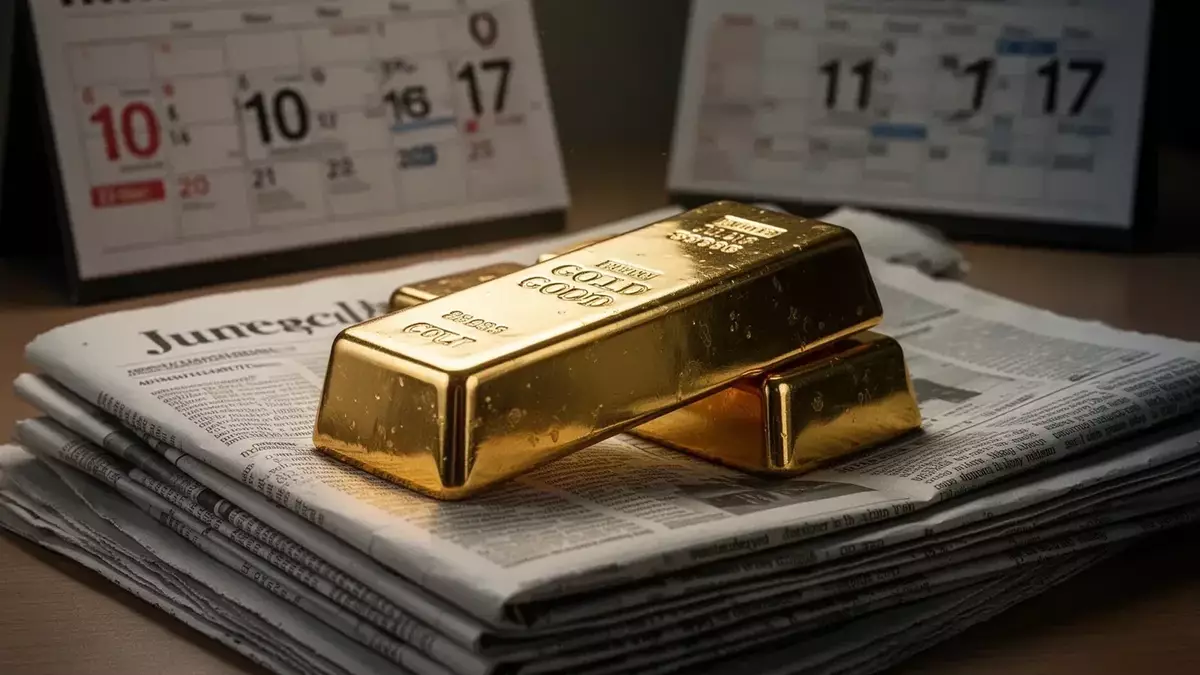
Gold at a Crossroads: Central Bank Buying Struggles to Overcome Hawkish Winds
14.06.2026 - 11:06:12 | boerse-global.de
The precious metal finds itself caught between two powerful forces. Central banks are stockpiling gold at a historic pace, yet the price has tumbled roughly 10 percent over the past month and sits nearly a quarter below its 2026 peak. The culprit? Rising real interest rates and a hawkish pivot from major central banks that are choking off the metal's appeal.
Gold closed the week at $4,239.70 an ounce, a level that masks a brutal 30-day stretch. That price is about 25 percent below the year's high of $5,626.80, and the relative strength index has sunk to 36.1, signalling an oversold market—though not yet a clear turnaround. The first line of support lies at $4,200, with the psychologically significant $4,000 mark below that. A break lower could trigger a deeper correction, while resistance sits at $4,300 and $4,350. Only a sustained move above $4,450 would flip the short-term chart structure to bullish.
The Real Rate Trap
Inflation alone would normally be a tailwind for gold, but the mechanism has broken. U.S. consumer prices hit 4.2 percent in May, driven by an energy spike of nearly a quarter since the Iran conflict erupted in late February. The European Central Bank responded on June 11 by hiking its deposit rate to 2.25 percent and the main refinancing rate to 2.40 percent—its first increase since September 2023. Eurozone inflation stands at a projected 3.0 percent, with growth limping at just 0.8 percent, a textbook stagflation mix.
Higher nominal yields on both sides of the Atlantic are pushing real rates upward, and that is toxic for a non-yielding asset like gold. The metal has shed nearly 10 percent over the past 30 days as markets price in further tightening.
Should investors sell immediately? Or is it worth buying Gold?
Warsh Takes the Stage
All eyes are now on the Federal Open Market Committee meeting June 16-17, the first chaired by newly installed Fed chief Kevin Warsh. Markets assign a 97 percent probability that the Fed will hold rates steady, but the outlook beyond that is more uncertain. Derivatives pricing implies a 70 percent chance of at least one hike by December. Warsh has signalled he prefers to decide meeting by meeting rather than telegraph a long-term path, which only adds to the uncertainty.
The Bank of Japan meets on June 15 and the Bank of England on June 18, following the ECB's move the prior week. If all three strike a restrictive tone, pressure on gold could intensify further.
Geopolitical crosscurrents add another layer. The Iran conflict has sent safe-haven flows into gold, but it has also stoked inflation through higher energy costs. U.S. producer prices surged 6.5 percent year-on-year in May. Reports of potential peace talks between Washington and Tehran briefly eased tensions, but the durability of those signals remains unclear.
Central Banks Fill the Gap
Despite the price slump, institutional demand continues to provide a structural floor. Global central banks bought a net 244 tonnes of gold in the first quarter of 2026, well above the five-year average, according to the World Gold Council. The People's Bank of China made its largest single purchase since late 2024 in May, the 19th consecutive month of buying, raising its total reserves to 2,321.5 tonnes. Poland added to its stockpile, which now stands at 595 tonnes.
The shift in demand composition is notable. Physical investment in bars and coins surpassed jewellery as the largest single category for the first time in 2026, reaching 474 tonnes in Q1—the second-largest quarterly increase on record. Overall gold demand hit $193 billion in the first quarter, a 74 percent leap from a year earlier.
Gold at a turning point? This analysis reveals what investors need to know now.
Major investment banks have stood by their year-end targets, which imply substantial upside from current levels. Goldman Sachs sees $5,400, J.P. Morgan $6,000, Morgan Stanley $5,200, and UBS $5,500—all 25 to 44 percent above Friday's close.
The Week Ahead
The near-term trajectory hinges on Wednesday's FOMC decision and Chairman Warsh's subsequent press conference. Markets will parse every word for clues on the rate path. Until then, gold is likely to oscillate in a tight range, with the potential for sharp moves in either direction once the central bank rhetoric is digested. The structural support from central bank buying remains intact, but it may take more than accumulating reserves to break the grip of rising real rates.
Ad
Gold Stock: New Analysis - 14 June
Fresh Gold information released. What's the impact for investors? Our latest independent report examines recent figures and market trends.