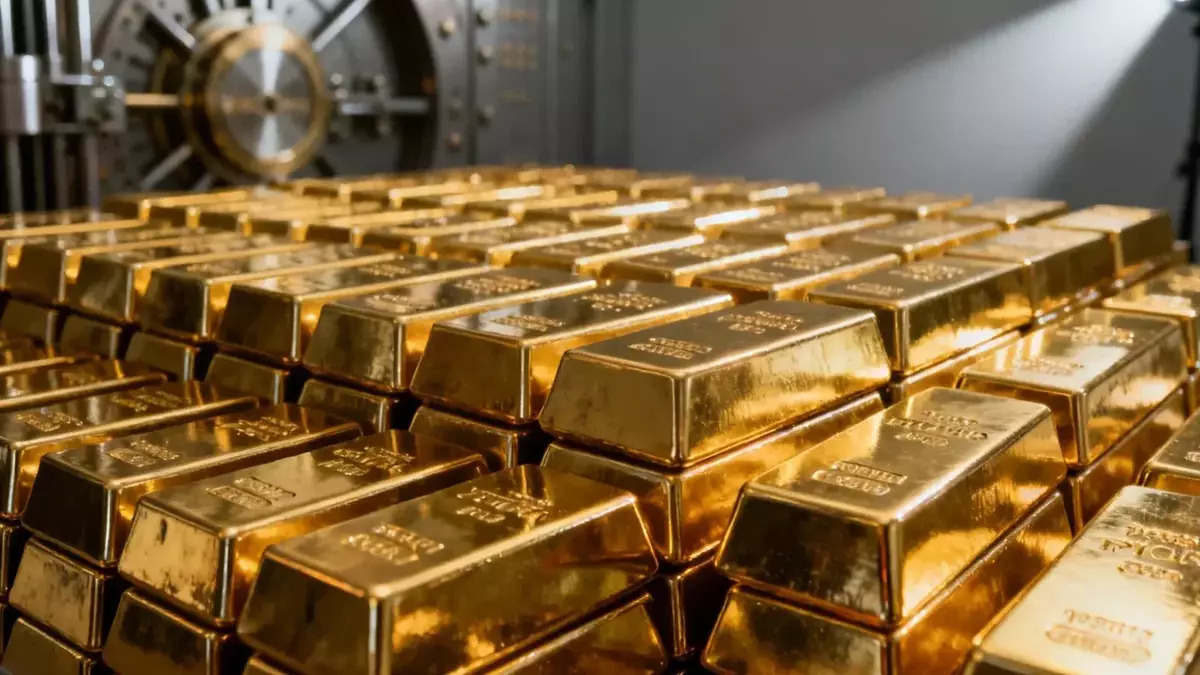
Gold’s $4,060 Crossroads: CPI, a Hawkish Fed, and Oil Jitters Challenge Central Bank Support
Published on 07/13/2026 at 09:52 | Redaktion boerse-global.de
Gold investors entered a pivotal week on shaky ground, with the precious metal sliding 1.4% on Monday to roughly $4,060 per ounce – erasing the entirety of the previous week’s gains in a single session. The trigger was a familiar one: escalating tensions between the U.S. and Iran. Yet the usual safe-haven bid failed to materialize, leaving the market confronting a rare paradox that has deepened over recent weeks.
The immediate catalyst was a weekend surge in hostilities. Iran’s Revolutionary Guard declared the Strait of Hormuz closed after attacking a Cyprus-flagged container vessel, vowing no ships would pass until the U.S. ends its “interference.” The Pentagon swiftly rejected that claim, but confusion over the waterway’s actual status rattled traders. Given that roughly one-fifth of the world’s crude oil transits the strait, the threat of disruption sent oil prices up about 3% on Monday. That spike, in turn, reignited inflation fears and shifted expectations for Federal Reserve policy. A more restrictive monetary outlook makes non-yielding gold less attractive, and Monday’s sell-off reflected precisely that calculus.
The Fed’s hawkish lean has been building for weeks. Minutes from the June meeting showed several policymakers favored a rate hike, and the central bank’s next decision on July 28-29 looms large. On Tuesday, the U.S. consumer price index will offer the latest inflation snapshot, followed by new Fed Chair Kevin Warsh’s first congressional testimony. Any sign that the central bank is prepared to act more aggressively could keep gold pinned near its recent lows.
But the metal is not without sturdy supports. Central banks have been buying at a near-record pace, creating a structural floor that analysts say should limit downside. The People’s Bank of China added roughly 480,000 ounces to its reserves in June, marking the 20th consecutive month of accumulation and the largest monthly addition since October 2023. Poland remains the most aggressive buyer globally this year, followed by Uzbekistan with 16.5 tonnes and Kazakhstan with 6.5 tonnes. A World Gold Council survey of 74 central banks found that 45% plan to increase their gold holdings over the next twelve months – the highest reading since the survey began in 2018 – while only one institution intends to sell. The motives cited include geopolitical uncertainty, diversification away from the U.S. dollar, and a long-term shift in reserve allocation.
Should investors sell immediately? Or is it worth buying Gold?
Despite that relentless demand, gold has struggled to gain traction. At Friday’s close of $4,127.60, the metal was down 1.18% for the week, 2.64% on the month, and 4.93% year-to-date. The record high of $5,626.80 from January 2026 now seems distant, with the current price more than 26% below that peak. The relative strength index sits at 44, signaling neutral-to-weak momentum without extreme oversold conditions.
The technical picture has also deteriorated. The weekly chart has formed a head-and-shoulders pattern with a neckline at $4,200, a level gold has already broken below. For any meaningful recovery to materialize, the metal would need to reclaim the $4,200–$4,220 zone. The next upside target would then be the 200-day moving average at roughly $4,491, but gold currently trades 5.45% below its 50-day average of $4,365.48 and 9.07% below its 200-day average. The 52-week low of $3,901.30, set in October 2025, is only about 5.8% away.
HSBC, which revised its forecasts last week, argues that Iran-linked declines are unlikely to persist. “The conflict still has the power to push gold lower, but we do not believe Iran-related drops will prove lasting on their own,” the bank wrote, pointing to ongoing structural supports such as fiscal deficits, economic instability, and high sovereign debt levels that underpinned the market before the current tensions erupted.
Gold at a turning point? This analysis reveals what investors need to know now.
For now, gold is caught between competing forces: a central bank buying spree that provides a robust floor, and a hawkish Fed compounded by oil-induced inflation fears. The outcome of this week’s CPI data and Warsh’s testimony will help determine whether the metal can stabilize above $4,000 or test the lows of last autumn. Until the status of the Strait of Hormuz becomes clearer, volatility across gold, oil, and the dollar is likely to remain elevated.
Ad
Gold Stock: New Analysis - 13 July
Fresh Gold information released. What's the impact for investors? Our latest independent report examines recent figures and market trends.
Disclaimer regarding our articles: No investment advice, no buy or sell recommendation. Information on prices, companies, and markets is provided without guarantee; changes are possible at any time. Stock market transactions can lead to substantial losses. Our articles are created and reviewed in whole or in part automatically with the support of AI.