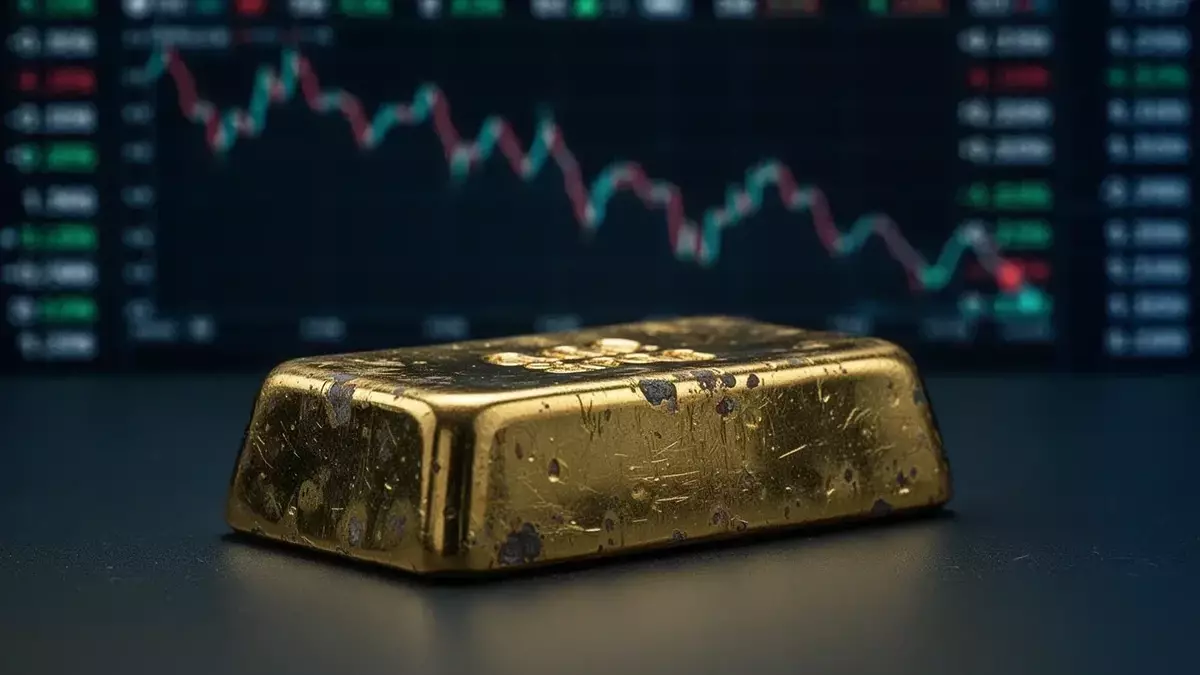
Gold's Hawkish Shock: Fed's Rate-Hike Signals and Goldman's $500 Target Cut Send Metal Below $4,200
20.06.2026 - 16:06:03 | boerse-global.de
Gold prices suffered their steepest monthly decline in months as the Federal Reserve under new chairman Kevin Warsh slammed the door on rate cuts. The metal closed Friday at $4,172.90 an ounce, a near-8% monthly loss, and now sits more than 25% below its 52-week high of $5,626.80. The relative strength index has tumbled to 35.4, flirting with oversold territory.
The catalyst was a dramatically hawkish revision to the Fed’s dot plot. Nine of 19 FOMC members now favor a rate increase during 2026, with markets pricing a roughly 70% probability of a September move. The median year-end rate forecast jumped to 3.8%, and the central bank removed all references to future rate cuts from its policy statement. Warsh also announced a sweeping reform of Fed communications, injecting fresh uncertainty over liquidity conditions. The US dollar index surged to an eight-week high, making gold dearer for non-dollar buyers and accelerating the selloff.
Wall Street’s response was swift. Goldman Sachs slashed its year-end 2026 gold target by $500 to $4,900, blaming the disappearance of any hope for Fed easing. The bank warned that if the central bank actually hikes, gold could slide all the way to $4,400 in the near term. The cut widens an already yawning gap among analysts: UBS clings to a $5,500 target, pointing to robust central bank buying, while Citibank has lowered its three-month forecast to $4,000. The spread between the most bullish and most bearish price calls now stands at $1,500 — a testament to the uncertainty surrounding the rate path.
Should investors sell immediately? Or is it worth buying Gold?
Central bank purchases remain a powerful floor. Official sector buying hit a net 244 tonnes in the first quarter of 2026, well above the five-year average. China aggressively expanded its reserves, and Poland added 31 tonnes. Yet these inflows have not been enough to offset the dollar-driven exodus of speculative capital. Asian demand, a traditional cushion, is also wobbling: India raised import duties on gold, and traders there are offering the metal at a discount to the international spot price, further eroding a key support.
Technically, the picture has darkened. Gold now trades below its 200-day moving average, and the March low of $4,098 is the immediate downside target. A break there would open the door to a test of the psychologically critical $4,000 level. On the upside, a formidable resistance wall sits near $4,330, limiting any snapback rallies. The next major catalyst is Friday’s PCE inflation data, which could cement the Fed’s restrictive stance if it comes in hot.
Sister metals are not faring better. Silver, platinum and palladium all declined in sympathy with gold, underscoring the broad-based retreat across the precious metals complex. For now, investors are bracing for more turbulence as the tug-of-war between hawkish monetary policy and central bank reserve accumulation plays out.
Ad
Gold Stock: New Analysis - 20 June
Fresh Gold information released. What's the impact for investors? Our latest independent report examines recent figures and market trends.