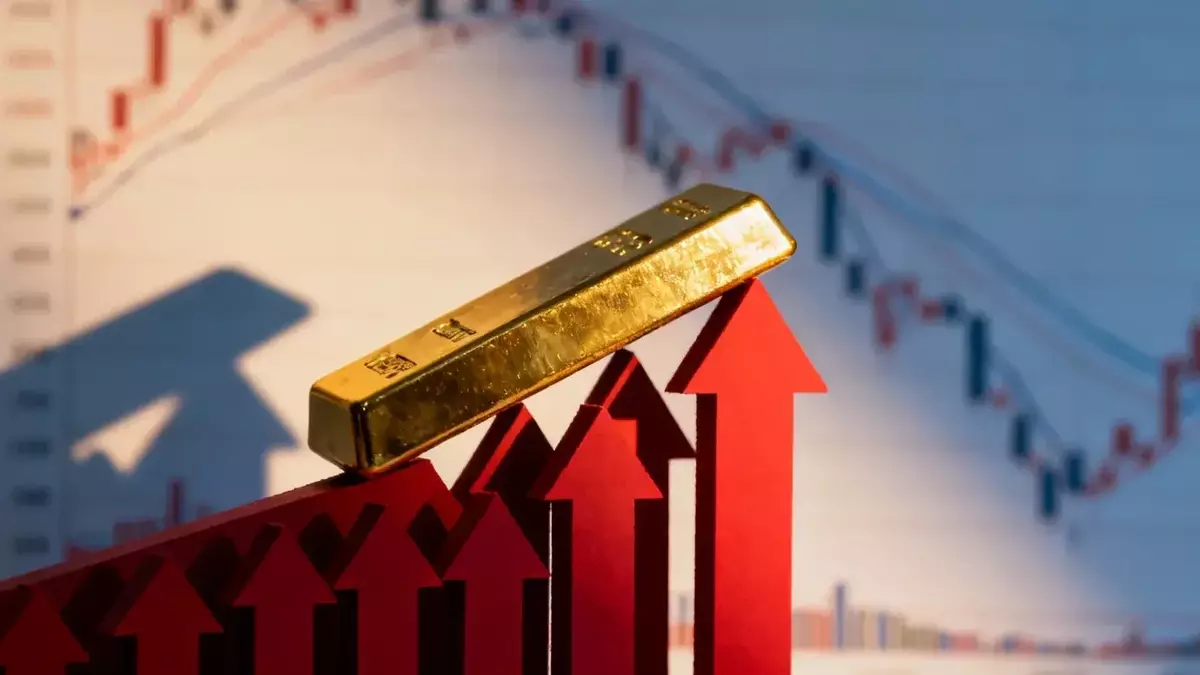
Gold Snaps Five-Week Skid as Jobs Data Disappoints, but Divergent Bank Targets Highlight Uncertain Outlook
Published on 07/03/2026 at 19:46 | Redaktion boerse-global.de
Gold clawed back above $4,180 on Friday, ending its longest losing streak in five weeks after a disappointing US employment report rekindled hopes of a softer Federal Reserve. The precious metal advanced 1.05% to settle at $4,180.20 per ounce, recovering from a dip below the psychologically important $4,000 mark earlier in the week.
The catalyst for the turnaround came from two directions. First, Fed Chairman Kevin Warsh used his speech at the ECB symposium in Sintra to acknowledge easing inflation risks, pointing to falling energy and gasoline prices. While he stopped short of committing to a rate cut, markets interpreted his tone as less hawkish than feared. US Treasury yields retreated in response, and gold — which pays no interest — benefited directly from the lower opportunity cost.
Then came the sharper blow: the US economy added just 57,000 nonfarm payrolls in June, well below the 110,000–115,000 consensus estimate and the weakest increase in four months. The dollar slid against major currencies, making dollar-denominated gold cheaper for overseas buyers. Traders described the subsequent rally as a technical rebound amplified by short covering.
Should investors sell immediately? Or is it worth buying Gold?
Yet the medium-term outlook remains deeply divided on Wall Street. J.P. Morgan Global Research reaffirmed its $6,000 per ounce target for the fourth quarter of 2026, arguing that the recovery will accelerate once central bank tightening peaks. Goldman Sachs, by contrast, cut its year-end 2026 forecast to $4,900 from $5,400, citing expectations that the Fed will not deliver any rate cuts this year. The divergence underscores how much uncertainty remains over the pace of monetary easing.
Beneath the price action, structural demand from central banks continues to provide a floor. According to the World Gold Council’s latest mid-year outlook, global central banks purchased 244 tonnes of gold in the first quarter of 2026, up from 208 tonnes in the previous quarter and well above the long-term average. Poland has been a steady accumulator, while Turkey is selling from reserves to support the struggling lira, and Russia continues to liquidate holdings under sanctions pressure.
Geopolitical factors add another layer of support. Ongoing negotiations between the US and Iran over shipping in the Strait of Hormuz have kept safe-haven bids elevated. Institutional investors are maintaining hedges, even as the spot price sits 25.71% below the 52-week high of $5,626.80 set in January. Year to date, gold is still down 3.72%.
On the technical side, the bounce above $4,106 has generated a buy signal, according to primary-article analysis. Resistance now stands at $4,214 and $4,264, with a move to $4,381 possible if momentum holds. The 50-day moving average at $4,414.88 remains a ceiling, while the relative strength index at 46.1 leaves room for rallies without suggesting overbought conditions. For now, the path ahead hinges on whether the jobs miss marks a genuine pivot in the data or a one-off soft patch.
Ad
Gold Stock: New Analysis - 3 July
Fresh Gold information released. What's the impact for investors? Our latest independent report examines recent figures and market trends.
Disclaimer regarding our articles: No investment advice, no buy or sell recommendation. Information on prices, companies, and markets is provided without guarantee; changes are possible at any time. Stock market transactions can lead to substantial losses. Our articles are created and reviewed in whole or in part automatically with the support of AI.