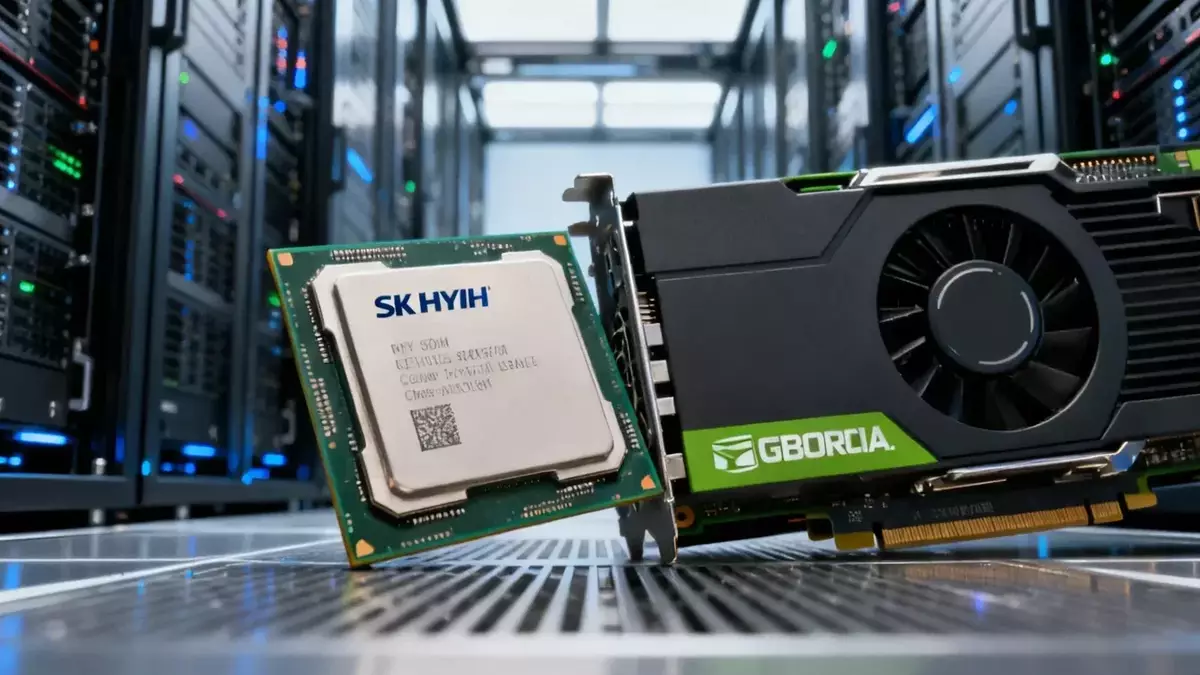
Nvidia’s European Build-Out and Ethernet Coup Signal Deepening AI Moat
Published on 06/23/2026 at 03:12 | Redaktion boerse-global.de
The numbers coming out of Hamburg this week tell a story that goes far beyond quarterly earnings. At the ISC High Performance 2026 conference, Nvidia revealed that 35 of its AI supercomputers are currently under construction across Europe—a footprint that will give more than three million researchers access to its hardware. Since last year, the region has installed or announced 800 AI Exaflops, with Nvidia infrastructure powering over 90% of the continent’s AI factory builds. This is not a sales pitch; it is a strategic entrenchment.
Yet that is only half the picture. Nvidia has simultaneously seized the lead in another corner of the datacenter. Its Spectrum-X platform has propelled the company to the top of the global Ethernet switch market for AI clusters, capturing a 21.5% share. Revenue in the segment surged 193% to $2.1 billion, as the total market swelled to roughly $10 billion. Large cloud providers are standardising on Nvidia’s networking gear to stitch together their massive GPU clusters, giving the chip giant a second moat beyond its core graphics business.
The hardware underpinning both of these advances is the Vera-Rubin platform, which has entered mass production. Built around the Vera processor and Rubin GPU, the architecture targets autonomous AI agents and promises ten times the performance of its predecessor. System integrators such as Bull, Dell Technologies, GIGABYTE, HPE and Supermicro are already building high-density racks that pack up to 144 GPUs each. Global manufacturing partners are scaling output to meet demand for the second half of 2026, and the new systems are being integrated into existing supercomputers in North America and Europe.
Europe’s specific deployments underscore how thoroughly Nvidia is embedding itself in scientific infrastructure. Germany’s first AI factory, HammerHAI at the HLRS in Stuttgart, will receive more than 850 GPUs via the Nvidia GB200 NVL4. Italy’s IT4LIA factory will sport over 8,000 GPUs, delivering 82 Exaflops for training and 164 Exaflops for inference. On the JUPITER exascale system, powered by Grace Hopper Superchips, four projects are mapping the human brain at cellular resolution, simulating Earth’s climate at one-kilometre granularity, developing AI for next-generation mobile networks, and emulating a universal 50-qubit quantum computer. The breadth—from neurons to atmosphere, from wireless to quantum—shows that exascale computing has moved from research into production.
Should investors sell immediately? Or is it worth buying Nvidia?
The geopolitical backdrop only strengthens the case. The United States has imposed export restrictions on GPUs and related products, with further controls likely. Europe is watching the Washington-Beijing chip war and quietly building Nvidia-based infrastructure at record speed. France’s KI-Fabrik, run by GENCI, announced a partnership at VivaTech that gives startups and mid-sized companies access to cutting-edge compute. By anchoring itself in the continent’s scientific and strategic fabric, Nvidia is making a generational lock-in: once workflows and CUDA-trained talent are built on its platform, switching costs become prohibitive.
Investors will have a chance to press for details at tomorrow’s virtual shareholder meeting. On the agenda are production ramp curves for Blackwell and Vera Rubin, as well as the commercialisation of the broader AI ecosystem. The company still has roughly $58.5 billion remaining in its buyback authorisation, offering a substantial floor. Nvidia’s balance sheet remains robust, but analysts will listen closely for signals on HBM memory and advanced packaging bottlenecks, which are still critical constraints.
The stock closed in Frankfurt on Monday at €182.56, up 13% for the year. It sits just above its 50-day moving average of €180.49, with a neutral RSI of 51.2. On the New York listing, the shares trade at approximately €184, still about 9% below the all-time high and 47% above the 52-week low. The consensus analyst target of €261 implies 42% upside, and the RSI of 52 points to neither overbought nor exhausted sentiment.
Nvidia at a turning point? This analysis reveals what investors need to know now.
Whether the catalyst comes from the European build-out, the networking dominance, or the Vera-Rubin ramp, the shareholder meeting could provide the next spark. Nvidia is telling Europe—in concrete, silicon and Exaflops—that its lead will last a very long time.
Ad
Nvidia Stock: New Analysis - 23 June
Fresh Nvidia information released. What's the impact for investors? Our latest independent report examines recent figures and market trends.
Disclaimer regarding our articles: No investment advice, no buy or sell recommendation. Information on prices, companies, and markets is provided without guarantee; changes are possible at any time. Stock market transactions can lead to substantial losses. Our articles are created and reviewed in whole or in part automatically with the support of AI.