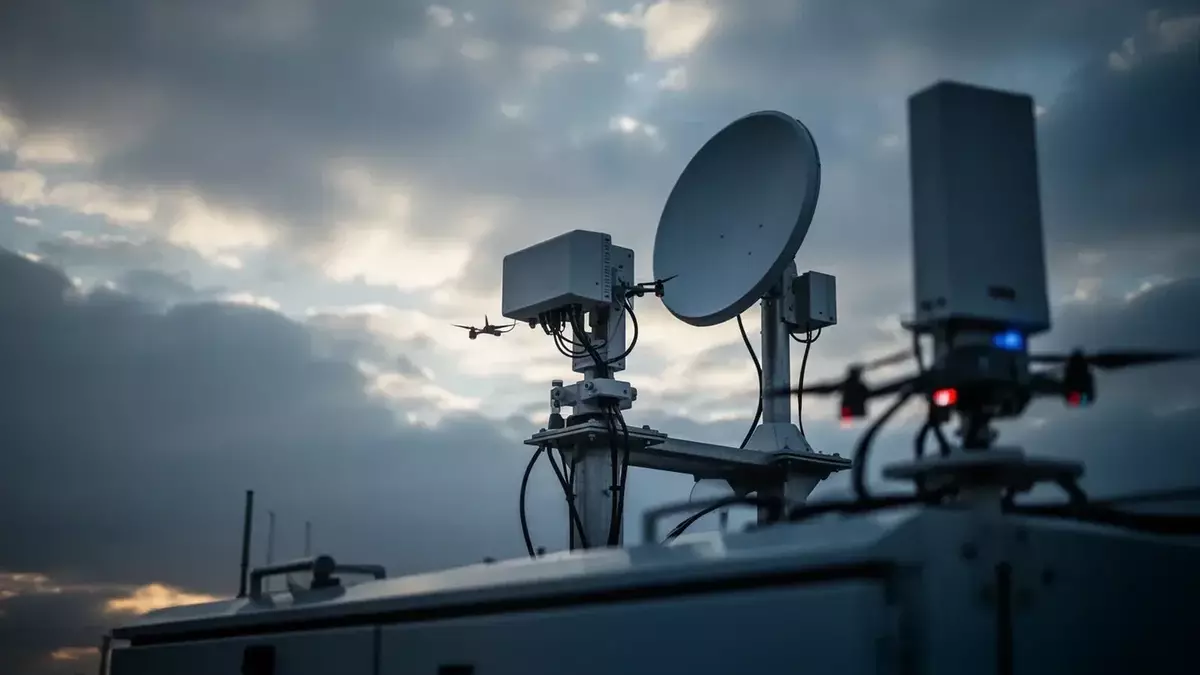
With A$2.3 Billion in Sight, DroneShield Turns to a Retired Admiral to Navigate the Pentagon's Maze
Published on 07/04/2026 at 17:47 | Redaktion boerse-global.de
The numbers paint a picture of explosive demand: a 2.3 billion Australian dollar sales pipeline, quarterly revenue growth of 121%, and a market that’s expected to nearly triple by the early 2030s. Yet DroneShield’s stock closed Friday at just €1.49 — a brutal 59% below its October 2025 peak of €3.65. The disconnect between the company’s prospects and its share price has never been wider, and the appointment of a three-decade naval veteran to the board is a clear signal that management knows exactly where the bottleneck sits.
Retired Rear Admiral Lee Goddard joined DroneShield’s board as an independent non-executive director on July 1, 2026 — just weeks after Angus Bean took over as chief executive. Goddard’s 30 years in national security and defence procurement are meant to open the kind of doors that smaller anti-drone specialists rarely walk through. Converting a 2.3 billion Australian dollar pipeline into binding contracts requires navigating the labyrinthine budgets of NATO defence ministries, and Goddard’s Rolodex is now the company’s most valuable non-financial asset.
The early numbers are encouraging. In the first quarter of its 2026 financial year, DroneShield posted revenue of 74 million Australian dollars, a 121% jump from the same period a year earlier. The entire 2025 fiscal year already delivered a 276% revenue surge, and the company has locked in 171 million Australian dollars in secured revenue for 2026. The ultimate prize is a billion US dollars in annual sales by 2030, with more than 30% of that coming from high-margin software subscriptions — a shift that would fundamentally change the earnings profile.
Global tailwinds are blowing hard. The counter-unmanned aerial systems market is projected to expand at a compound annual growth rate of 25.2% from 2026, reaching nearly $20 billion by 2033. At the NATO Industry Day in Ramstein, military planners pointed out that a single interception sortie using two fighter jets can cost over €85,000 — a price tag that makes electronic jamming systems a strategic necessity. The US Department of Defense has carved out roughly $75 billion in its 2027 budget for drone and anti-drone technology. Even India joined the party on July 4, unveiling a massive defence procurement package that explicitly favours indigenous counter-drone systems.
Should investors sell immediately? Or is it worth buying DroneShield?
Yet investors are demanding proof, not potential. The stock has tumbled nearly 25% since the start of the calendar year, and its relative strength index at 39.8 suggests oversold conditions rather than a healthy buying climax. Annualised volatility over the past 30 days stands at 70.74%, reflecting the whipsaw action that has punished both bulls and bears. The shares trade 20% below their 50-day moving average of €1.86 and well under the 200-day line at €2.03, leaving the technical trend unambiguously broken.
The competitive landscape is deepening the scepticism. Rival AeroVironment recently secured a $500 million contract with the US Army for counter-drone systems, sending its own stock sharply higher and underscoring the scale at which top-tier players are now winning. DroneShield is no longer fighting niche peers; established defence primes and a wave of new drone-related initial public offerings on the ASX are crowding the same capital and attention.
For the stock to reclaim lost ground, the next catalyst is expected in the second half of 2026. A “Tier-One” contract worth more than 50 million Australian dollars — likely from a Western government — could trigger a test of the €2.00 level. Without such a win, or if AeroVironment and others continue to grab market share, the €0.82 52-week low becomes a realistic danger zone.
DroneShield at a turning point? This analysis reveals what investors need to know now.
The market capitalisation of €1.35 billion already prices in a good deal of success. DroneShield has the ambition, the product and now the boardroom firepower to chase billion-dollar defence programmes. What it still lacks is the signed proof that the enormous pipeline will turn into cash, not just headlines.
Ad
DroneShield Stock: New Analysis - 4 July
Fresh DroneShield information released. What's the impact for investors? Our latest independent report examines recent figures and market trends.
Disclaimer regarding our articles: No investment advice, no buy or sell recommendation. Information on prices, companies, and markets is provided without guarantee; changes are possible at any time. Stock market transactions can lead to substantial losses. Our articles are created and reviewed in whole or in part automatically with the support of AI.