Europe's Machine Safety Overhaul Lands in 2027 — and the Training Manual Is Already Being Rewritten
Published on 10/24/2026 at 00:30 | Editorial boerse-global.de
Industrial operators across Europe are being told to treat hands-on instruction, not paperwork, as the frontline defence against machinery accidents — with a sweeping new EU rulebook waiting in the wings.
Trade publications and technical guidance are placing fresh emphasis on formal instruction and verified safety training for anyone who operates industrial machinery, from automated production lines to heavy construction plant. The reasoning is straightforward: complex equipment and powerful engines only stay safe in the hands of workers who have been properly qualified, and that qualification is now viewed as a core lever for cutting workplace accidents and containing operational risk.
Engines, compressors and the rules that surround them
Before anyone touches a powered machine, the requirements begin. Training and formal testing are mandatory prior to a worker's first shift on the equipment. Staff with health conditions that could impair their operation are barred from running the machines, as are employees under the influence of alcohol or sedating medication. Tampering with or servicing a machine while it is running is strictly forbidden.
Combustion engines carry their own checklist. Exhaust pipes must be routed outdoors without exception, open flames are prohibited during refuelling, and petrol may not be used to clean air filters.
Compressors must never exceed their specified operating pressure, and safety valves on pressure vessels are subject to regular inspection. Generators require proper protective earthing, plus an insulation resistance measurement before they are restarted after a long idle period.
Maintenance and mechanic work brings additional safeguards into play. Axle components must not be guided by hand into machine combinations, and heavy parts must be moved with a hoist. Portable electric hand lamps are capped at 36 volts, electric drills must run from earthed sockets, and any work on pressurised systems has to follow pressure-vessel regulations.
Three phases, and a lockout that actually locks
Mobile and stationary construction equipment such as concrete mixers demands structured qualification too, even though no single universal certificate exists for them. Specialist instruction breaks operation into three stages. Before start-up comes verification of stable ground, protective devices and the manufacturer's specifications.
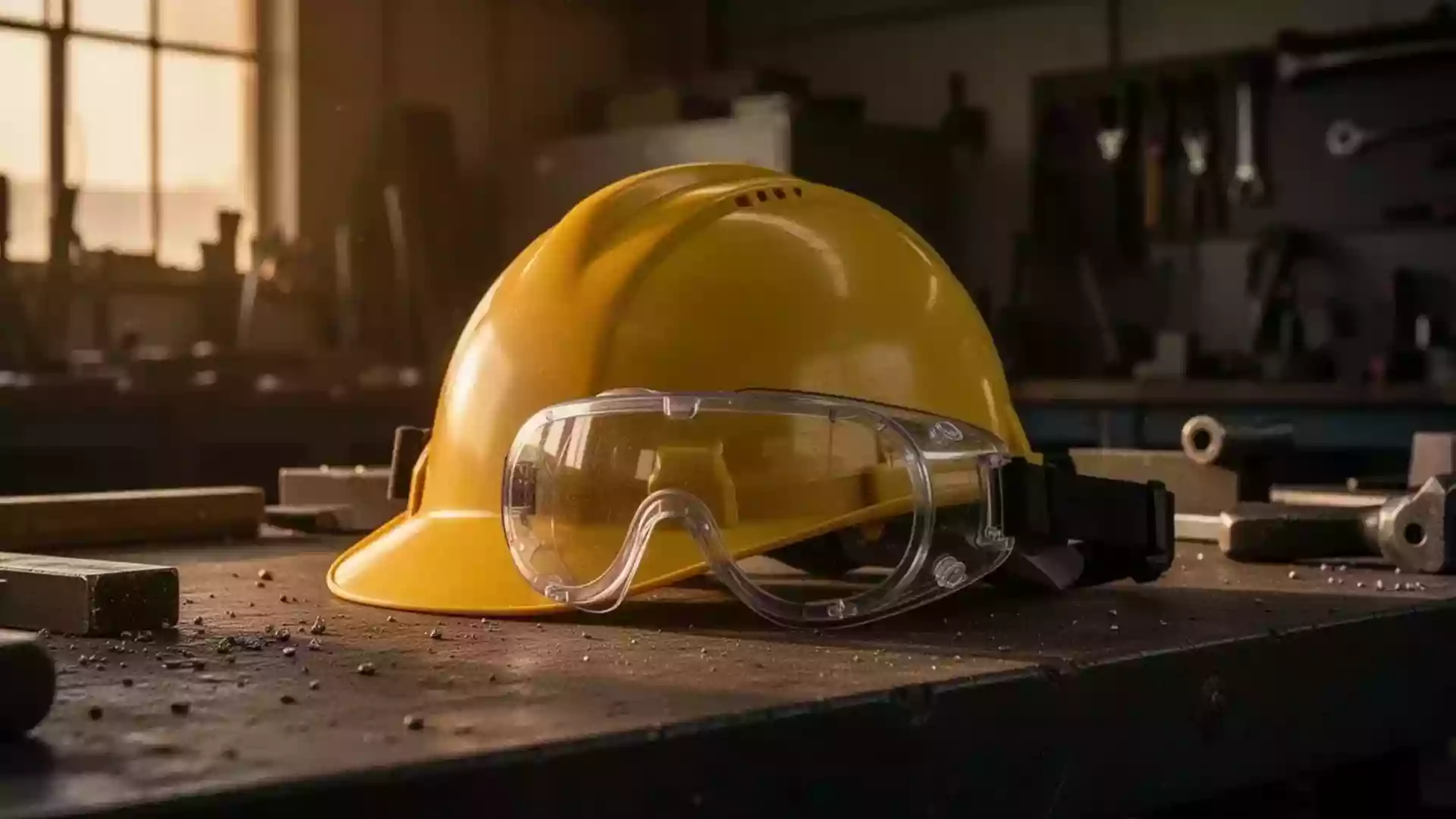
During operation, correct loading matters — water goes in first, followed by cement, sand or aggregate, which keeps risks and overfilling in check. Once the work is done, the mixer must be cleaned immediately. Personal protective equipment, including safety glasses and gloves, is compulsory throughout.
Servicing mixers and conveyors calls for disciplined energy-isolation protocols, known as lockout/tagout. Pressing an emergency stop button alone does not count as reliable isolation. Main switches and local power breakers must be opened, the power sources physically locked, and warning signs posted.
All this hands-on training only holds up if it is backed by a documented risk assessment — and a missing one is exactly where employers get caught out after an incident. A free toolkit gives you 41 ready-to-use templates and checklists covering fire safety, manual handling, first aid and lone working, so the paperwork keeps pace with the shop floor. Download the free Risk Assessment Toolkit
On conveyors, emergency stops at both ends have to be engaged to prevent an accidental remote restart. At mixers, the maintenance hatch must be held securely open and a dedicated supervisor assigned.
Hoisting equipment gets a three-pillar check before use:
- Equipment integrity: inspection of the load-bearing body, wire ropes or chains, attachment points, brakes, gearbox and controls.
- Environment control: a clear load-lifting zone, no people beneath suspended loads, and warning notices in place.
- Operator readiness: full knowledge of every emergency stop and an emergency plan on hand. Each hoist requires a formal load test and certification before its first commissioning.
Lasers, saws and planers: precision limits
Modern manufacturing is pushing industrial laser robots into more facilities, and they bring their own qualification demands. Because these systems often run at between 1,000 and 6,000 watts, and investment starts at 50,000 US dollars even for smaller robotic welding setups, training has to cover emergency-stop and interlock procedures alongside the specific laser-safety standards.
For instruction that sticks, in-person or on-site courses in small groups of two to four people are recommended; purely digital formats are considered inadequate for this class of high-power equipment.
Woodworking has equally precise limits. On circular saws, timber shorter than 40 centimetres or containing knot holes must not be cut, and the blade may protrude no more than 3 millimetres above the thickness of the wood.
At surface planers, working wood thinner than 15 millimetres, shorter than 300 millimetres, or wider than the planing width itself is prohibited, with a specified feed of 3 to 5 millimetres.
A new legal baseline — and the accidents it is meant to stop
All of this sits inside a strict legal framework. In Europe, the Machinery Directive forms the foundation, and it is due to be replaced by the new EU Machinery Regulation, fully applicable from 20 January 2027, which also addresses areas such as cybersecurity and artificial intelligence.
Accident analyses from various regions underline why training and technical instruction remain indispensable. Among the most common causes of industrial accidents are haste, routine procedures, poor risk assessments and inadequate training — all of which feed into human error.
Equipment rules are only half the picture — employers also carry broad duties for the safety of every worker and visitor on site, and inspectors expect the paperwork to prove it. A free Health & Safety Toolkit bundles ready-to-use risk assessments, checklists and toolbox talks covering PPE, fire safety, first aid and more, already used by over 37,000 UK companies. Get the free Health & Safety Toolkit
Manufacturing and construction are the sectors most affected. A systematic approach that pairs theoretical instruction with practical familiarisation on the specific machine remains the most effective way to spot hazards early and prevent accidents over the long term.