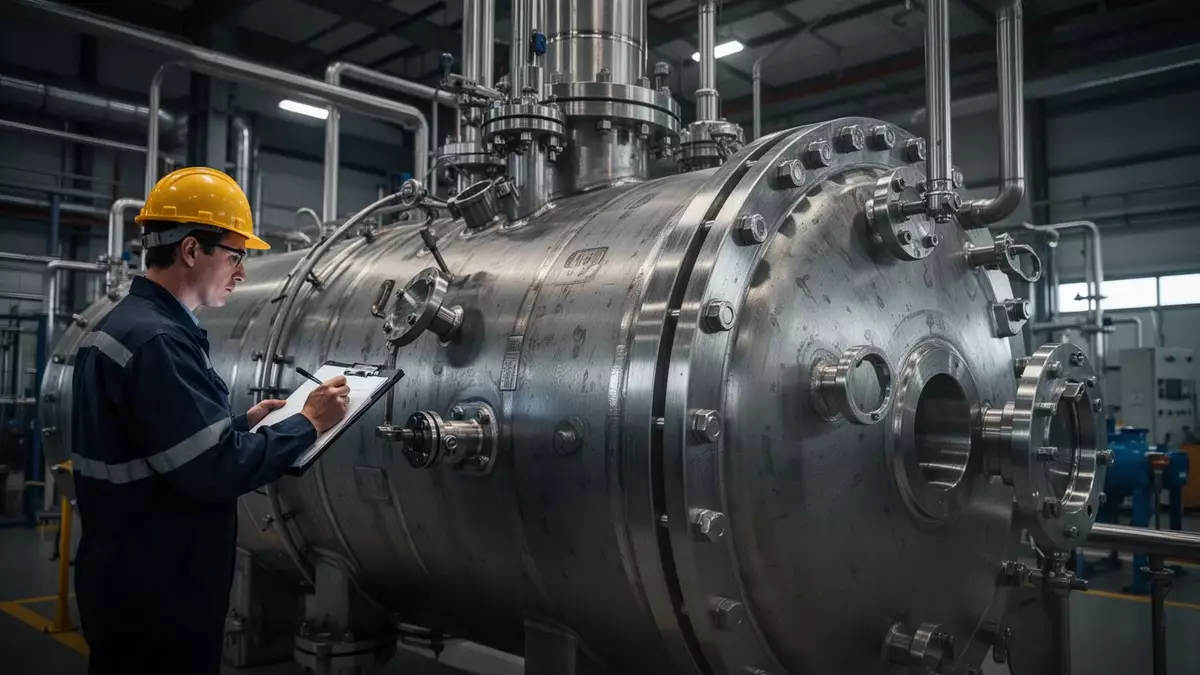
Fatal Baotou Steel Blast: Corrosion and Failed Emergency Response Cited in Official Report
Published on 08/02/2026 at 21:47 | Redaktion boerse-global.de
A devastating explosion at a Baotou Steel Group facility in Inner Mongolia that killed 10 people and injured 84 others has been traced to long-term corrosion on the inner wall of a steam storage pressure vessel, according to an official investigation report released on August 2, 2026.
The findings, published by authorities on Sunday, point to significant maintenance and oversight failures at the plant. Workers reportedly noticed a leak around 90 minutes before the blast on January 18, yet no effective emergency response was initiated. The explosion was powerful enough to scatter debris across a five-kilometer radius and disrupt nearby rail operations.
For UK employers, the case is a stark reminder that corrosion and deferred maintenance on pressure systems can have catastrophic consequences — and that a leak is always a signal to act, not to wait.
When a leak appears, the clock starts ticking — and the difference between a near-miss and a catastrophe often comes down to how quickly you can act. Yet many UK employers discover too late that their risk assessments are outdated or incomplete. A free toolkit with 41 ready-to-use templates and checklists helps you document hazards properly and respond confidently when warning signs emerge. Download the free Risk Assessment Toolkit
Seven Arrests and 62 Disciplined
The investigation has led to serious legal consequences for those involved. Seven employees at the Baotou Steel Group plant face arrest, while a further 62 individuals have been disciplined or held accountable for the incident. Four companies involved in the plant's operations have also been penalized.
The report was highly critical of the facility's design, maintenance protocols, and lack of adequate oversight. In response, Inner Mongolia Baotou Steel Union Co Ltd has announced plans to intensify hazard investigations and rectification efforts across its operations.
The case has also reignited broader calls for stronger safety standards internationally. In Pakistan, the Central Mines Labour Federation has requested a judicial probe into a methane gas explosion at the Sorange coalfield near Quetta that killed 36 miners. The federation is urging the adoption of international safety conventions, improved gas detection systems, and enhanced training for personnel.
When Workers Are Ordered Back Into Danger
The Baotou tragedy highlights the critical importance of evacuation protocols — a lesson reinforced by a recent incident in Japan. Following an earthquake on July 28, two employees died in an explosion at Aeon Mall Kumamoto after their employer, Habita, ordered them to return to the building to secure sales proceeds in a safe. Company executives have since apologized to the victims' families, acknowledging the failure to prioritize staff safety over property during an emergency.
The right to refuse unsafe work and the duty to protect employees over assets are principles embedded in UK health and safety law. Under the Health and Safety at Work etc. Act 1974, employers have a legal obligation to ensure, so far as is reasonably practicable, the health, safety, and welfare of their employees — a duty that does not pause during an emergency.
The Health and Safety at Work etc. Act 1974 places a legal duty on every UK employer to protect their workforce — and failing that duty can lead to heavy fines, prosecution, and reputational damage. Yet many businesses are unknowingly non-compliant simply because their documentation is out of date. A free toolkit provides 9 practical tools, including risk assessments, checklists, and a director's liability guide, to help you meet your legal obligations with confidence. Get the free Health & Safety at Work Act 1974 Toolkit
Similarly, an update from the U.S. Chemical Safety Board regarding a hydrogen sulfide leak at Woodland Pulp earlier this year noted the absence of fixed gas detectors. That incident resulted in the deaths of a 20-year-old intern and a 26-year-old engineer, while 10 other individuals were exposed to the toxic gas.
Coordinating Mass Evacuations in North America
While industrial sites face scrutiny over internal protocols, emergency management agencies in North America are currently managing massive public evacuations due to a surge in wildfire activity. Over the weekend of August 1-2, 2026, thousands of residents across Washington, Oregon, Idaho, and British Columbia were ordered to flee their homes.
In Washington, the Old Trails Fire north of Airway Heights grew to 3,500 acres by Sunday morning, threatening up to 5,000 structures. Governor Bob Ferguson declared a statewide wildfire emergency and mobilized the Washington National Guard for the first time since 2021. Preliminary estimates suggest that more than 600 structures have already been destroyed by a cluster of fires in the Spokane area, where hundreds of evacuees sought shelter at the Spokane Convention Center.
Emergency management experts emphasize that effective large-scale evacuations require layered communication and route planning. Current protocols in affected regions recommend:
- Identifying at least two primary and alternate routes to essential destinations.
- Monitoring official alerts via digital and paper formats.
- Coordinating the relocation of livestock and pets well in advance of evacuation orders.
- Maintaining vehicle fuel levels above a round-trip requirement to account for congestion and detours.
In Idaho, the Tartar Fire near Weiser expanded by 80,000 acres overnight to reach 95,000 acres by early August, forcing the closure of U.S. Highway 95. Meanwhile, in British Columbia, the Bradley Creek wildfire jumped Westside Road on August 1, prompting the Okanagan Indian Band to issue immediate evacuation orders for residents south of Highway 97. Regional emergency officials continue to urge families to prepare "grab-and-go" bags and register at designated arenas and community centers as fires remain out of control across the region.
Disclaimer regarding our articles: No investment advice, no buy or sell recommendation. Information on prices, companies, and markets is provided without guarantee; changes are possible at any time. Stock market transactions can lead to substantial losses. Our articles are created and reviewed in whole or in part automatically with the support of AI.