Semiconductor ETF's July Wipeout Gives Way to a Fragile, Two-Speed Recovery
Published on 08/02/2026 at 16:13 | Redaktion boerse-global.de
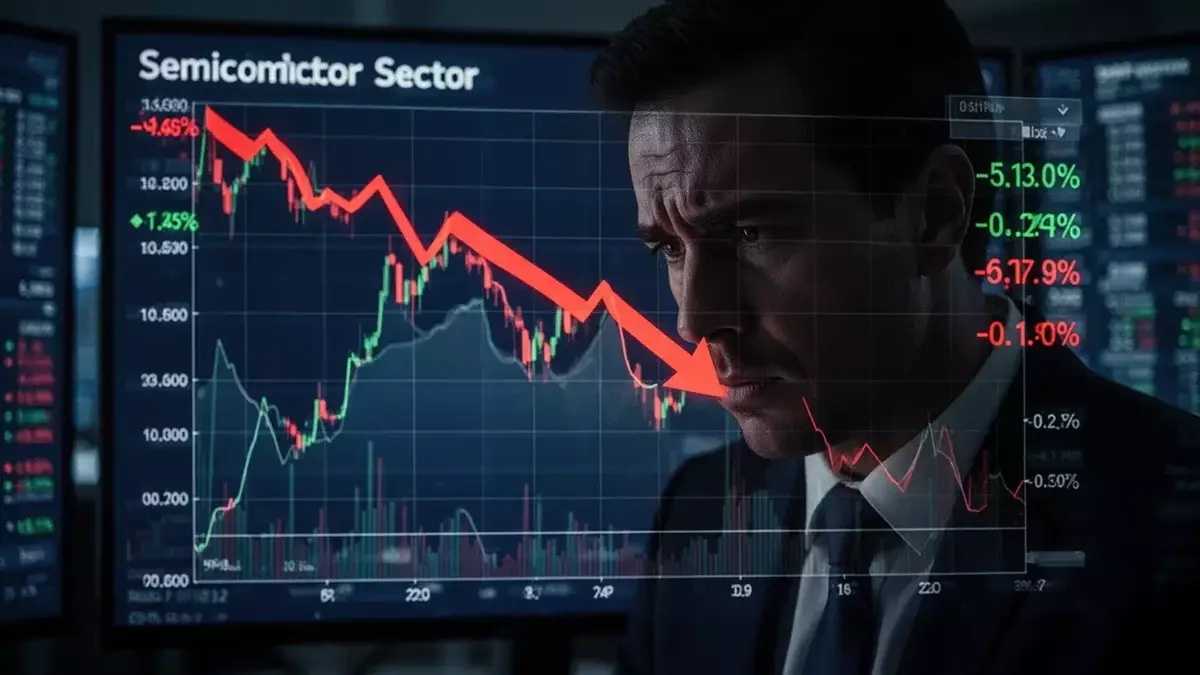
The numbers that defined July for the iShares MSCI Global Semiconductors UCITS ETF are almost too stark to reconcile. A 22.1 percent monthly decline — the fund's worst stretch since December 2002 — was followed within days by a violent rebound that saw Asian memory giants hit their trading limits for the first time in over a decade. The whiplash has left investors holding a fund that is simultaneously down 17.90 percent over 30 days and up 125.87 percent year over year.
At the center of the storm was a forced deleveraging that turned a routine profit-taking rotation into a cascade. Leopold Aschenbrenner's Situational Awareness fund, a high-profile AI vehicle, lost 67 percent of its value in July and was compelled to liquidate its entire public equity portfolio. Citadel stepped in to acquire a substantial portion of the roughly $16 billion portfolio, effectively removing a known forced seller from the market and blunting what some observers had feared would become a $3 trillion sell-off. The episode served as a stark reminder of how margin calls can transform an orderly correction into a downward spiral — one that erased a combined $1.3 trillion in market value from 20 chip stocks between July 24 and 28 alone. Nvidia shed $238 billion in that span, while Micron lost $113 billion. The VIX posted its largest one-day spike since March, and options volume hit a record 7.8 million contracts.
Memory Mania and the Kospi's Record Rebound
No market felt the pain more acutely than South Korea, where the Kospi suffered its worst month since the global financial crisis, falling 22 percent in July. The index's recovery was equally historic: a record 17.91 percent surge on Friday brought it to 6,595.45 points. Samsung rocketed 26.81 percent higher on the day, while SK Hynix climbed 29.95 percent — enough to trigger the upper trading halt for the first time since 2009. The rebound came with a regulatory twist: retail investors, burned by leveraged ETFs introduced in May, voiced open criticism of the products, prompting the government to impose stricter rules on leveraged vehicles.
The fundamental driver behind the volatility is a memory-chip shortage that industry watchers have dubbed "RAMaggedon." PC memory prices in Hong Kong have climbed from roughly HK$300–400 to as much as HK$1,500, with TrendForce estimating a five- to sixfold increase within a year. Samsung's chief financial officer expects supply constraints to persist through 2028. Both Samsung and SK Hynix are responding with long-term supply agreements: Samsung plans to lock in 60 to 70 percent of its memory production through five-year contracts with data-center customers, while SK Hynix has concluded negotiations with around ten buyers.
Hyperscalers Throw a Lifeline
The rescue came from the cloud. Amazon reported second-quarter revenue of $200.61 billion with AWS growth of 37 percent, sending the stock up 15 percent — its best single-day gain since 2012. The company also raised its 2026 capital expenditure budget from $200 billion to $220 billion. Microsoft followed suit: Azure grew 43 percent, and the stock jumped 16 percent on July 30, its largest one-day move ever. The Philadelphia Semiconductor Index responded with a 7.5 percent gain on July 30, though it has since stalled — Friday's close was up just 0.07 percent, leaving the index roughly a fifth below its June 22 record high.
European chipmakers caught the updraft as well. Infineon climbed 9 percent on Thursday and added another 3.64 percent on Friday to close at €62.08, though the stock still sits about 31 percent below its 52-week high of €89.67. The company reports its own quarterly results on Wednesday.
Strong Fundamentals, Nervous Hands
The disconnect between operational performance and share prices remains the sector's defining tension. Micron delivered record fiscal third-quarter revenue of $41.46 billion — well above the $35.84 billion analyst consensus — with earnings per share of $25.11 versus expectations of $20.28. Yet the stock still fell 10.6 percent for the week. Applied Materials jumped 15 percent purely on a competitor's strong results ahead of its own August 13 report, while Lam Research beat expectations with $2.35 billion in revenue and Silicon Motion posted 127 percent year-over-year growth. HSBC analysts have flagged a 37 percent probability that hyperscaler capital expenditure overshoots this year, underscoring the market's anxiety over overinvestment even as the spending itself props up chip demand.
For the ETF, the technical picture offers little clarity. The fund closed Friday at €16.27, up 0.27 percent on the day, but remains 24.39 percent below its 52-week high of €21.52 from June 22. Annualized volatility of nearly 68 percent reflects the sector's frayed nerves, while a relative strength index of 41.6 suggests the fund is neither overbought nor oversold. Year to date, the ETF is still up 70.30 percent — a reminder that even after July's carnage, the long-term AI narrative remains intact. The question now is whether the memory shortage and hyperscaler spending can outrun the valuation concerns that triggered the rout in the first place.
Ad
iShares MSCI Global Semiconductors UCITS ETF USD Acc Stock: New Analysis - 2 August
Fresh iShares MSCI Global Semiconductors UCITS ETF USD Acc information released. What's the impact for investors? Our latest independent report examines recent figures and market trends.
Read our updated iShares MSCI Global Semiconductors UCITS ETF USD Acc analysis...
Disclaimer regarding our articles: No investment advice, no buy or sell recommendation. Information on prices, companies, and markets is provided without guarantee; changes are possible at any time. Stock market transactions can lead to substantial losses. Our articles are created and reviewed in whole or in part automatically with the support of AI.