Nvidia’s Networking Revenue Surges 199% as AI’s Bottleneck Shifts from Chips to Connections
29.05.2026 - 09:11:19 | boerse-global.de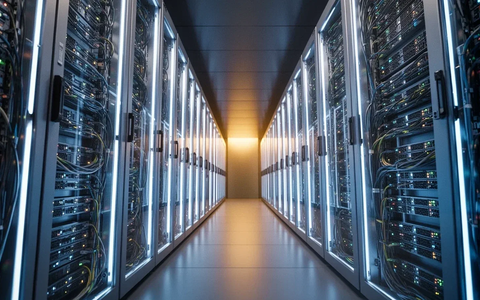
Nvidia’s transformation from a graphics-chip powerhouse into an integrated AI-infrastructure giant is accelerating, and the numbers are beginning to tell a story that goes far beyond GPUs. The company’s data-center networking business generated a record $14.8 billion in the latest quarter, a 199% leap from a year earlier, underscoring how the race to scale artificial intelligence is now as much about connectivity as it is about raw compute.
Managing the flow of data across tens of thousands of processors has emerged as the critical engineering challenge of the AI era, and Nvidia is betting big on solving it with proprietary technology. Gilad Shainer described the shift as the emergence of “AI factories” — data centers designed as fully integrated systems where switches, network adapters, and software work in lockstep with GPUs and CPUs. The new Blackwell architecture is amplifying demand for high-speed interconnects like InfiniBand and Spectrum-X Ethernet, and Nvidia now claims its in-house Ethernet-networking business alone is larger than all of its main Ethernet rivals combined.
The push toward optical connections inside these clusters is gaining urgency. According to a research note from Rosenblatt Securities, Nvidia has asked its suppliers to increase capacity for indium-phosphide lasers twentyfold by 2030, though the suppliers themselves see a twelvefold increase as more realistic. Co-packaged optics, which place laser components directly next to the chips, promise faster data transfers with lower power consumption — and are becoming the next bottleneck in the AI supply chain.
That supply chain is increasingly anchored in Taiwan. Speaking at the TD Cowen technology conference on May 28, CEO Jensen Huang disclosed that Nvidia will spend between $100 billion and $150 billion annually with its manufacturing partners on the island, funding production of the Blackwell Ultra architecture and the upcoming Vera-Rubin platform. Huang confirmed that the first Vera-Rubin systems remain on track for delivery later this year, and the next major product unveiling is expected at the GTC keynote in Taipei on June 1.
Should investors sell immediately? Or is it worth buying Nvidia?
Nvidia’s massive capital spending is being fueled by a cash-generation machine that shows no signs of slowing. Free cash flow hit $48.6 billion in the first quarter of fiscal 2027 alone, enabling the board to authorize an additional $80 billion in share repurchases on May 18. Combined with remaining funds from earlier programs, the total potential buyback capacity now stands at nearly $118 billion — one of the largest capital-return programs in the technology sector. The quarterly dividend is also being raised sharply, from $0.01 to $0.25 per share, payable on June 26 to shareholders of record on June 4.
The stock, however, has been a more subdued story. Despite the record results, Nvidia shares closed at $214.25 on May 28, up just 0.78% on the day, as the market processed the news against already lofty expectations. Over the past several months the stock has consolidated in a range between roughly $210 and $230 (in dollar terms), with the RSI dipping to 36.4 — a signal of mild oversold conditions after a year-to-date gain of about 14%.
Looking ahead, Nvidia has guided for revenue of approximately $91 billion in the second quarter of fiscal 2027, plus or minus 2%, with GAAP and non-GAAP gross margins of roughly 74.9% and 75.0%, respectively. Analysts on the conference call pointed to rising memory costs as a potential headwind, though the company’s high-margin software ecosystem and CPU business offer some buffer.
Nvidia at a turning point? This analysis reveals what investors need to know now.
The real catalyst, management argues, is the expansion of complete AI infrastructure rather than any single product release. Nvidia estimates the market for advanced AI chips could reach a volume of $1 trillion over the next two years, and if the “AI factory” model becomes the industry standard, its networking segment will sit ever closer to the center of the valuation story. With the Vera-Rubin launch and the optical-laser supply chain push both gaining momentum, the next chapter of Nvidia’s narrative may be written not in transistors, but in the cables and photons that link them together.
Ad
Nvidia Stock: New Analysis - 29 May
Fresh Nvidia information released. What's the impact for investors? Our latest independent report examines recent figures and market trends.
So schätzen die Börsenprofis Nvidia’s Aktien ein!

Für. Immer. Kostenlos.