
Aoraki / Mount Cook National Park, glaciers above Mount Cook Village
Published on 09/14/2026 at 17:11 | Editorial responsibility: Rafael Müller, Editor-in-Chief AD HOC NEWS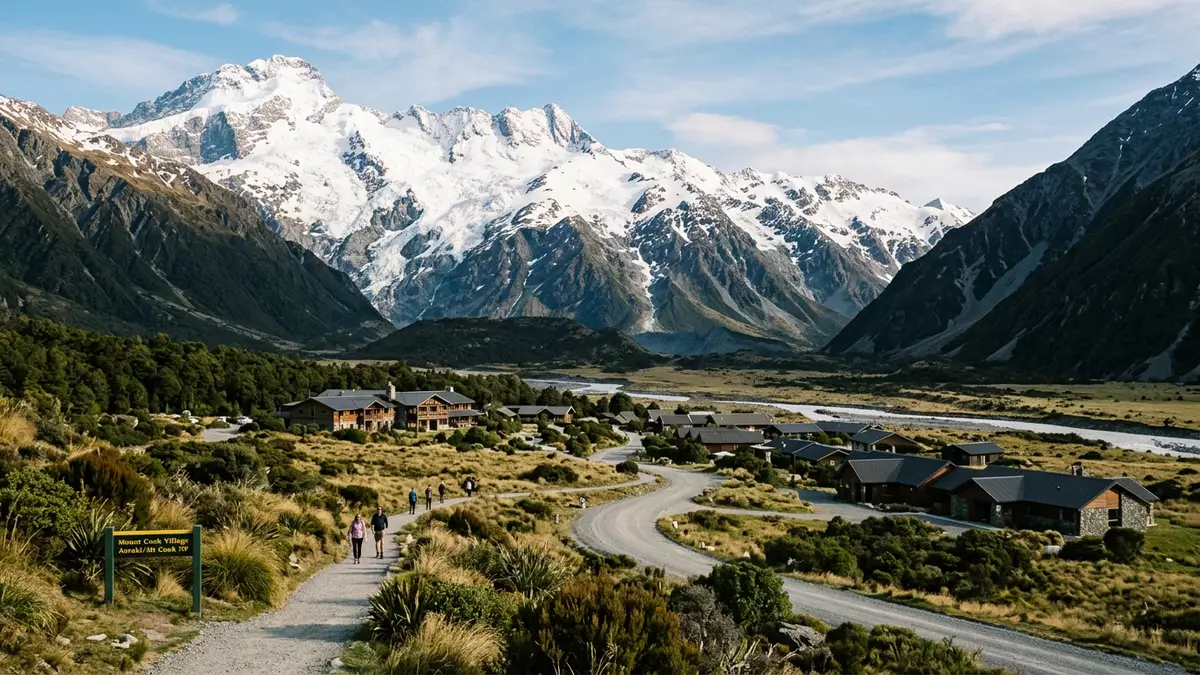
Aoraki / Mount Cook National Park in New Zealand’s Southern Alps is an alpine landscape where steep valleys, broad glaciers and high summits surround Mount Cook Village at the road’s end. Established as a national park in 1953, it protects a dense concentration of peaks and glacier systems focused around Aoraki / Mount Cook, the country’s highest mountain.
Alpine scale around Aoraki / Mount Cook
Aoraki / Mount Cook National Park lies on the South Island of New Zealand, extending along the crest and eastern flank of the Southern Alps in the Canterbury Region.Aoraki / Mount Cook National Park The protected area covers about 707 km² (273 sq mi), giving space for an alpine landscape where rock and ice dominate above a relatively short stretch of valley floor.an area of 707 square kilometres
At the centre stands Aoraki / Mount Cook, reaching 3,724 m (12,218 ft) above sea level in a compact cluster of ridges and faces that rise sharply from the surrounding valleys.Aoraki / Mount Cook with a summit at 3,724 m Within the park, numerous summits pass the 3,000 m (9,843 ft) mark, and more than 70 named glaciers cover a significant portion of its surface, with ice recorded over roughly 40 percent of the park’s area.many peaks above 2,000 metres and extensive glaciation
Glaciers, valleys and dark skies
The core impression of Aoraki / Mount Cook National Park is the way glacier systems press close to the valley floor while remaining part of a high-altitude environment. Major valley glaciers such as the Tasman and Hooker sit on the flanks of Aoraki / Mount Cook and neighbouring peaks, feeding proglacial lakes and streams that run along the valley bottom towards the Mackenzie Basin.Tasman Glacier and Hooker Glacier on the flanks of Aoraki / Mount Cook Above them, smaller cirque and hanging glaciers occupy high basins and gullies, adding layers of ice to almost every major ridge.
The park forms part of the Te W?hipounamu – South West New Zealand World Heritage Area, recognised for its alpine scenery, extensive glacier cover and intact high mountain ecosystems.Te W?hipounamu World Heritage designation In addition, Aoraki / Mount Cook National Park and the wider Mackenzie Basin are included in the Aoraki Mackenzie International Dark Sky Reserve, giving the area formal status for its clear, dark night skies over the alpine peaks.Aoraki/Mackenzie International Dark Sky Reserve
Mount Cook Village at the end of the road
Mount Cook Village, officially named Aoraki / Mount Cook, sits within the national park at the end of State Highway 80, which branches north from the Mackenzie Basin and Lake Pukaki.Mount Cook Village at the end of State Highway 80 The settlement stands south of the summit of Aoraki / Mount Cook and acts as the main visitor hub, with accommodation, guiding services and an information centre serving people heading into the surrounding valleys.
From Mount Cook Village, walking tracks and alpine routes radiate into glacier-fed valleys such as Hooker and Mueller, and towards higher terrain where huts provide bases for experienced parties.Aoraki/Mount Cook National Park visitor facilities The village’s position beneath steep valley walls and high peaks means that many outlooks, even at low altitude, carry direct lines of sight to glaciers, snowfields and the upper sections of the Southern Alps.
Visiting Aoraki / Mount Cook National Park: what travellers from Western Europe should know
- Aoraki / Mount Cook National Park lies on the South Island of New Zealand, reached along State Highway 80 from the Mackenzie Basin towards Mount Cook Village.
- The terrain around Mount Cook Village and the main valleys includes steep slopes, uneven rocky paths and sections of track that gain significant altitude over relatively short distances.
- The park is part of New Zealand, where the official language is English and the currency is the New Zealand dollar.
- Entry requirements depend on your nationality; UK travellers can check the FCDO travel advice at gov.uk/foreign-travel-advice, Irish travellers the Department of Foreign Affairs at ireland.ie.
Searching for Aoraki / Mount Cook National Park on social platforms
These links open searches for Aoraki / Mount Cook National Park on each platform.
Frequently asked questions about Aoraki / Mount Cook National Park
Where is Aoraki / Mount Cook National Park?
Aoraki / Mount Cook National Park is on the South Island of New Zealand, in the Canterbury Region along the eastern side of the Southern Alps.
What can visitors expect on a visit to the park?
Visitors encounter steep alpine valleys, large glacier systems, prominent snow-covered peaks and a compact settlement at Mount Cook Village surrounded by high mountain terrain.
What makes Aoraki / Mount Cook National Park distinctive?
The combination of New Zealand’s highest mountain, extensive glaciation over much of the park’s area and recognised dark skies over an alpine landscape gives it a distinctive character.


