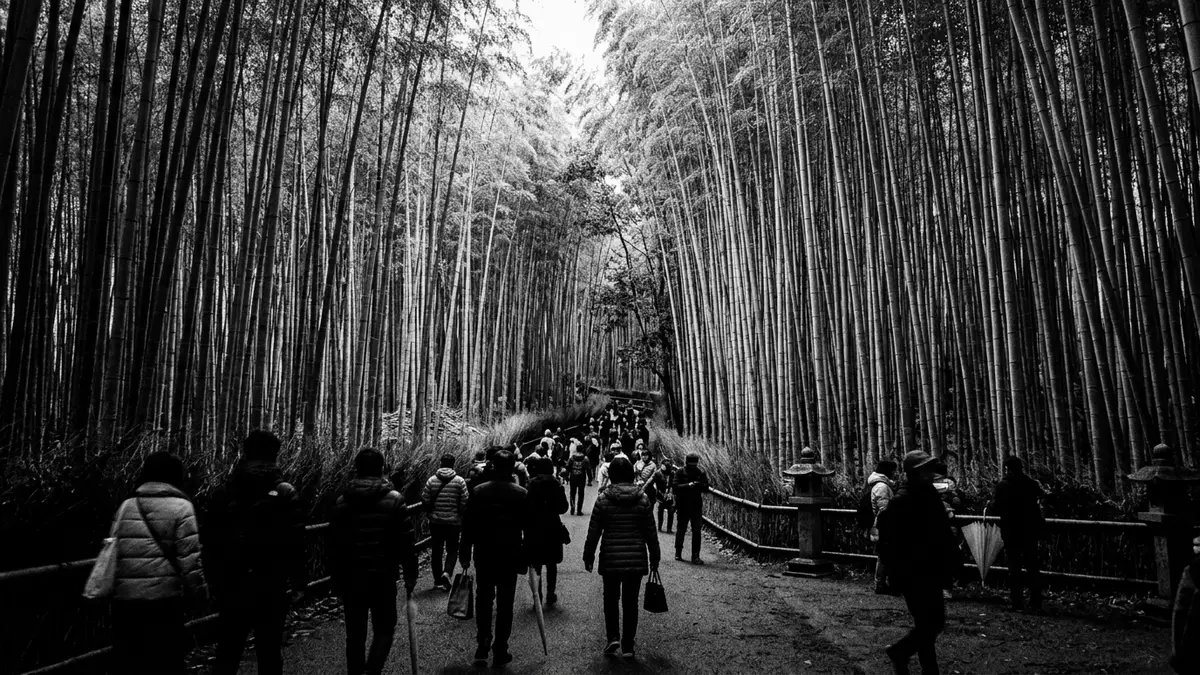
Arashiyama Chikurin’s bamboo paths in Kyoto
Published on 08/07/2026 at 15:03 | Editorial responsibility: Rafael Müller, Editor-in-Chief AD HOC NEWS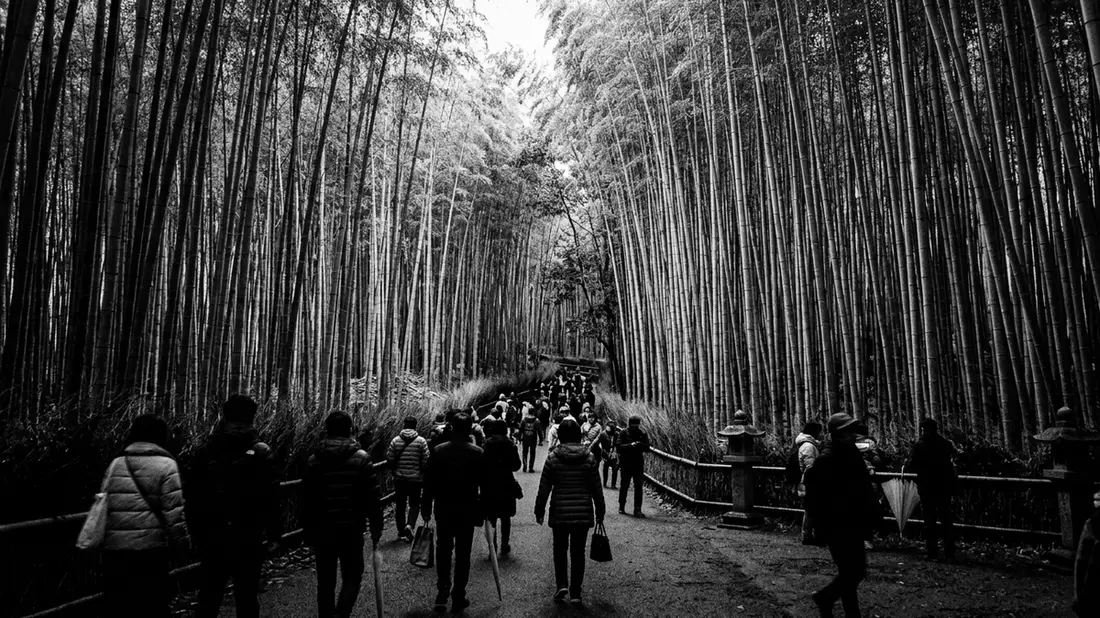
Arashiyama Chikurin in Kyoto is a bamboo grove rather than a built monument, and that gives it a very different character from the temples and villas around Arashiyama. The tall bamboo stands close together, with a path running through the grove, and the scene depends on vertical lines, filtered light and dense green stems.
Arashiyama Chikurin and the Arashiyama landscape
The grove sits within Arashiyama, one of Kyoto’s best-known western districts, where the Hozu River, wooded hills and long-established visitor routes create a compact landscape. Bamboo has long been part of Japanese garden and temple settings, and Arashiyama Chikurin fits that broader cultural setting without needing any ornate architecture.
Its identity comes from repetition: stem beside stem, leaf above leaf, with the path cutting a clear line through the planting. The result is simple but striking in form, because the eye reads height, spacing and texture before anything else.
A walk through the grove’s vertical rhythm
What visitors notice first is scale. The bamboo rises far above head height, and the grove feels enclosed by living columns rather than walls.
The path is the key route through the site, and the main experience is walking between the trunks while looking upward. The stems are slender, pale green to yellow-green, and the leaves form a lighter canopy above the path.
Bamboo, gardens and Kyoto’s west side
Arashiyama Chikurin belongs to a wider Kyoto tradition in which bamboo, stone and planting work together in gardens and temple precincts. It sits comfortably in that setting because bamboo has a long association with screens, fences and garden margins throughout Japan.
The grove is also a reminder that a landscape can be a place of design even when it is largely made of plants. In Arashiyama, the bamboo, the hills and the nearby cultural sites form a sequence that is easy to read on foot.
Visiting Arashiyama Chikurin: what travellers from Western Europe should know
- Arashiyama Chikurin is in Kyoto, in western Japan, and is reached from the city by local rail, bus or on foot from nearby Arashiyama sights.
- Admission arrangements and opening hours are set by the site's operator and change with the season; the official website is the only binding source.
- Late morning and early afternoon can bring busier paths, while the grove’s vertical forms are easy to read in softer light.
- The site itself is level in parts but includes a walking route under tall bamboo, with natural ground underfoot.
- Local signs may appear in Japanese and English, and cash and cards are both commonly used across Kyoto.
- Entry requirements depend on your nationality. UK travellers should check the FCDO travel advice at gov.uk/foreign-travel-advice; Irish travellers the Department of Foreign Affairs at ireland.ie; EU and EEA citizens their own national foreign ministry.
Searching for Arashiyama Chikurin on social platforms
These links open searches for Arashiyama Chikurin on each platform.
Frequently asked questions about Arashiyama Chikurin
Where is Arashiyama Chikurin?
Arashiyama Chikurin is in Arashiyama, on the western side of Kyoto in Japan. It sits within a district known for bamboo, river scenery and temple grounds.
What should a visit feel like?
Expect a walk through tall bamboo along a defined path. The grove is compact in visual terms but rich in texture, with stems and leaves filling most of the view.
What makes it distinct?
Its strength is the bamboo itself: the repetition of vertical culms, the enclosing green corridor and the clear line of the path. That combination gives the place its identity without any need for buildings or ornament.