
Archaia Agora and the open-air centre of ancient Athen
Published on 09/24/2026 at 06:48 | Editorial responsibility: Rafael Müller, Editor-in-Chief AD HOC NEWS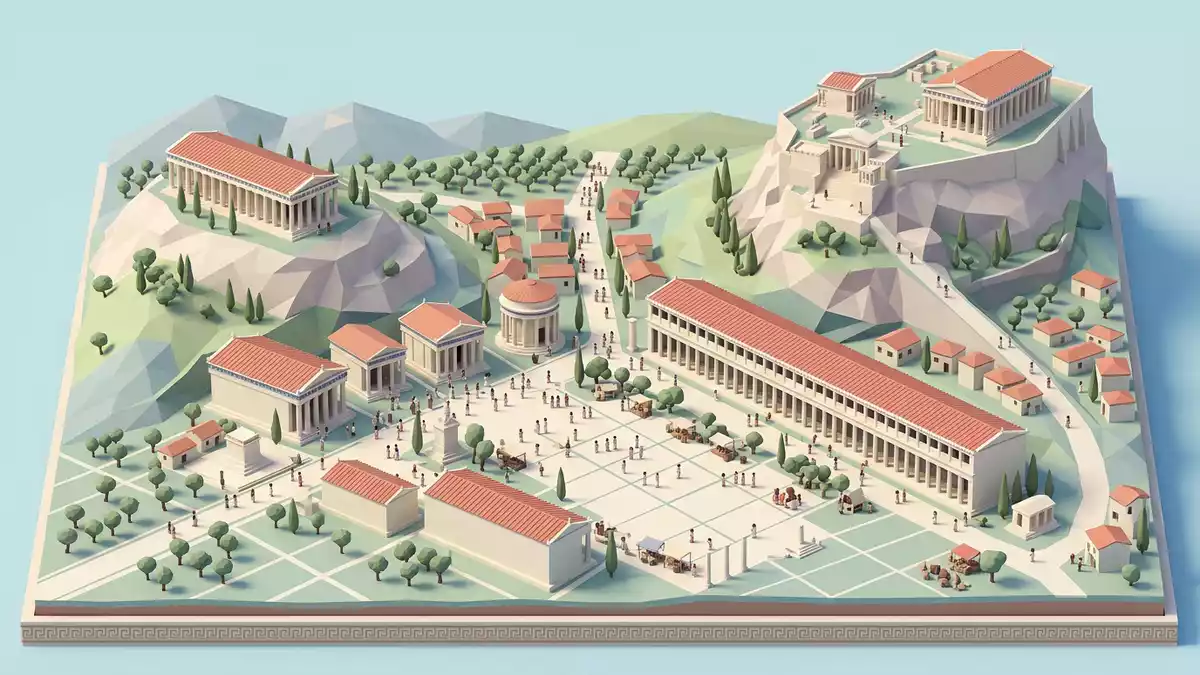
Archaia Agora spreads below the Acropolis as an open archaeological landscape framed by stoas, temples and civic buildings. The site became a public area in the early sixth century BC, during the time of Solon, and its open ground held many functions of ancient Athenian life.
Archaia Agora: a public square without a single purpose
The Greek word agora named both a marketplace and a gathering place. In Athenian life, the meaning reached far beyond trade. Administrative work, legal proceedings, political meetings, religious activity and social encounters occupied the same civic area.
The Agora lay on the north-western slope of the Acropolis. Citizens met here, magistrates carried out their duties, traders displayed goods and public buildings defined the spaces between movement and assembly. The arrangement was not a single monumental hall, but a broad urban setting whose buildings served different parts of civic life.
The area had a long history before its classical form. A cemetery occupied the ground during the Late Bronze Age, dated to 1600–1100 BC, and burial activity continued into the Iron Age. The Agora’s sixth-century transformation placed the area within the public life of Athens.
From Solon to the Roman period
Solon is associated with the public organisation of the Agora in the sixth century BC. During the classical period, the site contained council buildings, law courts, shrines, altars and stoas. These structures belonged to a city where political participation, legal duties and commerce shared one physical setting.
The Persian sack of Athens in 480–479 BC caused extensive damage. Reconstruction followed, and further building phases appeared during the Hellenistic and Roman periods. The area changed through additions, destruction and rebuilding, while its position beneath the Acropolis remained constant.
The Herulian attack of AD 267 damaged many buildings. The civic centre declined, and the Agora was gradually abandoned after the Slavic invasion of AD 580. During the Byzantine period and the centuries before Athens became the capital of the independent Greek state in 1834, residential development occupied parts of the area.
Systematic excavation began on 25 May 1931 under the American School of Classical Studies at Athens. The work brought together architectural remains, inscriptions, pottery and everyday objects from a long sequence of occupation. The excavation timeline places the Agora within Athens’ wider archaeological history.
Stoa of Attalos and the Temple of Hephaestus
The Stoa of Attalos forms the clearest architectural edge of the archaeological park. Attalos II of Pergamon commissioned the original building during his reign from 159 to 138 BC. The structure stood on the eastern side of the Agora, with colonnaded walkways and shops behind them.
The reconstructed stoa contains the Museum of the Ancient Agora. Its displays present finds from the excavated area, linking small objects with the civic buildings and streets that surrounded them. Marble, limestone, inscriptions and pottery give the museum a material connection with the open ground outside.
The Temple of Hephaestus rises on the western side of the Agora. It is a Doric temple dedicated to Hephaestus and Athena Ergane, and its preserved columns and entablature remain a major feature of the landscape. The temple’s position above the surrounding remains creates a visible meeting point between religious architecture and the civic spaces below.
The Church of the Holy Apostles stands within the archaeological area as a later monument. Its presence adds a Byzantine layer to a site that includes prehistoric burials, classical civic buildings, Hellenistic construction, Roman alterations and Christian architecture.
Archaia Agora therefore reads as an urban sequence rather than an isolated ruin. The open centre, the long colonnade of the Stoa of Attalos, the Temple of Hephaestus and the church each represent a different part of Athens’ built history.
Visiting Archaia Agora: what travellers from Western Europe should know
- Archaia Agora lies below the north-western slope of the Acropolis, between Monastiraki and Thissio in central Athen. The site is reached through the historic centre, with Adrianou Street beside the archaeological area.
- The ground is an open archaeological park with uneven surfaces, exposed foundations and changes in level. The Temple of Hephaestus occupies higher ground than many of the remains around the Agora.
- The Stoa of Attalos contains the Museum of the Ancient Agora. The Temple of Hephaestus, the Church of the Holy Apostles and the excavated civic buildings stand within the same archaeological setting.
- The official language is Greek and the currency is the euro.
Searching for Archaia Agora on social platforms
These links open searches for Archaia Agora on each platform.
Frequently asked questions about Archaia Agora
Where is Archaia Agora?
Archaia Agora lies below the north-western slope of the Acropolis in central Athen, between Monastiraki and Thissio. Adrianou Street runs beside the archaeological area.
What can visitors expect at Archaia Agora?
The site combines open excavated ground with the Stoa of Attalos, the Museum of the Ancient Agora, the Temple of Hephaestus and the Church of the Holy Apostles.
What distinguishes Archaia Agora?
Its buildings represent civic, commercial, religious and residential phases across a long history. The open centre remains framed by monuments from classical, Hellenistic, Roman and Byzantine Athens.


