
Atomium and the visible geometry of Expo 58
Published on 09/24/2026 at 06:43 | Editorial responsibility: Rafael Müller, Editor-in-Chief AD HOC NEWS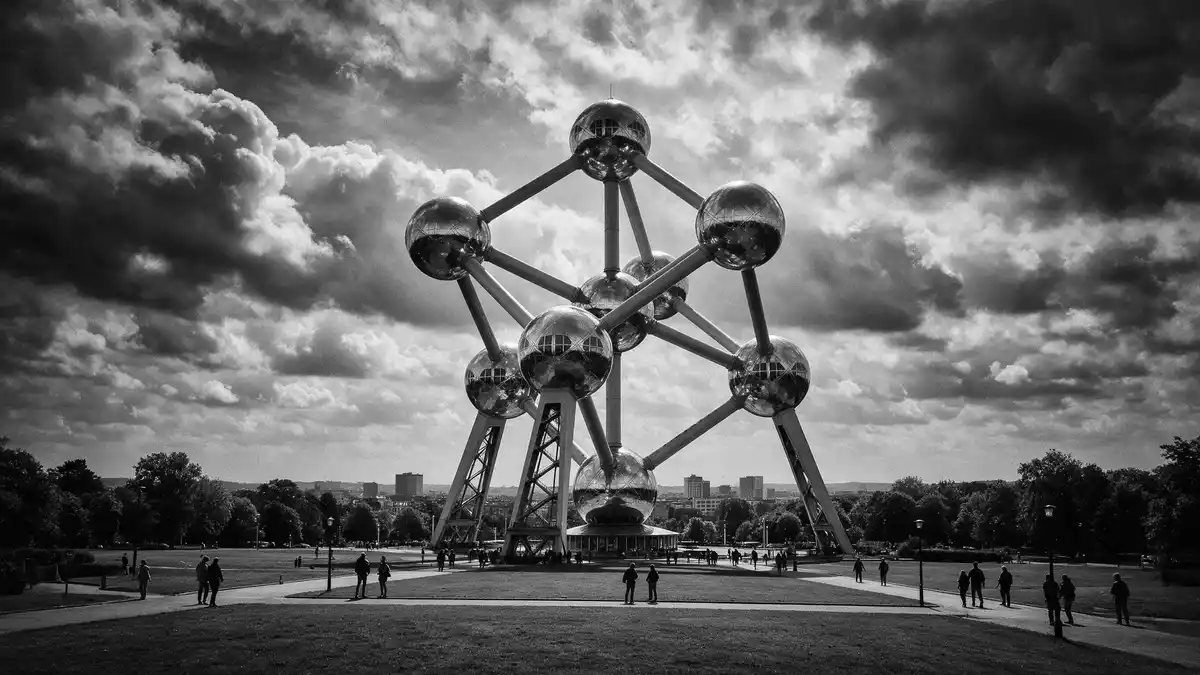
Atomium rises on the Heysel Plateau in northern Brüssel as a giant steel interpretation of an iron crystal. André Waterkeyn created the structure for the 1958 Brussels World’s Fair, and its nine spheres remain joined by a network of tubes.
At 102 metres, Atomium is both a building and a large-scale scientific image. Its polished metal surfaces, elevated walkways and exhibition rooms make the geometry legible from the surrounding district.
Nine spheres above the Heysel Plateau
The structure contains nine spheres, each measuring 18 metres across. They represent the atoms in a unit cell of an iron crystal, expanded to architectural scale.
Steel tubes connect the spheres across the composition. The tubes have a diameter of 3.30 metres, while the complete structure reaches 102 metres above the plateau. The proportions remain readable from ground level, where the spheres appear as separate volumes linked into one framework.
Atomium’s form is not a conventional tower. Its centre is occupied by an open arrangement of metal spheres, diagonals and supports. The lower pavilion anchors the composition, while the upper elements rise above the trees and buildings of Laeken.
André Waterkeyn’s Expo 58 structure
Engineer André Waterkeyn designed Atomium for the Brussels World’s Fair of 1958. Architects André and Jean Polak developed the building, which was completed on 25 March 1958.
The fair placed science, engineering and industrial materials at the centre of its public setting. Atomium served as the fair’s flagship building and emblem, combining an exhibition venue with a large architectural symbol.
Its original material was aluminium over a steel framework. A restoration campaign between 2004 and 2006 replaced the exterior cladding with stainless steel, giving the spheres their reflective appearance.
The interior connects several spheres through stairs, escalators and lifts. Exhibition areas occupy the enclosed volumes, while the upper sphere contains a panoramic space above the lower parts of the building.
From scientific model to Brussels landmark
Atomium’s distinctive character comes from the tension between scale and subject. An iron crystal belongs to the language of microscopy and materials science, yet the building turns that structure into a public landmark.
The nine spheres are not arranged as isolated ornaments. Their tubes form a continuous architectural system, with movement through the building passing between large metal volumes. The design can therefore be read from outside as sculpture and from inside as architecture.
Atomium stands beside Brussels Expo and opposite Mini-Europe on the Heysel Plateau. Nearby Laeken supplies the urban setting, while the building’s height gives its geometry a clear presence across the northern part of the city.
The structure also preserves a physical link with Expo 58. Its date, designers, materials and scientific subject remain visible in the building itself, without requiring a reconstruction of the fair’s wider grounds.
Visiting Atomium: what travellers from Western Europe should know
- Atomium stands on Atomiumsquare in Laeken, in northern Brüssel. Metro line 6 reaches Heysel station, and tram line 7 also serves the district.
- The visit involves vertical movement through a structure of stairs, escalators and lifts. Exhibition rooms occupy enclosed spheres connected by tubes.
- Atomium is opposite Mini-Europe and beside Brussels Expo on the Heysel Plateau. The Centenary Palace forms part of the nearby exhibition complex.
- Belgium’s official languages are Dutch, French and German, and its currency is the euro.
Searching for Atomium on social platforms
These links open searches for Atomium on each platform.
Frequently asked questions about Atomium
Where is Atomium?
Atomium is on the Heysel Plateau in Laeken, northern Brüssel. It stands beside Brussels Expo and opposite Mini-Europe.
What does a visit to Atomium include?
The building contains exhibition spaces inside its spheres. Stairs, escalators and lifts connect the interior levels and tubes.
What makes Atomium distinctive?
Its nine 18-metre spheres represent an iron-crystal unit cell. André Waterkeyn created the 102-metre structure for Expo 58 in 1958.


