
Badshahi Masjid and Lahore’s red sandstone sweep
Published on 09/10/2026 at 08:39 | Editorial responsibility: Rafael Müller, Editor-in-Chief AD HOC NEWS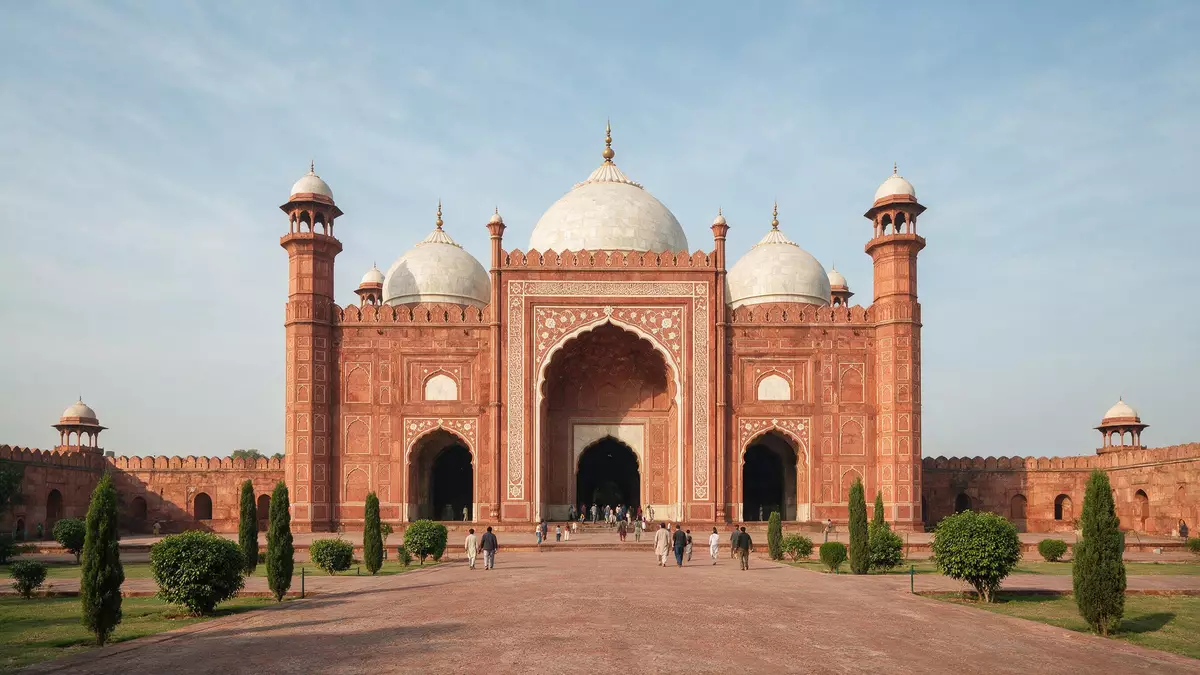
Badshahi Masjid in Lahore is a vast Mughal mosque of red sandstone and white marble, completed under Aurangzeb in 1673. Its broad forecourt, marble domes and corner minarets give the complex a clear architectural rhythm from the first glance.
A Mughal mosque in red sandstone and marble
The mosque belongs to the late Mughal period and is associated with Emperor Aurangzeb, who commissioned it in 1671. Its construction is commonly placed between 1671 and 1673, and its setting opposite Lahore Fort makes the ensemble immediately legible in the cityscape.1671 and 1673
Red sandstone forms the exterior, while white marble appears in the domes and inlay. The mosque is a major example of Mughal architecture, with a composition that brings together a high plinth, a large courtyard and a prayer hall framed by minarets.Mughal architecture
The mosque and the fort across the road
Badshahi Masjid stands near the western edge of the historic Walled City, beside Lahore Fort. That relationship is part of its identity: the mosque and fort read as a paired Mughal statement in stone, brick and marble.adjacent to Lahore Fort
The forecourt is large and open, with the prayer hall set behind it and minarets rising at the corners. The whole composition is formal rather than crowded, with repeated arches and domes carrying the eye across the façade and into the enclosed worship space.red sandstone inlaid
A mosque with a later, harder history
The building’s history includes periods of military use under Sikh and British rule, followed by restoration and return to worship. Those phases are part of the mosque’s biography, but the fabric that survives is still recognisably Mughal, with the dome line and the monumental entrance dominating the approach.built in 1673
That combination of imperial scale and later damage makes the mosque more than a decorative showpiece. It is a working religious monument whose present appearance reflects both seventeenth-century ambition and the survival of a major Lahore landmark through changing regimes.Mughal mosque
Visiting Badshahi Masjid: what travellers from Western Europe should know
- The mosque stands in Lahore, in Punjab, Pakistan, near Lahore Fort and the historic Walled City.
- The approach is on level ground across a wide forecourt, with minarets and the prayer hall visible before entry.
- Red sandstone, white marble and a high platform give the complex a strong material contrast across its main surfaces.
- The official language is Urdu and the currency is the Pakistani rupee.
- Entry requirements depend on your nationality; UK travellers can check the FCDO travel advice at gov.uk/foreign-travel-advice, Irish travellers the Department of Foreign Affairs at ireland.ie.
Searching for Badshahi Masjid on social platforms
These links open searches for Badshahi Masjid on each platform.
Frequently asked questions about Badshahi Masjid
Where is Badshahi Masjid?
Badshahi Masjid is in Lahore, in the Pakistani province of Punjab. It stands close to Lahore Fort and the old city walls.
What should a visit there feel like?
The complex presents a broad open forecourt, a monumental prayer hall and a strong contrast between red sandstone and white marble. The scale is architectural rather than intimate.
What makes it distinctive?
Its association with Aurangzeb, its 1670s construction and its position beside Lahore Fort make it one of the clearest Mughal ensembles in South Asia.


