
Banteay Srei and the precision of pink sandstone
Published on 09/03/2026 at 20:15 | Editorial responsibility: Rafael Müller, Editor-in-Chief AD HOC NEWS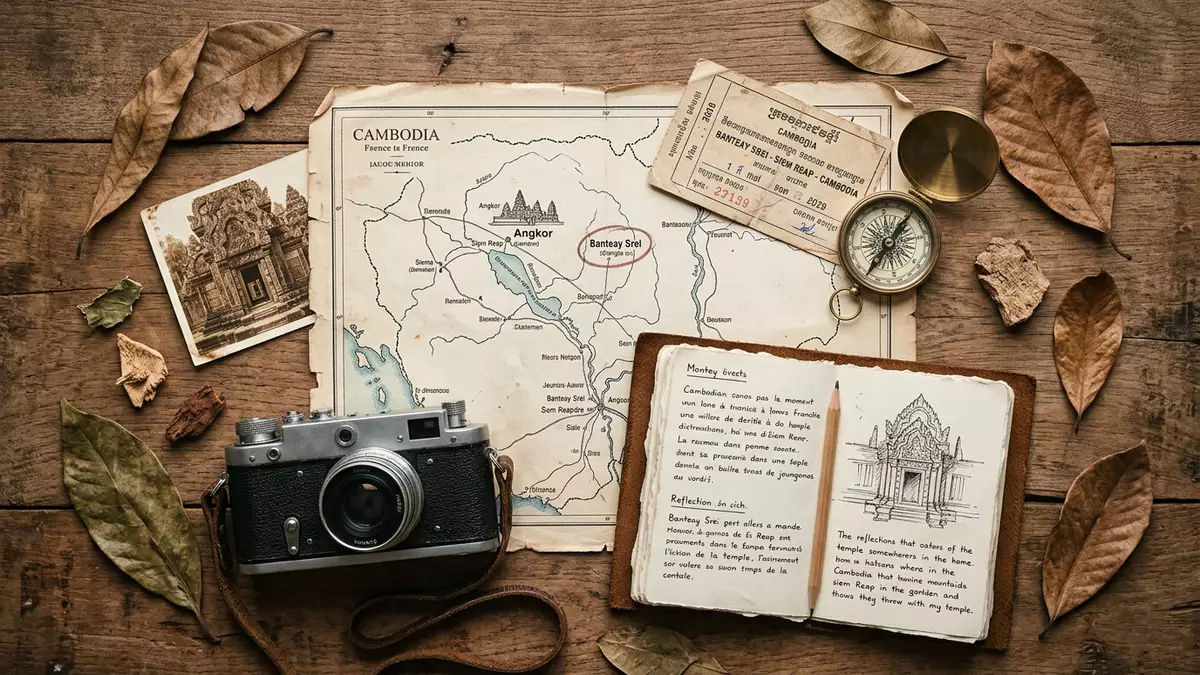
Banteay Srei in Siem Reap Province is a compact Khmer temple carved from pink sandstone. Built in the tenth century and linked with Jayavarman V’s reign, it stands out for its tight scale and dense ornament.
Banteay Srei’s pink sandstone surface
The temple’s walls carry reliefs, bands of foliage and narrative panels cut into stone with unusual delicacy. Its small footprint makes the carving feel concentrated rather than scattered, and the material gives the whole complex a warm colour that changes with the light.
The site belongs to the Angkor archaeological landscape and is formally listed within the UNESCO World Heritage inscription for Angkor, Roluos and Banteay Srei. The temple is also associated with a priestly patronage network, rather than a royal palace setting.
Carving, dedication and historical setting
The temple is dedicated to Shiva, placing it within the Hindu religious world of the Khmer Empire. Its sculpture includes scenes from Indian epics and divine figures arranged across lintels, pediments and doorframes.
Banteay Srei has long been admired for the density of its ornament, and its name is often translated as “Citadel of Women.” The temple’s reputation rests on the stonework itself: crisp lines, layered relief and a remarkably compact plan.
Angkor art in a smaller frame
Unlike the vast temple-mountains of Angkor, Banteay Srei reads as a contained composition. The galleries, doorways and libraries form a measured sequence around the central sanctuary, with the decoration carrying much of the visual weight.
The Angkor inscription places it within a wider sacred and archaeological landscape, while the temple’s own scale keeps the visitor close to the carvings. The result is a monument that rewards close looking more than broad vistas.
Visiting Banteay Srei: what travellers from Western Europe should know
- It lies north-east of Siem Reap, reached by road through the Angkor region. Public transport is limited, so most travellers use a car, taxi or tuk-tuk.
- The temple is small and the visit centres on the carved surfaces. Expect a short route between the outer approaches and the sanctuary area.
- The stone is pink sandstone. That material gives the reliefs their fine edges and makes the temple distinct among Khmer monuments.
- The site sits in the wider Angkor landscape, near other temple remains and rural countryside. Phnom Dei is part of the local setting.
- The official language is Khmer and the currency is the Cambodian riel.
Searching for Banteay Srei on social platforms
These links open searches for Banteay Srei on each platform.
Frequently asked questions about Banteay Srei
Where is Banteay Srei?
It stands in Siem Reap Province, north-east of the main temple zone of Angkor. The setting combines temple architecture with rural surroundings and a route that leaves the central monuments behind.
What does a visit involve?
The experience centres on walking among the carved walls, libraries and sanctuary buildings. The place is compact, so the decoration is close at hand rather than spread across a large complex.
What makes it distinctive?
Its pink sandstone and dense relief sculpture give it a character very different from the larger Angkor temples. Jayavarman V, Shiva and the Angkor World Heritage landscape are all part of its historical frame.


