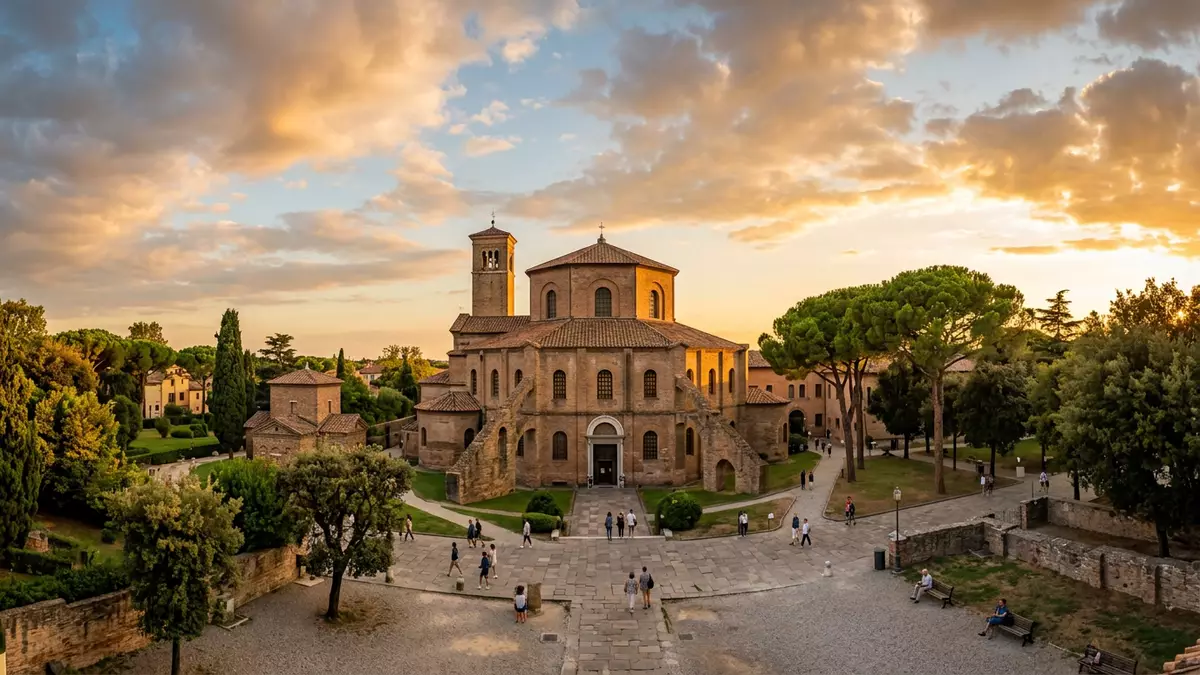
Basilica di San Vitale and its mosaics in Ravenna
Published on 08/10/2026 at 15:19 | Editorial responsibility: Rafael Müller, Editor-in-Chief AD HOC NEWS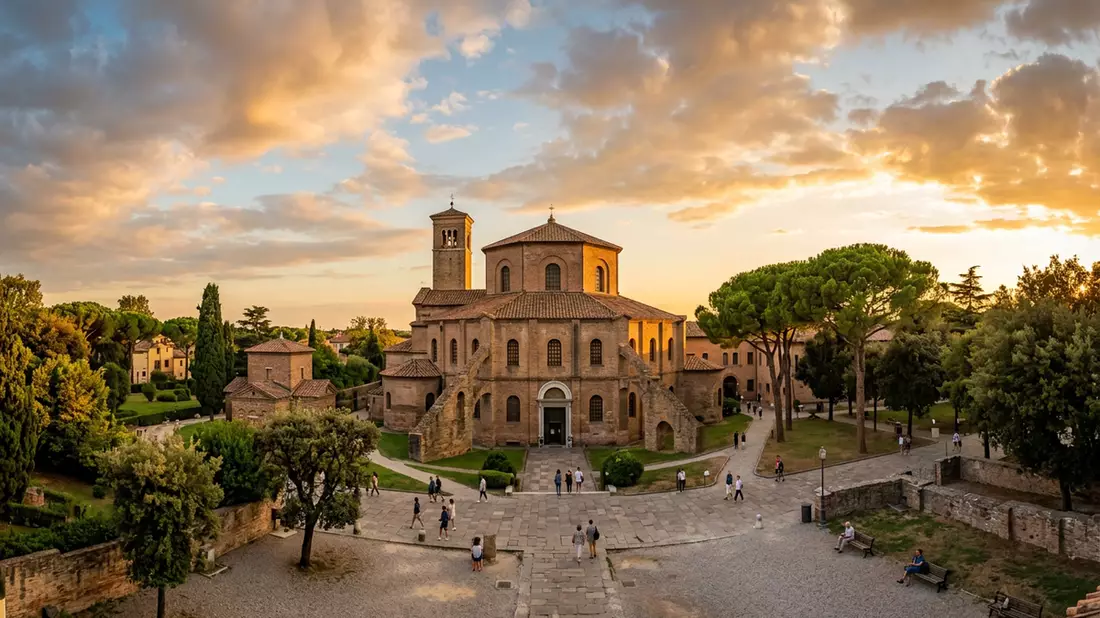
Basilica di San Vitale in Ravenna is a sixth-century church whose octagonal plan and mosaic surfaces make the interior read like a compact chamber of colour. Built under Bishop Ecclesius and consecrated in 547, it belongs to the early Byzantine landscape of northern Italy.
Octagonal space and mosaic surfaces in Ravenna
The church’s central space is ringed by tall arcades and domed above, with marble columns separating the core from the surrounding ambulatory. The plan is easy to read from the entrance, where the geometry opens outward from the centre rather than along a long nave.
The mosaics are the defining surface treatment. Gold backgrounds, patterned garments and formal poses cover the apse and upper walls, while marble revetment grounds the lower levels in darker tones.
Justinian, Theodora and the sixth century
Among the best-known images are the imperial panels of Justinian and Theodora, set within the church’s liturgical space. Their presence links Basilica di San Vitale with Ravenna’s role in the sixth century, when the city stood within the orbit of the Byzantine world.
The building’s architecture and decoration work together as a single ensemble. The octagon, the vaults and the mosaics create a sequence of layered surfaces, with each part giving the others more weight.
From church history to later preservation
Basilica di San Vitale remains one of Ravenna’s central monuments for late antique art and architecture. Its survival gives visitors a direct view of Byzantine mosaic technique in a church that has kept its essential form and visual character.
The interior rewards slow looking. Capitals, arches, pavements and wall scenes all contribute to a space that is as much about surfaces as it is about structure.
Visiting Basilica di San Vitale: what travellers from Western Europe should know
- Ravenna is reached by rail and road from other cities in Emilia-Romagna, with the basilica in the historic centre.
- Admission arrangements and opening hours are set by the site's operator and change with the season; the official website is the only binding source.
- Spring and early autumn are comfortable seasons for walking between Ravenna’s churches and mosaic sites.
- The approach is on level streets, and the church interior involves ordinary steps and stone floors.
- Italian is the main language in the area, and card payment is common in larger venues nearby.
- Entry requirements depend on your nationality. UK travellers should check the FCDO travel advice at gov.uk/foreign-travel-advice; Irish travellers the Department of Foreign Affairs at ireland.ie; EU and EEA citizens their own national foreign ministry.
Searching for Basilica di San Vitale on social platforms
These links open searches for Basilica di San Vitale on each platform.
Frequently asked questions about Basilica di San Vitale
Where is Basilica di San Vitale?
It stands in Ravenna, in north-eastern Italy, close to the historic centre and other mosaic monuments. The setting makes it easy to combine with other churches and museums in the city.
What should visitors expect inside?
An octagonal church with marble columns, vaulted space and dense mosaic decoration. The interior is compact, richly layered and built around the central space.
What makes it distinctive?
The combination of sixth-century architecture and major Byzantine mosaics gives Basilica di San Vitale its character. The imperial panels and the octagonal plan are among its most recognisable features.