
Basilica di San Vitale and Ravenna’s Byzantine mosaics
Published on 08/18/2026 at 13:56 | Editorial responsibility: Rafael Müller, Editor-in-Chief AD HOC NEWS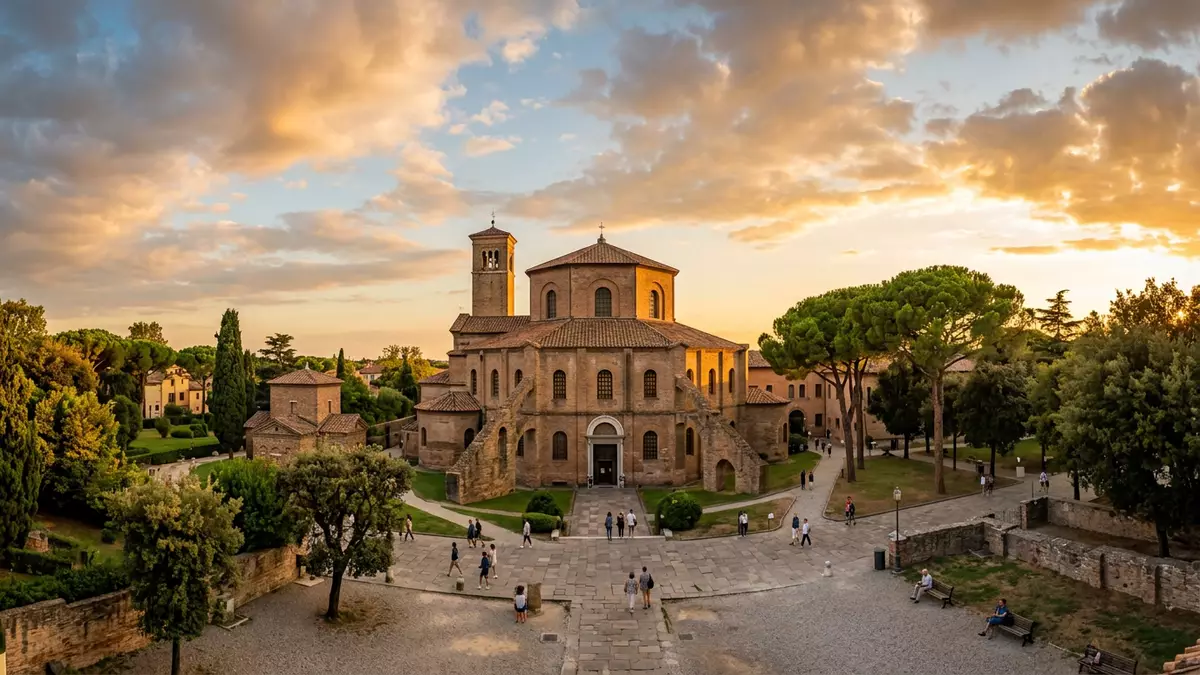
Basilica di San Vitale in Ravenna is an octagonal church of the sixth century, set among the Early Christian Monuments of Ravenna and linked to Justinian’s Byzantine world. Its red-brick shell and glittering mosaics make the building read as structure and image at once.
The octagon at the centre of Ravenna
The church is one of the eight monuments inscribed on the UNESCO World Heritage List as the Early Christian Monuments of Ravenna. It belongs to the city’s late antique fabric and stands in north-western Ravenna, where the Byzantine and western traditions meet in stone and glass.
The building was begun under Bishop Ecclesius and consecrated by Bishop Maximian in 547. That date places it firmly in the age of Justinian, and the name of Julianus Argentarius is tied to its patronage.
Brick outside, mosaic within
San Vitale is recognisable by its central plan, octagonal outline and double-shell arrangement. The exterior is comparatively plain, with brickwork that gives little hint of the interior’s richness.
Inside, marble revetment, columns, capitals and mosaics create a dense surface of colour and pattern. The famous imperial panels of Justinian and Theodora, together with the apse mosaic of Christ, belong to the building’s best-known imagery.
Byzantine art in an Italian city
The basilica belongs to the artistic language of Ravenna’s sixth century, when the city linked western Roman inheritance and eastern imperial taste. Its form recalls Constantinople, yet it remains rooted in the materials and craft of the Adriatic city.
UNESCO describes it as one of the highest creations of Byzantine architecture in Italy, and that judgement fits the building’s mix of geometry, surface and iconography. The result is a church that reads as architecture before it reads as narrative.
Visiting Basilica di San Vitale: what travellers from Western Europe should know
- The basilica stands in Ravenna’s historic centre, close to other Early Christian monuments. It is reached on foot within the city and by local roads and public transport links.
- The building has a central octagonal plan and a tall interior space. The masonry and mosaics reward slow looking rather than a rushed pass-through.
- The official language is Italian and the currency is the euro.
- Entry requirements depend on your nationality; UK travellers can check the FCDO travel advice at gov.uk/foreign-travel-advice, Irish travellers the Department of Foreign Affairs at ireland.ie.
Searching for Basilica di San Vitale on social platforms
These links open searches for Basilica di San Vitale on each platform.
Frequently asked questions about Basilica di San Vitale
Where is Basilica di San Vitale?
It is in Ravenna, in north-eastern Italy, within the group of Early Christian Monuments recognised by UNESCO. The church sits in the city’s historic centre.
What does a visit involve?
The main impression comes from the central octagon, brick exterior and richly decorated interior. The mosaics and marble surfaces are the features to focus on.
What makes it distinctive?
The basilica combines an octagonal plan with Byzantine decoration and sixth-century patronage linked to Ecclesius, Maximian and Julianus Argentarius. Its imperial mosaics give the building its strongest visual identity.


