
Basilica di San Vitale and the shimmering world of Ravenna mosaics
Published on 09/10/2026 at 06:11 | Editorial responsibility: Rafael Müller, Editor-in-Chief AD HOC NEWS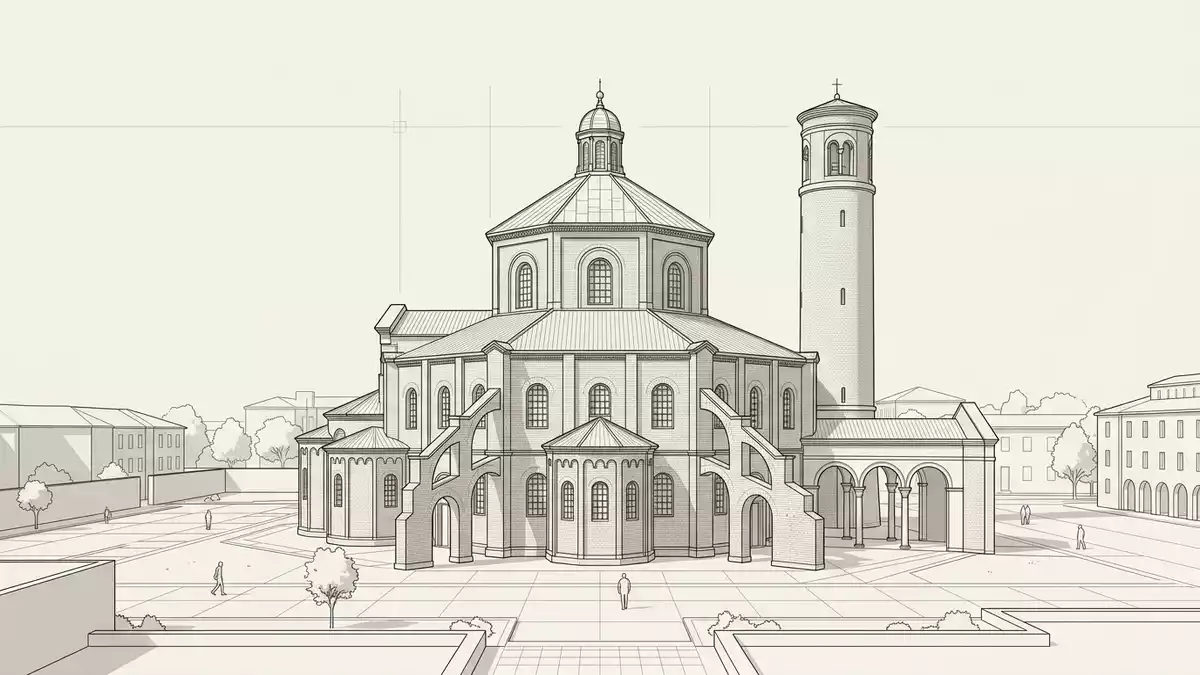
Basilica di San Vitale in Ravenna is one of the clearest encounters with early Byzantine space and mosaic still available in Europe, where a compact church plan opens into a vertical world of colour and gold. Built in the sixth century during the reign of Emperor Justinian I and consecrated in 547, it stands as a landmark of Christian architecture shaped around a central octagon and an enveloping programme of images.Built between 526 and 547
Early Byzantine architecture in an octagonal shell
The exterior of Basilica di San Vitale keeps a low profile, with plain brick walls and modestly articulated volumes that give little indication of the richness inside.An important example of early Byzantine art and architecture The plan centres on an octagonal core surrounded by an ambulatory and galleries, a form that brings the focus away from a long nave and towards a compact central space.
Within this structure, columns and piers carry arcades that rise in tiers, framing views into the sanctuary and guiding the eye upwards towards the vaults.Built in the sixth century The lower walls are faced in veined marble panels and carved capitals, while the architectural shell steps inwards through arches and niches, creating alternating zones of enclosure and openness around the central space.Marble revetment and an octagonal core
Mosaics of power, scripture and ceremony
The identity of Basilica di San Vitale is defined above all by its mosaics, which cover the apse, presbytery and triumphal arch with dense biblical imagery and imperial portraits.Mosaics in the apse and presbytery In the sanctuary, panels depict Old and New Testament scenes, the Lamb of God surrounded by plants and animals, and processions of saints set against gleaming backgrounds.Christian iconography throughout the interior
On one wall of the presbytery, Emperor Justinian stands with courtiers and clergy, and on the opposite wall Empress Theodora appears with her attendants, both holding liturgical vessels as they move towards the altar.Justinian and Theodora mosaics in the sanctuary These panels bridge theology and politics, showing secular and ecclesiastical figures aligned within a sacred setting, with gold tesserae and stylised garments emphasising their status.Imperial mosaics from the mid sixth century
A UNESCO-listed mosaic city around the basilica
Basilica di San Vitale forms part of a wider ensemble of early Christian and Byzantine monuments in Ravenna that have been inscribed together on the UNESCO World Heritage List.UNESCO World Heritage monument since 1996 Nearby, the small Mausoleum of Galla Placidia keeps its own mosaic cycle, and other churches and baptisteries across the city extend this mosaic tradition into different scales and themes.Part of Ravenna’s mosaic ensemble
Inside Basilica di San Vitale itself, floor mosaics run around the ambulatory and into the area before the presbytery, incorporating geometric motifs and, in front of the sanctuary, a marble labyrinth set within the pavement.Labyrinth in the sixteenth-century floor Together with the wall mosaics, these surfaces create a continuous decorated environment, marking Basilica di San Vitale as a central reference point for anyone tracing Ravenna’s role in sixth-century Mediterranean art.Mosaics that remain intact in their original form
Visiting Basilica di San Vitale: what travellers from Western Europe should know
- Basilica di San Vitale stands in central Ravenna on Via San Vitale, within walking distance of the Mausoleum of Galla Placidia and other historic religious buildings.
- The interior is reached through a modest entrance and opens into an octagonal space with steps and changes in level between the ambulatory, galleries and presbytery.
- Ravenna lies in the Emilia-Romagna region of northern Italy and is served by regional rail connections; the official language is Italian and the currency is the euro.
Searching for Basilica di San Vitale on social platforms
These links open searches for Basilica di San Vitale on each platform.
Frequently asked questions about Basilica di San Vitale
Where is Basilica di San Vitale located?
Basilica di San Vitale stands in the historic centre of Ravenna in the Emilia-Romagna region of Italy, close to the Mausoleum of Galla Placidia.
What should visitors expect inside the basilica?
Visitors encounter an octagonal interior lined with marble and crowned by sixth-century mosaic cycles in the apse and presbytery, including panels of Justinian and Theodora.
What makes Basilica di San Vitale distinctive among churches?
Its combination of a centralised Byzantine plan, extensive mosaics and its place within Ravenna’s UNESCO-listed group of early Christian monuments makes Basilica di San Vitale distinctive.


