
Basilica di Superga and the Baroque crown above Turin
Published on 09/10/2026 at 06:43 | Editorial responsibility: Rafael Müller, Editor-in-Chief AD HOC NEWS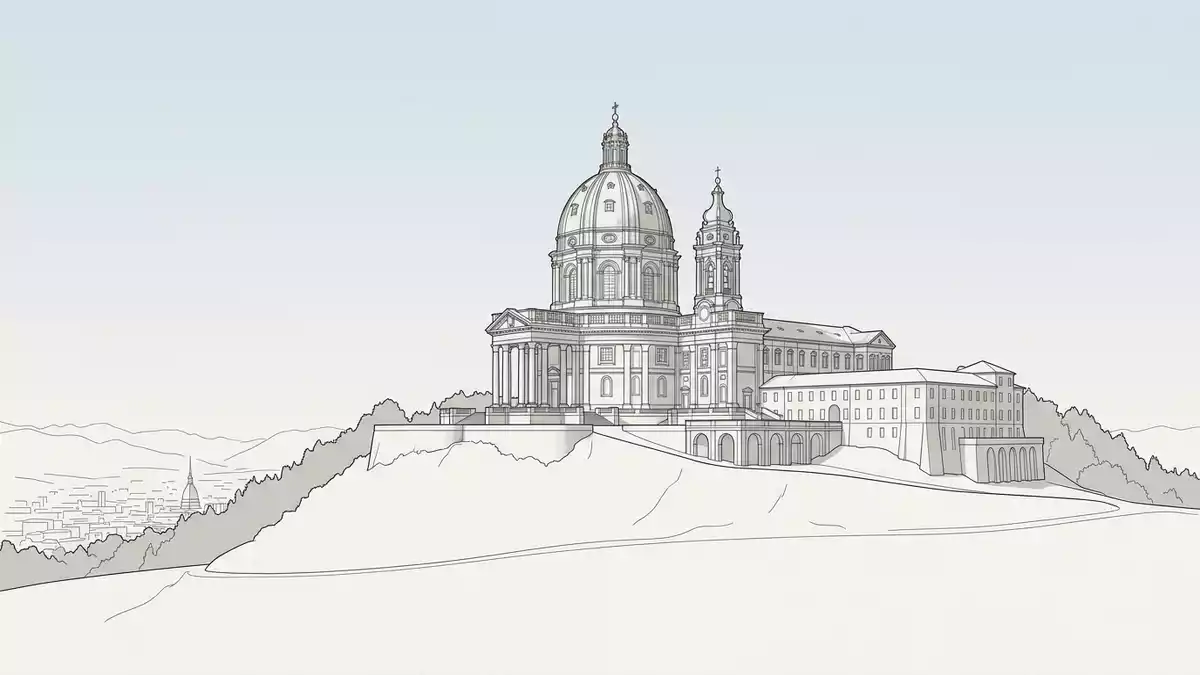
High above Turin, Basilica di Superga crowns a Piedmont hill with a late Baroque silhouette: a dominant dome, twin bell towers and a long classical portico fronting the church. Built in the early eighteenth century under Victor Amadeus II of Savoy and designed by Filippo Juvarra, it links the city’s skyline to the dynastic ambitions of the House of Savoy.
A Savoy basilica on the Superga hill
Basilica di Superga stands on the hill of the same name on the eastern edge of Turin, in the hills that frame the Piedmontese capital and look towards the Alps. The sanctuary is connected visually with the royal palace at Rivoli and the city below, a deliberate placement that ties the church to Savoy power and the emerging kingdom.position on the hill
The basilica’s origins lie in the siege of Turin in 1706, when Duke Victor Amadeus II of Savoy climbed the hill of Superga to observe the Franco-Spanish lines around the city and to pray for victory.siege of Turin in 1706 After the city’s liberation, he resolved to build a sanctuary here in gratitude, anchoring the story of Superga in the House of Savoy’s ascent within early eighteenth-century Europe.
Filippo Juvarra’s Baroque architecture
Victor Amadeus II entrusted the design of Basilica di Superga to Filippo Juvarra, a Sicilian architect in Savoy service and a leading figure of Piedmontese Baroque.Filippo Juvarra in Savoy service Ground was broken in 1717 and the sanctuary was inaugurated in 1731, giving the church a clear place in the architectural history of the eighteenth century.built from 1717 to 1731
The composition mixes late Baroque movement with a disciplined classical order. A high dome rises above the crossing, flanked by two symmetrical bell towers that frame the façade. In front, a deep colonnaded portico with tall columns presents a formal, palace-like face to the approach from Turin, while the church behind is oriented along an axis that continues out towards Rivoli. The elevation on the hill gives the dome and towers a strong profile against the sky, and from the terrace outside the portico there are wide views over Turin, the Po Valley and, on clear days, the alpine arc.
Royal crypt and Savoy memory
Basilica di Superga is dedicated to the Nativity of Mary and carries a strong dynastic role, housing the tombs of the House of Savoy in its crypt.tombs of the House of Savoy Members of the royal family, including Victor Emmanuel I of Sardinia and his relatives, are buried here, and the crypt is laid out as a sequence of chapels and sarcophagi beneath the floor of the church.royal tombs in the crypt
For visitors, the combination of hilltop basilica and royal burial place sets Basilica di Superga apart from many urban churches. The main interior carries the language of Piedmontese Baroque, with stucco decoration and altars aligned along the nave, while the crypt below introduces a quieter world of stone and royal heraldry. Above and around the complex, the hill forms part of the Natural Park of the Superga Hill, so the sanctuary sits within protected landscape rather than dense city streets.Natural Park of the Superga Hill
Visiting Basilica di Superga: what travellers from Western Europe should know
- Basilica di Superga stands on the Superga hill to the east of Turin, reached by road and by a historic rack railway climbing from the city’s outskirts to the sanctuary.
- The approach to the basilica involves uphill ground and a terrace set above the slope, with steps inside the church and stairs leading down to the royal crypt.
- The church lies within the Natural Park of the Superga Hill on the edge of Turin, so the immediate surroundings combine religious architecture with wooded paths and open viewpoints.
- The official language is Italian and the currency is the euro.
Searching for Basilica di Superga on social platforms
These links open searches for Basilica di Superga on each platform.Frequently asked questions about Basilica di Superga
Where is Basilica di Superga located?
Basilica di Superga stands on the Superga hill on the eastern side of Turin in northern Italy, within the Natural Park of the Superga Hill.
What can visitors expect on a visit to Basilica di Superga?
Visitors encounter an eighteenth-century Baroque basilica with a high dome and portico, a terrace overlooking Turin and access to the Savoy royal crypt beneath the church.
What makes Basilica di Superga distinctive among churches in Turin?
Its combination of Juvarra’s hilltop Baroque architecture, a strong connection to the siege of Turin in 1706 and its role as the burial place of the House of Savoy gives it a distinctive profile.


