
Boccadasse and the colourful fishing village within Genoa
Published on 09/23/2026 at 13:18 | Editorial responsibility: Rafael Müller, Editor-in-Chief AD HOC NEWS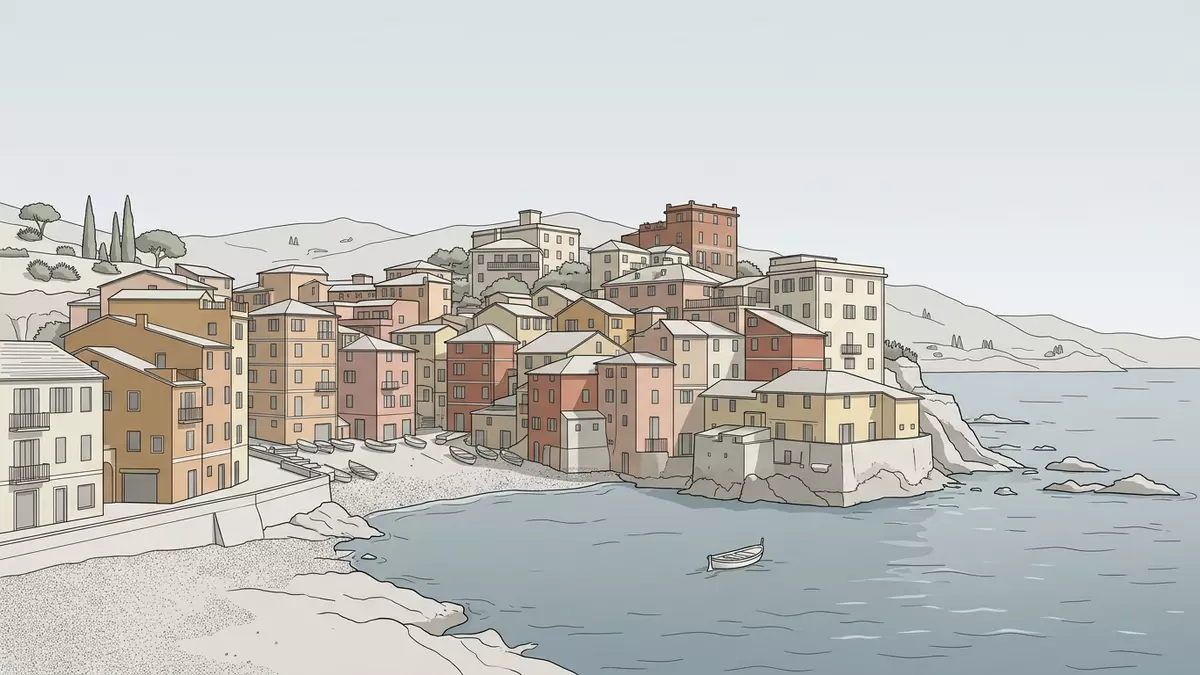
Boccadasse is a former fishing village folded around a small pebble cove on Genoa’s Ligurian coast. Pastel houses, narrow lanes and boats on the shore preserve a compact maritime landscape within the city, between Corso Italia and Capo Santa Chiara.
Boccadasse around its pebble cove
The cove is the centre of Boccadasse’s physical character. A strip of pebbles meets the sea below closely grouped houses, while the village lanes rise from the waterfront towards the surrounding streets of Albaro. The shoreline remains legible as a landing place, with boats, stone edges and low buildings gathered around the bay.
The houses carry the colours and forms associated with Ligurian coastal architecture. Their façades face the water in a tight arrangement, leaving the beach and the small square near the shore as the village’s most open spaces. Boccadasse is an old mariners’ settlement within Genoa, not a separate coastal town. Its location is recorded by Genoa’s coastal village.
From maritime settlement to Genoa district
Boccadasse is traditionally dated to around the year 1000 in local accounts linked to Spanish fishermen. The foundation story belongs to the village’s cultural memory, while its secure identity rests on centuries of coastal fishing, small maritime trade and life beside the Ligurian Sea.
The settlement belonged to San Francesco d’Albaro before its incorporation into Genoa in the nineteenth century. A Royal Decree dated 26 October 1873 transferred San Francesco d’Albaro into the municipality of Genoa, placing Boccadasse within the city’s expanding urban administration. The Genoese name appears as Bocca d’Âze or Boccadâze, and several explanations for it remain part of local tradition.
Churches, villas and the coast beyond the cove
Boccadasse connects with a wider coastal sequence along Corso Italia. The route includes the church of Sant’Antonio in Boccadasse, while nearby buildings show the architectural variety of Genoa’s eastern seafront. Liberty-style villas, rationalist buildings by Luigi Carlo Daneri and the art déco Villa Canali-Gaslini by Gino Coppedè form part of this urban setting.
The Abbey of San Giuliano adds a medieval landmark to the coastal landscape. Its foundation is dated to 1240, and the complex includes a church, convent and small cloister in a Romanesque-Gothic style. Fort San Giuliano, built between 1826 and 1836, and the remains of the Vagno battery place military architecture near the residential and maritime buildings. The wider route is outlined in the Corso Italia route.
Visiting Boccadasse: what travellers from Western Europe should know
- Boccadasse lies on Genoa’s eastern seafront, between Corso Italia and Capo Santa Chiara. It is reached through Genoa’s urban streets and by the coastal promenade.
- The village is arranged around a pebble beach and narrow lanes. The route from the shore rises through compact streets towards Albaro and Capo Santa Chiara.
- Corso Italia links Boccadasse with San Giuliano Abbey, Fort San Giuliano and other buildings along Genoa’s eastern coast.
- The official language is Italian and the currency is the euro.
Searching for Boccadasse on social platforms
These links open searches for Boccadasse on each platform.
Frequently asked questions about Boccadasse
Where is Boccadasse?
Boccadasse is on Genoa’s eastern seafront in Liguria, between Corso Italia and Capo Santa Chiara. It forms part of the Albaro area within the municipality of Genoa.
What can visitors expect to see?
The village contains a pebble cove, pastel-coloured houses, narrow lanes, boats and the church of Sant’Antonio. Corso Italia connects it with coastal buildings, San Giuliano Abbey and Fort San Giuliano.
What makes Boccadasse distinctive?
Its identity comes from the close relationship between a small maritime cove and a historic fishing settlement. The village’s compact houses remain grouped directly around the shore inside a large Italian city.


