
Bukchon Hanok Maeul and Seoul’s hillside roofs
Published on 09/23/2026 at 12:26 | Editorial responsibility: Rafael Müller, Editor-in-Chief AD HOC NEWS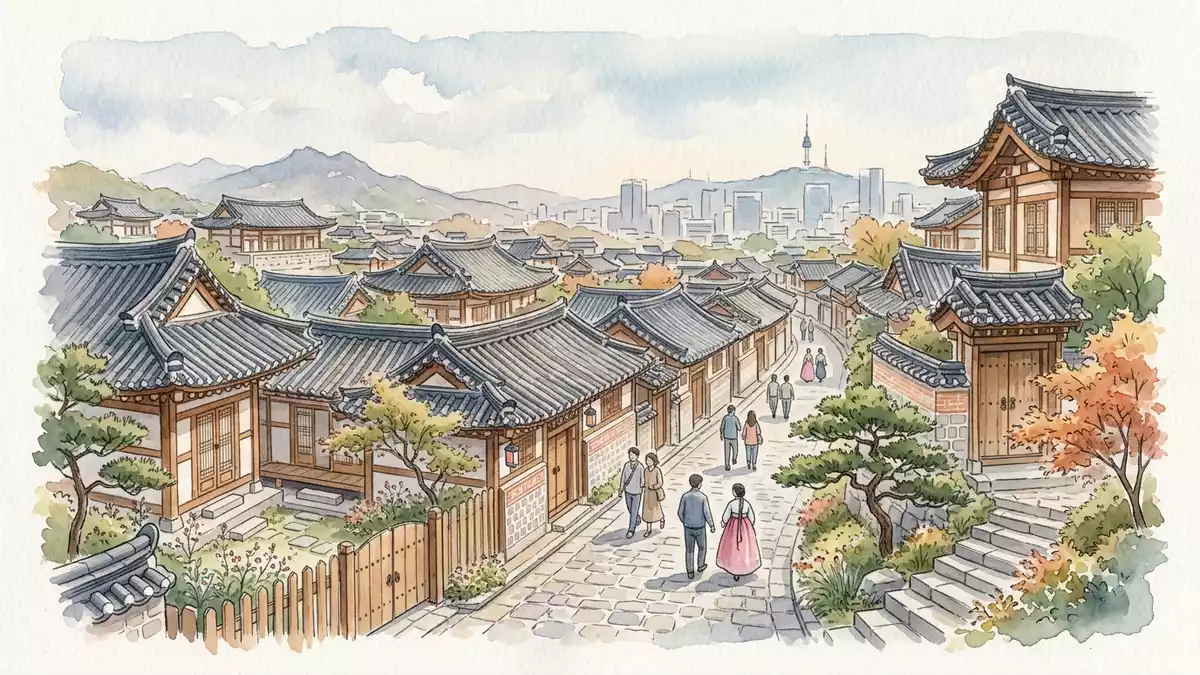
Bukchon Hanok Maeul is a residential neighbourhood in Seoul where timber-framed hanok houses cover the slopes between Gyeongbokgung Palace and Changdeokgung Palace. Its close-set roofs, courtyards and narrow lanes preserve a distinct architectural landscape inside Jongno-gu, while homes, workshops and cultural spaces remain part of the neighbourhood.
Bukchon’s roofs between Seoul’s royal palaces
The name Bukchon means “northern village”. The district lies north of Cheonggyecheon Stream and Jongno, with Mount Bugak rising to the north. Gyeongbokgung, Changdeokgung and Jongmyo Shrine surround the neighbourhood as major landmarks of historic Seoul.
Bukchon’s most recognisable feature is its repeated pattern of tiled roofs. Timber posts and beams rest on stone foundations, while clay walls, wooden details and interior courtyards form the basic language of traditional Korean domestic architecture. The lanes climb and bend across the hillside, placing rooflines at different levels.
Hanok homes from the Joseon period
Bukchon was a residential quarter for high-ranking officials and aristocratic families during the Joseon dynasty, which ruled Korea from 1392 to 1910. The district’s position near the royal palaces connected domestic life with the political centre of the capital. Bukchon’s Joseon history remains central to its identity.
The neighbourhood changed during the twentieth century as Seoul’s population grew and housing patterns became denser. Groups of smaller hanok were built around the 1930s, creating much of the close-set urban fabric visible in the lanes. Their scale differs from the larger compounds associated with elite residences in the late Joseon period.
Living architecture in Jongno-gu
Bukchon Hanok Maeul is not an isolated monument. It is a lived-in district with private houses, craft studios, galleries, cafés and cultural facilities set beside ordinary residential streets. The relationship between preserved buildings and daily use gives the neighbourhood its particular character.
Traditional features appear at close range: tiled eaves, timber framing, plastered walls, stone thresholds and courtyards behind gates. Some buildings retain the proportions of historic hanok, while others contain contemporary interiors or serve new cultural uses. Traditional hanok houses remain the defining architectural presence.
Several lanes provide views across overlapping roofs and the surrounding city. Gyedong-gil is associated with shops, cafés and workshops, while the nearby palace districts add walls, gates and wooded grounds to the wider setting. Bukchon’s architecture is read through individual doors and rooflines as much as through the neighbourhood as a whole.
Visiting Bukchon Hanok Maeul: what travellers from Western Europe should know
- Bukchon Hanok Maeul lies in Jongno-gu, Seoul, between Gyeongbokgung Palace and Changdeokgung Palace. Seoul’s subway and bus network serves the surrounding palace district.
- The neighbourhood occupies sloping ground. Narrow lanes, steps and rising streets form part of the route through the hanok area.
- Bukchon is a residential district. Houses, entrances and side streets belong to local residents, alongside cultural venues and craft businesses.
- The official language is Korean and the currency is the South Korean won.
Searching for Bukchon Hanok Maeul on social platforms
These links open searches for Bukchon Hanok Maeul on each platform.
Frequently asked questions about Bukchon Hanok Maeul
Where is Bukchon Hanok Maeul?
It is in Jongno-gu, central Seoul, between Gyeongbokgung Palace and Changdeokgung Palace. Cheonggyecheon Stream and Jongno lie south of the district.
What can visitors expect there?
Visitors find sloping lanes, close-set hanok houses, tiled roofs, courtyards, craft spaces and views towards Seoul’s palace district. The area remains a residential neighbourhood.
What makes Bukchon distinctive?
Its identity comes from the concentration of traditional Korean houses within a living urban district. Joseon-period history, twentieth-century hanok streets and present-day residential use appear together in the same hillside setting.


