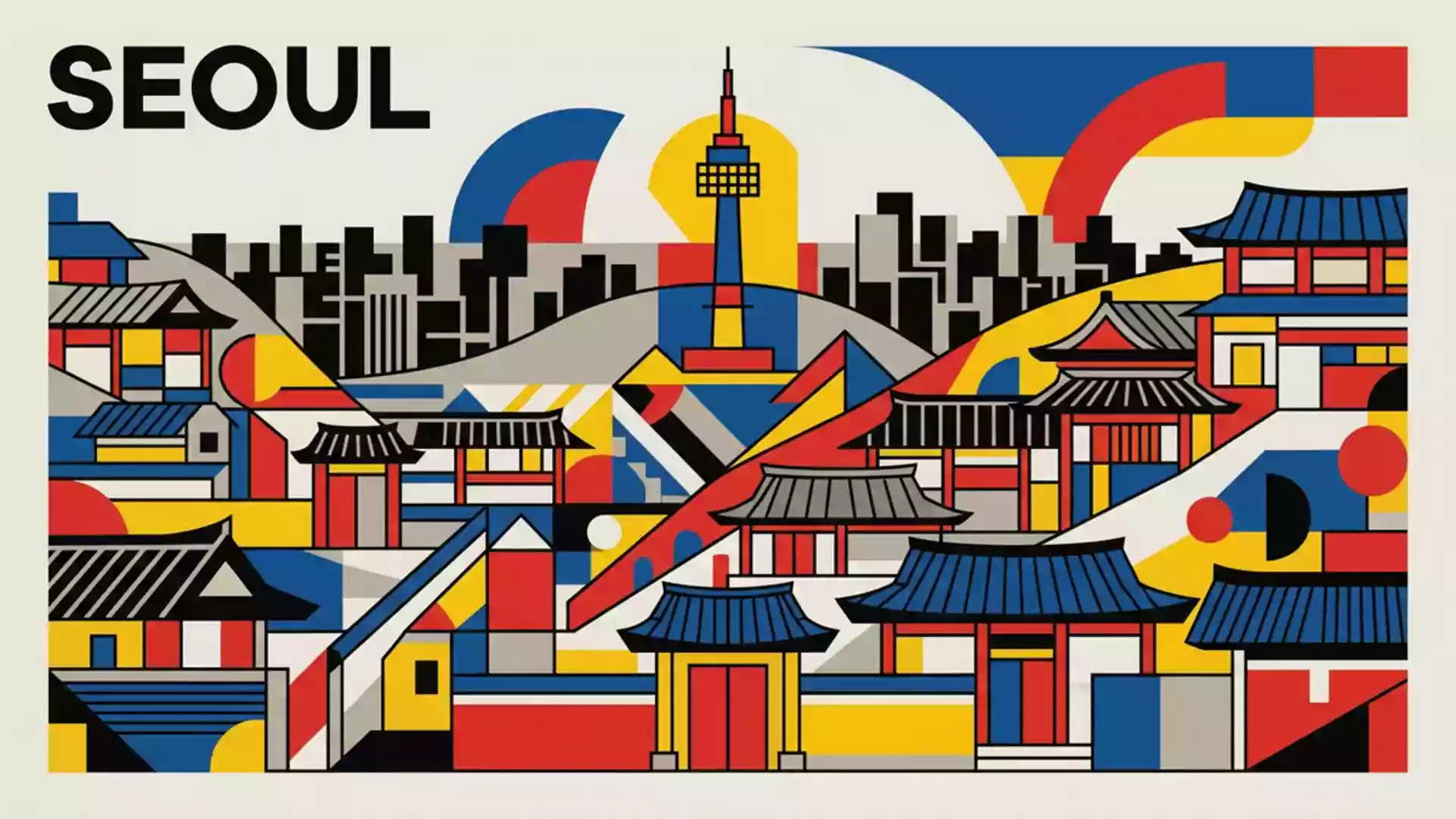
Bukchon Hanok Maeul and the tiled roofs between Seoul’s royal palaces
Published on 09/01/2026 at 09:20 | Editorial responsibility: Rafael Müller, Editor-in-Chief AD HOC NEWS
Bukchon Hanok Maeul in Seoul is a historic neighbourhood of traditional Korean houses, known as hanok, set between the royal palaces of Gyeongbokgung and Changdeokgung. Rooted in the Joseon dynasty, this district preserves a dense fabric of timber-framed courtyard homes, stepped lanes and low tiled roofs inside one of Asia’s largest cities.
Between palaces and shrines in central Seoul
Bukchon Hanok Maeul lies in Jongno-gu, central Seoul, on ground that stretches between Gyeongbokgung Palace to the west and Changdeokgung Palace to the east.The village is situated between Gyeongbokgung Palace and Changdeokgung Palace This position places the neighbourhood within walking distance of Jongmyo Shrine, one of the most important Confucian royal memorial sites in Korea.Bukchon Hanok Village is described as being surrounded by Gyeongbokgung Palace, Changdeokgung Palace and Jongmyo Shrine
The name “Bukchon” means “northern village” in Korean and refers to its position north of Cheonggyecheon Stream and the Jongno area, which formed one of the historic east–west axes of Seoul.The district’s name is explained as referring to its location north of Cheonggyecheon in Jongno-gu Several neighbourhoods come together inside this label, including Gahoe-dong and parts of Wonseo-dong and Jae-dong, but visitors experience them as one continuous district of alleys and hanok roofs.
Hanok architecture shaped in the Joseon dynasty
The hanok of Bukchon are closely associated with the Joseon dynasty, which ruled Korea from 1392 to 1910 and set the urban framework of Seoul.The houses here are described as hanoks dating back to the Joseon Dynasty Many of the houses follow the classic hanok pattern of timber posts and beams resting on stone foundations, with clay walls and tiled roofs arranged around inner courtyards. From the lanes, visitors see rooflines stepping with the slope, exposed structural timbers and entrance gates leading into private compounds.
Historically, this area housed members of the yangban elite, the scholar-official class of the Joseon period, which influenced the scale and finish of the buildings.Seoul records describe Bukchon as a residential area for Joseon-era nobility and gentry around 600 years ago In the twentieth century many hanok were altered or replaced, but conservation efforts have restored a large number of structures, creating a rare continuous streetscape of historic Korean residential architecture embedded in the contemporary city grid.
A living residential conservation area
Bukchon Hanok Maeul functions as a residential neighbourhood as well as a conservation area, so visitors encounter everyday life alongside cultural spaces. Some hanok now host cultural centres, craft workshops, teahouses and guesthouses, while others remain private family homes.VisitKorea notes that many hanoks operate as cultural centres, guesthouses, restaurants and teahouses Small galleries and studios occupy former residential units, adding a contemporary layer of design and art to the district’s historic fabric.
The city of Seoul recognises Bukchon Hanok Maeul as a key traditional residential area and highlights a series of designated scenic viewpoints where clusters of hanok roofs can be seen against the backdrop of the city skyline.Seoul’s hanok portal describes Bukchon as the city’s most representative traditional residential area with clusters of hanok between the palaces and Jongmyo Shrine Narrow lanes climb and dip along the hillside, and some viewpoints align directly towards palace complexes or towards the modern high-rise districts beyond, underscoring the contrast between new and old Seoul.
Visiting Bukchon Hanok Maeul: what travellers from Western Europe should know
- Bukchon Hanok Maeul lies in Jongno-gu on the northern side of central Seoul, and is reached easily on the Seoul Metro via Anguk Station on Line 3.
- The neighbourhood is built on sloping terrain, with stepped alleys and some steep sections that require walking on uneven stone or concrete surfaces.
- The area sits between Gyeongbokgung Palace and Changdeokgung Palace, so it is straightforward to combine a walk through Bukchon with visits to at least one of these royal complexes.
- The official language is Korean and the currency is the South Korean won.
- Entry requirements depend on your nationality; UK travellers can check the FCDO travel advice at gov.uk/foreign-travel-advice, Irish travellers the Department of Foreign Affairs at ireland.ie.
Searching for Bukchon Hanok Maeul on social platforms
These links open searches for Bukchon Hanok Maeul on each platform.
Frequently asked questions about Bukchon Hanok Maeul
Where is Bukchon Hanok Maeul in Seoul?
Bukchon Hanok Maeul is in Jongno-gu, central Seoul, between Gyeongbokgung Palace and Changdeokgung Palace on the northern side of the old city centre.
What should travellers expect when walking through Bukchon Hanok Maeul?
Travellers encounter narrow lanes lined with traditional hanok houses, some used as homes and others as cultural spaces, on sloping terrain with stepped streets and viewpoints.
What makes Bukchon Hanok Maeul distinctive among historic districts?
It preserves a large concentration of Joseon-era hanok dwellings within a living residential neighbourhood, framed by royal palaces and a modern city skyline.