
Butchart Gardens in Brentwood Bay’s transformed quarry landscape
Published on 09/14/2026 at 17:09 | Editorial responsibility: Rafael Müller, Editor-in-Chief AD HOC NEWS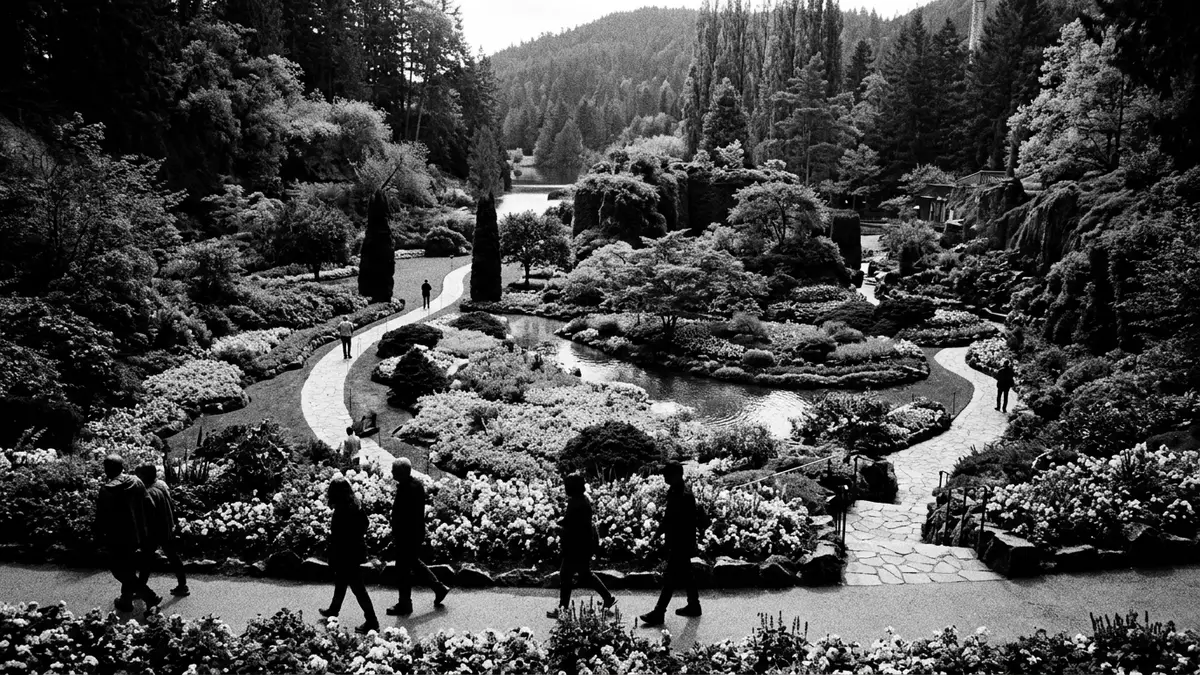
On the Saanich Peninsula at Brentwood Bay on Vancouver Island, Butchart Gardens presents an elaborate series of display gardens laid across the site of a former limestone quarry and estate. Founded in 1904 by Jennie and Robert Pim Butchart, the gardens developed through the first half of the twentieth century into a landscaped panorama that later gained formal recognition as a National Historic Site of Canada in 2004.
From industrial quarry to Sunken Garden
The story of Butchart Gardens begins with cement. In 1904 Robert Pim Butchart established a Portland cement works beside Tod Inlet, exploiting rich limestone deposits on the west side of the Saanich Peninsula.Portland cement works beside Tod Inlet As stone was removed, a steep-sided quarry remained close to the Butcharts’ residence. From that year Jennie Butchart began laying out flower beds and pathways around the industrial void, using the exposed rock faces and irregular terrain as a backdrop for planting.Jennie Butchart began to shape this landscape in 1904
By 1909 the main limestone quarry had been exhausted, freeing the pit from further extraction and turning it into a permanent hollow with high walls and a floor far below the surrounding estate.limestone quarry exhausted by 1909 Jennie Butchart intensified the reclamation of this area over the following years, building up deep flower beds, arranging shrubs and trees along the slopes and inserting a network of paths and steps. The result is the Sunken Garden, completed in 1921, where visitors descend from the rim into a theatrical basin of lawns, flower borders and specimen trees framed by the quarry walls.Sunken Garden completed in 1921
The estate gardens: Japanese, Italian and Rose
Beyond the quarry basin, Butchart Gardens extends across the former estate in several distinct compositions that reflect early twentieth-century garden fashion. On the waterfront side, a Japanese Garden was begun in 1906, drawing on traditional Japanese landscaping and later work by landscape architect Isaburo Kishida.Japanese Garden designed in 1906 Winding paths lead beneath maples and other trees towards the shore of Brentwood Bay, where views open out over the inlet. Elements such as a Torii gate and flowing streams are set among the planting, giving this part of the garden a markedly different character from the quarry interior.Torii gate and flowing streams
Closer to the house, an Italian Garden occupies the site of the Butcharts’ former tennis court, converted into a formal composition in 1926 with geometric beds and container planting around a central water feature.tennis court converted to Italian Garden The Rose Garden, laid out in the later 1920s, brings together hybrid tea roses, climbers and ramblers in curving beds that visitors walk through as a sequence of arches and paths, contrasting with the level lawns and clipped outlines of the Italian Garden.Rose Garden developed in 1929
A family garden recognised as a historic site
The Butcharts named their estate Benvenuto in 1908, adopting the Italian word for welcome as the property’s name.estate named Benvenuto in 1908 Over the following decades Jennie Butchart continued to refine the gardens, introducing plants such as the Tibetan blue poppy in the 1920s and expanding the range of tree species, including California redwoods planted in the 1930s.Tibetan blue poppy and redwoods In 1939 the gardens were passed to their grandson Robert Ian Ross, marking a generational handover that kept the property within the family while opening it more systematically to visitors.gifted to Robert Ian Ross in 1939
Mid-twentieth-century additions reinforced Butchart Gardens as an attraction as well as a private landscape. Night illuminations were installed in the early 1950s, followed in 1964 by the Ross Fountain, a large water feature set within the former quarry to mark the garden’s sixtieth anniversary.Ross Fountain installed in 1964 Later decades saw further embellishments and the introduction of seasonal programmes, while ownership and management remained with descendants of Jennie and Robert Pim Butchart. In 2004 the gardens were formally designated a National Historic Site of Canada, recognising the transformation of an industrial quarry and estate into a landscaped ensemble spanning roughly 5.26 hectares and shaped between 1904 and 1939 under Jennie Butchart’s guidance.National Historic Site designation in 2004
Visiting Butchart Gardens: what travellers from Western Europe should know
- Butchart Gardens lies beside Tod Inlet on Vancouver Island’s Saanich Peninsula, north of Victoria, and is reached by road from Brentwood Bay and the surrounding region.
- The former quarry forms a hollow with paths, lawns and beds on several levels, so a visit involves walking on slopes and stairways as well as level garden paths.
- The official language is English and the currency is the Canadian dollar.
- Entry requirements depend on your nationality; UK travellers can check the FCDO travel advice at gov.uk/foreign-travel-advice, Irish travellers the Department of Foreign Affairs at ireland.ie.
Searching for Butchart Gardens on social platforms
These links open searches for Butchart Gardens on each platform.Frequently asked questions about Butchart Gardens
Where is Butchart Gardens located?
Butchart Gardens is on Vancouver Island’s Saanich Peninsula at Brentwood Bay in British Columbia, beside Tod Inlet north of Victoria.
What can visitors expect on a visit?
A visit takes in the Sunken Garden in the former quarry, the Japanese Garden by the waterfront, the Italian Garden near the house and the expansive Rose Garden.
What makes Butchart Gardens distinctive?
The gardens are distinctive for their origin as a reclaimed limestone quarry, the early twentieth-century estate layout and their designation as a National Historic Site of Canada.


