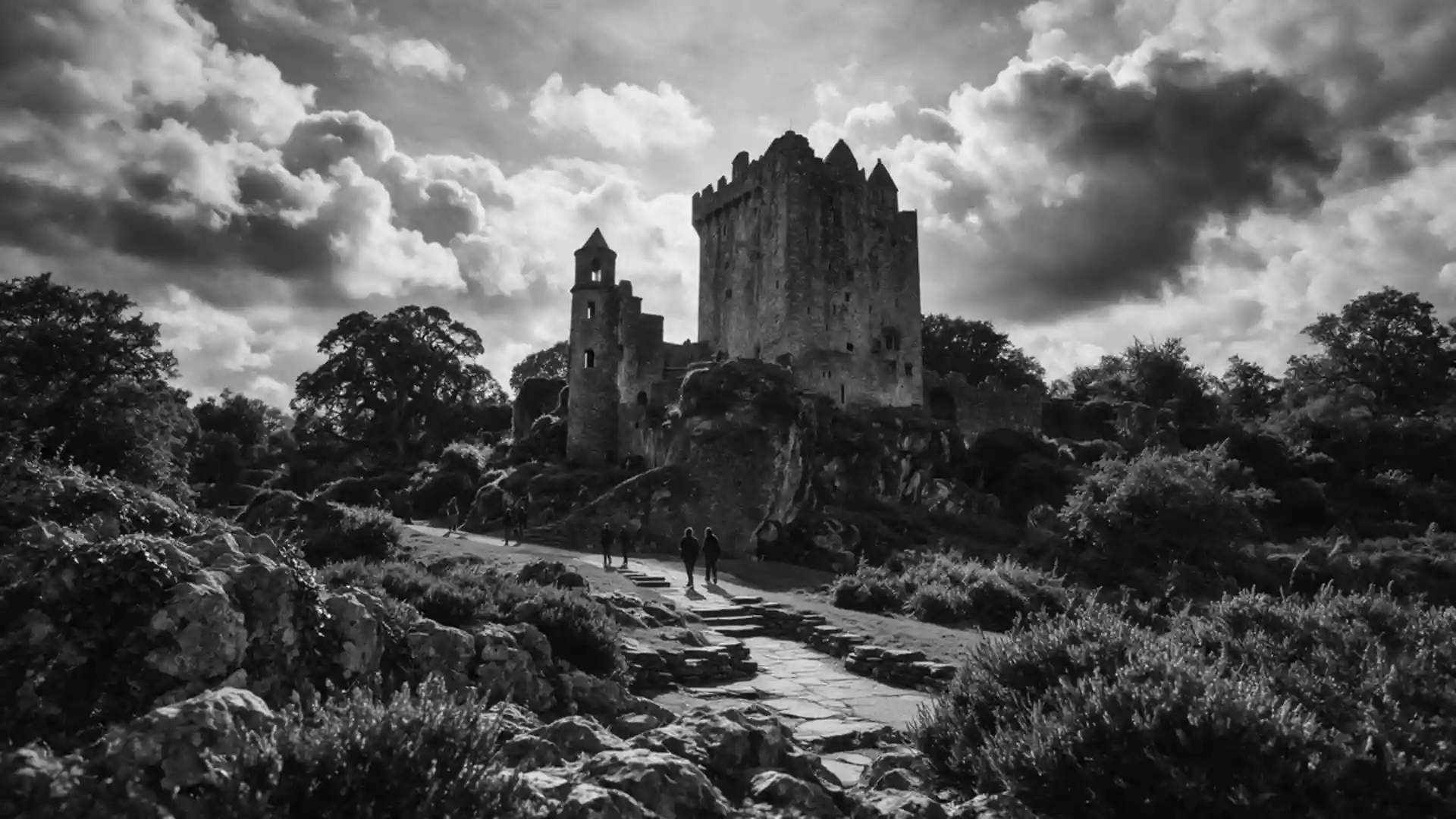
Caislean na Blarnan: a tower house above the River Martin
Published on 09/04/2026 at 11:07 | Editorial responsibility: Rafael Müller, Editor-in-Chief AD HOC NEWS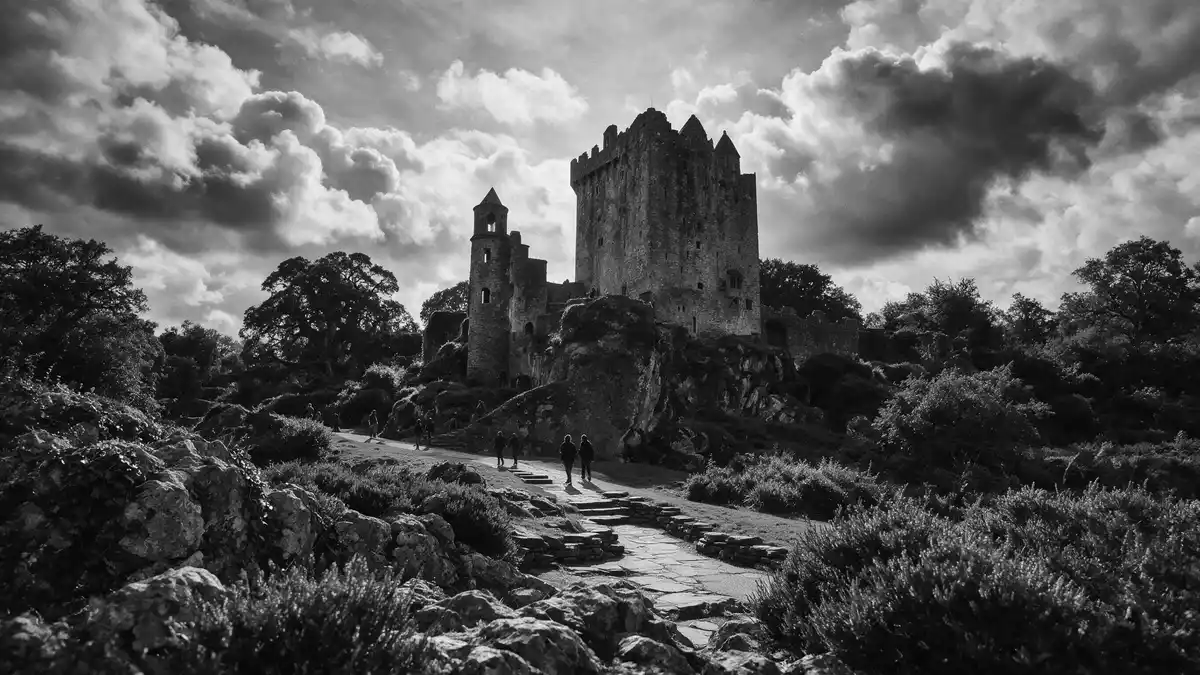
Caislean na Blarnan in Blarney, County Cork, is a late medieval tower house set on a limestone outcrop above the River Martin, surrounded by gardens and old trees. The castle’s current stone keep dates to 1446, when Cormac Láidir MacCarthy of the MacCarthy of Muskerry branch rebuilt the stronghold to create the fortified residence that dominates the estate to this day.
A Gaelic tower house with centuries of fortification
Caislean na Blarnan stands as a tall rectangular tower house, a type of fortified residence associated with Gaelic lords and Anglo-Irish families between the fifteenth and seventeenth centuriestower house. The keep rises above thick limestone walls, with defensive openings and battlements marking its upper edge, and its profile is visible across the surrounding parkland. The present castle is the third major structure on this rock, following an earlier stone stronghold of the early thirteenth century and a timber building linked to the tenth centurythird structure on this site.
The 1446 rebuilding is closely associated with Cormac Láidir MacCarthy, Lord of Muskerry, whose family formed a cadet branch of the Kings of Desmond and held extensive lands in MunsterMacCarthy of Muskerry dynasty. He raised the stone keep on the foundations of the earlier fortress, giving the castle the tall central tower that visitors see. Accounts of the site describe this keep as standing around 26 m (85 ft) high, with substantial wall thickness that underlines its defensive rolestone keep rises approximately 26 metres.
From MacCarthy stronghold to landscaped estate
For several centuries after 1446, Caislean na Blarnan served as a seat of the MacCarthy lords in this part of Munster, anchoring their local power. The stronghold’s role in Irish history includes a siege in 1646 during the Irish Confederate Wars, when Parliamentarian forces under Lord Broghill took the castle; after the Restoration of the monarchy in the seventeenth century it returned for a time to Donough MacCarty, later Earl of Clancartyseized in 1646 and later restored. The Williamite War of the 1690s brought confiscation of the MacCarthy lands, and the estate passed through new owners, including Sir James St John Jefferyes, governor of Cork, whose family shaped the later development of the groundsestate passed to Sir James St. John Jefferyes.
In the eighteenth and nineteenth centuries, the surroundings of Caislean na Blarnan evolved from a defensive setting into an ornamental landscape. The Jefferyes and, later, the Colthurst family developed walks, planted avenues and created formal and informal gardens across the estate, including rock features, standing stones and water elementsgrounds were landscaped in the 18th and 19th centuries. Nearby Blarney House, a Scottish baronial-style mansion completed in 1874, became the main family residence, while the medieval tower remained the visual and historical core of the propertyBlarney House completed in 1874.
The Blarney Stone and the climb through the keep
The most recognisable feature of Caislean na Blarnan is the Blarney Stone, a block of Carboniferous limestone set into the battlements of the tower. Over time, legend has attached to this stone the power to confer eloquence on those who kiss itstone conferring eloquence. One long-standing story connects the stone to the Stone of Scone: it recounts that Robert the Bruce gave part of that coronation stone to Cormac MacCarthy in gratitude for support at the battle of Bannockburn in 1314, and that this fragment became the Blarney Stone built into the castle’s battlementslegend of the Stone of Scone.
Reaching the Blarney Stone involves a climb through the interior of the keep. Visitors ascend a spiral staircase that runs through several storeys, passing stone chambers and the remains of the great hall on the way to the roofspiral stairs and battlements. At the top, the battlements form a walkway around the edges of the tower, with openings in the parapet where the stone sits. To carry out the traditional kiss, visitors lean back over the edge while supported by staff and metal rails, positioning themselves to reach the limestone set into the outer walllean back over the parapet.
Visiting Caislean na Blarnan: what travellers from Western Europe should know
- Caislean na Blarnan stands in Blarney, about north-west of Cork city in the south of Ireland, and is reached by road connections from Cork and other townsBlarney near Cork.
- The approach to the top of the keep involves a narrow spiral staircase with many stone steps, and the battlements are high above the ground with parapet openings beside the Blarney Stoneclimb 127 steps.
- The grounds around the tower house include gardens, rock features and woodland paths, so the terrain ranges from paved walkways to uneven natural surfacesgardens and rock close.
- The official language is Irish and English is widely used, and the currency is the euro.
Searching for Caislean na Blarnan on social platforms
These links open searches for Caislean na Blarnan on each platform.
Frequently asked questions about Caislean na Blarnan
Where is Caislean na Blarnan located?
Caislean na Blarnan stands in the town of Blarney in County Cork, in the south of Ireland, a short distance north-west of Cork city.
What should visitors expect on a visit?
Visitors encounter a tall fifteenth-century stone tower house with a spiral stair to its battlements, extensive gardens and parkland, and the Blarney Stone set high in the parapet.
What makes Caislean na Blarnan distinctive?
The combination of a late medieval Gaelic tower house, the legendary Blarney Stone linked to eloquence, and nineteenth-century landscaped grounds around the castle gives the site its distinctive character.