
Caminito del Rey follows a narrow ledge through limestone gorge
Published on 09/23/2026 at 21:11 | Editorial responsibility: Rafael Müller, Editor-in-Chief AD HOC NEWS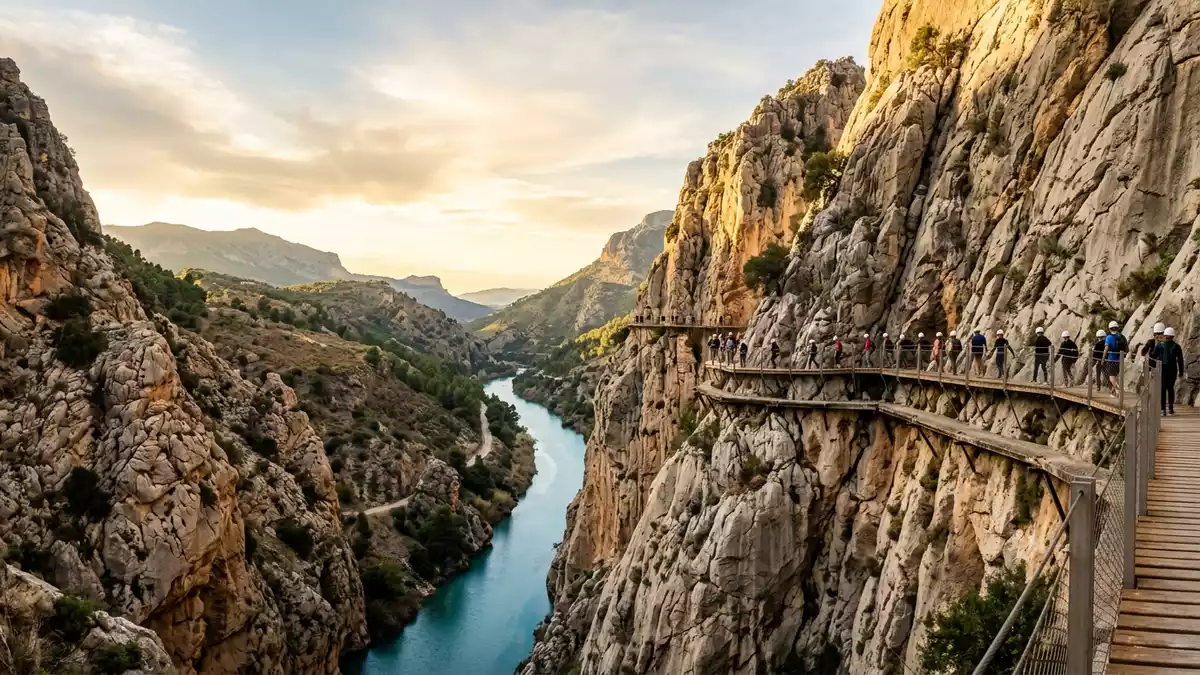
Caminito del Rey is a cliffside route through the Desfiladero de los Gaitanes near Ardales in Málaga Province. Its defining feature is a narrow walkway attached to limestone walls above the Guadalhorce River, linking historical hydroelectric infrastructure with a dramatic gorge landscape.
Caminito del Rey and the walls of the Gaitanes Gorge
The route begins in the municipality of Ardales, passes through Antequera and ends at El Chorro in Álora. The gorge belongs to the western Cordillera Bética, where the Guadalhorce has cut through Jurassic limestone and dolomite.
In some sections, the canyon walls rise more than 300 metres (984 ft), while the narrowest parts measure less than 10 metres (33 ft) across. The combination of vertical rock, water and elevated walkways gives Caminito del Rey its unmistakable setting. The Gaitanes Gorge history is closely connected with the railway and hydroelectric works of the nineteenth and twentieth centuries.
From hydroelectric access route to named walkway
The original path was built by the Sociedad Hidroeléctrica del Chorro between 1901 and 1905. It provided access between the Gaitanejo and El Chorro installations, carrying people and materials along the gorge beside a water channel.
King Alfonso XIII crossed the route in 1921 during the inauguration of the Conde del Guadalhorce dam. The path subsequently became known as Caminito del Rey, meaning the King’s Little Path. Its historical identity therefore combines industrial engineering, royal history and a route fixed directly to the cliff.
The present walkway includes newer timber and concrete sections, steel railings and viewing points above the older path. The historic structure remains visible beside the renovated route, creating a direct physical connection between early twentieth-century infrastructure and the protected visitor path.
A route shaped by limestone, water and elevation
The gorge is about three kilometres long and contains narrow passages, vertical strata and rock faces marked by the Guadalhorce. Cavities occur in the limestone above the river, while reservoirs and hydroelectric structures occupy the wider landscape around the canyon.
Caminito del Rey is not a level promenade. Its walkways cling to cliff faces, cross exposed sections and pass through rock-cut spaces. A suspension bridge spans part of the gorge, and the route includes views towards the river, reservoirs and the old industrial works.
The route’s materials are part of its visual character. Timber decking, concrete, steel and pale limestone appear together along the cliffs. This mixture reveals two distinct phases: the original working path and the later public walkway.
Visiting Caminito del Rey: what travellers from Western Europe should know
- The route begins near Ardales and finishes at El Chorro in Álora. RENFE regional trains serve El Chorro station, which connects with the southern end of the route.
- The walk follows cliffside platforms above the Guadalhorce and includes narrow passages, exposed rock and a suspension bridge. The terrain requires steady walking on elevated paths.
- The complete route includes access sections as well as the cliff walkways. The northern access lies near Ardales, while the southern access is associated with El Chorro.
- The official language is Spanish and the currency is the euro.
Searching for Caminito del Rey on social platforms
These links open searches for Caminito del Rey on each platform.
Frequently asked questions about Caminito del Rey
Where is Caminito del Rey?
Caminito del Rey lies in the Desfiladero de los Gaitanes in Málaga Province. The route starts near Ardales and ends at El Chorro in Álora.
What is the route like?
It is a cliffside walkway through a limestone gorge, with elevated platforms, narrow rock passages, a suspension bridge and views towards the Guadalhorce.
What makes Caminito del Rey distinctive?
The route combines a working path from 1901–1905 with a renovated walkway fixed to the same gorge walls. Its history includes King Alfonso XIII, who crossed it in 1921.


