
Castel Gandolfo above Lake Albano: papal villas in the Alban Hills
Published on 09/15/2026 at 07:04 | Editorial responsibility: Rafael Müller, Editor-in-Chief AD HOC NEWS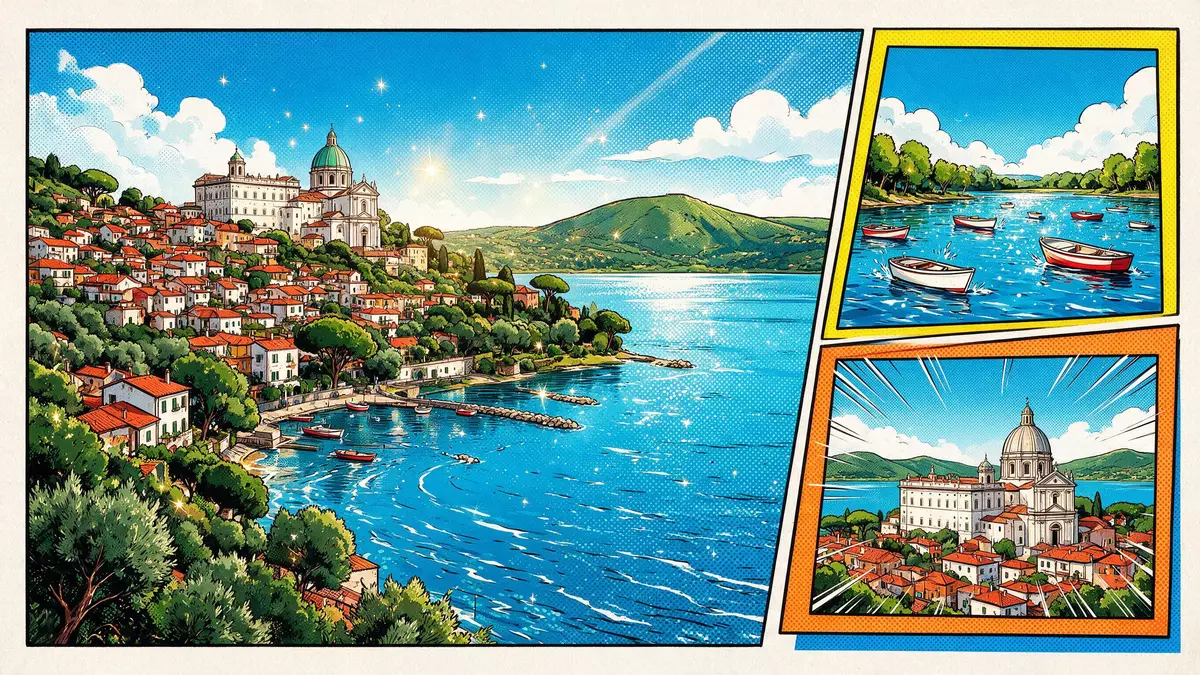
Castel Gandolfo is a small Italian town in the Alban Hills south of Rome, known for its hilltop setting above Lake Albano and the historic papal villas that overlook the water. The palace complex became a summer residence for the popes in the seventeenth century and later formed part of the extraterritorial properties of the Holy See in Italy, giving the town a close association with the Vatican that is visible in its architecture and gardens.
A hill town over a volcanic lake
The town of Castel Gandolfo stands on the rim of an ancient volcanic crater, looking down onto the deep basin of Lake Albano. The lake lies in the Alban Hills, a range of volcanic heights just south of Rome, and gives the town a strong sense of verticality, with the compact historic centre above and the shoreline below.Alban Hills just south of Rome The position on the crater rim means that streets and viewpoints in Castel Gandolfo frequently open towards long views across the water and towards the wooded slopes that ring the lake.
Lake Albano itself has a nearly enclosed form, its shores rising steeply to the surrounding hills, so many visitors experience Castel Gandolfo as a layered landscape of water, forest and stone. On the upper level sit the town’s piazzas, churches and the papal villas, while paths and roads descend towards lakeside promenades and small harbours along the shore. The contrast between the intimate historic streets and the wide volcanic basin is one of the most characteristic features of the place.
From imperial villa to papal summer residence
The area around Castel Gandolfo was already valued in Roman times, when Emperor Domitian established a villa in this part of the Alban Hills, reflecting the longstanding appeal of the location’s elevation and climate.ancient villa of Emperor Domitian The modern town later became closely linked with the papacy: Castel Gandolfo entered the domain of the Holy See in the early seventeenth century, and the construction of the Apostolic Palace created a dedicated summer residence for the pontiff above the lake.inalienable domain of the Holy See in 1608
Pope Urban VIII, who reigned from 1623 to 1644, is associated with the development of the papal residence at Castel Gandolfo in the first decades of the seventeenth century, working with architect Carlo Maderno to incorporate existing buildings into a new complex.designs by Carlo Maderno between 1624 and 1626 Over the following centuries, successive popes continued to use Castel Gandolfo as a seasonal retreat, and the villas evolved into a substantial estate with formal gardens, farm land and technical facilities. The Lateran Treaty of 1929 between the Holy See and Italy reaffirmed the status of the pontifical villas at Castel Gandolfo as an extraterritorial property, consolidating their role within the wider map of Vatican-owned sites in Italy.Lateran Treaty between the Holy See and Italy
The papal villas and gardens above Lake Albano
Within the boundaries of Castel Gandolfo lies a network of papal properties known as the Pontifical Villas, covering an area of about 55 hectares in and around the town. These include the Apostolic Palace, Villa Barberini and Villa Cybo, together forming a complex of residences, gardens and agricultural land that spreads along the crest above Lake Albano.Pontifical Villas cover over 55 hectares The villas sit in landscaped grounds with tree-lined avenues, flower beds and terraces that reflect Italian garden traditions, while the surrounding farmland has long supplied produce to the papal household.
The Papal Palace of Castel Gandolfo, sometimes referred to as the Apostolic Palace of Castel Gandolfo, forms the principal residential building within this complex and stands near the town’s central square.Papal Palace of Castel Gandolfo The complex has included a Vatican Observatory, known as the Specola Vaticana, as well as technical facilities and staff housing, underlining the self-contained character of the estate.Pontifical Villas comprise about 55 hectares In the twenty-first century the main palace building has taken on a museum role, allowing visitors to see state rooms and private apartments that once served as the setting for papal retreats.
Castel Gandolfo as a town of churches, piazzas and views
Beyond the papal villas, Castel Gandolfo retains the scale and texture of a small Italian town, with narrow streets, modest townhouses and a central piazza framed by civic and religious buildings. The historic centre includes churches from different periods, some with façades facing directly onto the main square, together with cafés and shops that occupy the ground floors of older structures. The stone paving, arcades and masonry give the town a continuity of materials, linking its everyday fabric to the more formal architecture of the papal palace.
Several routes lead from the town down towards the lake, where promenades and small harbours mark the shoreline. From these lower points, travellers see the town rising above the tree line, with the façades of the palace and other buildings forming a backdrop to moored boats and terraces. The combination of a crater lake, wooded slopes and historic architecture makes Castel Gandolfo a place where landscape and built form are closely intertwined, whether viewed from the hilltop streets or from the water’s edge.
Visiting Castel Gandolfo: what travellers from Western Europe should know
- Castel Gandolfo lies in the Lazio region of Italy, in the Alban Hills south of Rome, and is reached by regional rail and road links from the capital.
- The historic centre stands on the rim of the volcanic crater above Lake Albano, with steep streets and stairways connecting the upper town to viewpoints and routes towards the lakeside.
- The town is surrounded by wooded hills and the shore of Lake Albano, so short walks involve changes in elevation and transitions between paved streets and more natural terrain.
- The official language is Italian and the currency is the euro.
Searching for Castel Gandolfo on social platforms
These links open searches for Castel Gandolfo on each platform.
Frequently asked questions about Castel Gandolfo
Where is Castel Gandolfo located?
Castel Gandolfo is in the Lazio region of Italy, in the Alban Hills south of Rome, overlooking the volcanic basin of Lake Albano.
What can travellers expect on a visit?
Travellers encounter a compact hill town with churches and piazzas, the papal villas above the lake, and paths that descend towards promenades and small harbours on the shoreline.
What makes Castel Gandolfo distinctive?
The combination of the Apostolic Palace and other papal villas, their extraterritorial status linked to the Holy See, and the town’s position on the crater rim above Lake Albano gives Castel Gandolfo a distinctive character.


