
Castelul Peles and its carved timber architecture
Published on 09/23/2026 at 18:57 | Editorial responsibility: Rafael Müller, Editor-in-Chief AD HOC NEWS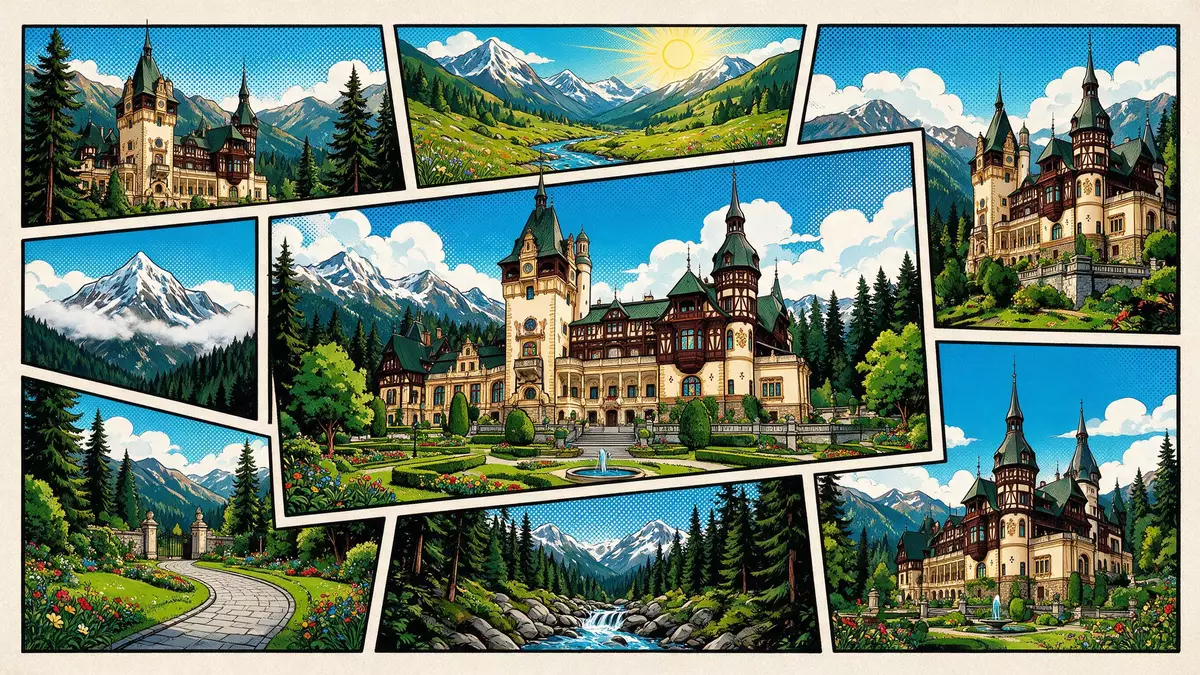
Castelul Peles rises above Sinaia in the Carpathian foothills as a palace assembled from masonry, carved timber and richly decorated interiors. Built for King Carol I of Romania, it combines German Neo-Renaissance forms with Italian, Gothic, Baroque and Moorish-Ottoman details.
Castelul Peles: a palace of wood, stone and plaster
The castle belongs to the Royal Domain of Sinaia, near the Bucegi Mountains. Its exterior is marked by steep roofs, projecting volumes, towers, balconies, gables and extensive carved timber set within the masonry.
The building uses wood, stone, brick and marble across its exterior and interior. The irregular arrangement of parts gives the palace a varied outline, while vertical architectural elements connect the lower masonry with the upper timber decoration. Its German Neo-Renaissance exterior belongs to the late nineteenth-century architectural culture of Central Europe.
Carol I and the making of a royal residence
Construction began in 1873, after the future site entered the royal domain. King Carol I initiated the project, and the settlement associated with the residence received the name Sinaia in 1874.
Wilhelm von Doderer prepared the initial plans, while Johannes Schultz directed the first principal phase between 1879 and 1883. The castle was inaugurated in 1883, and construction, alterations and additions continued until 1914. Karel Liman worked on the later phase, which changed the appearance and scale of the completed ensemble. This sequence is recorded in the castle’s architectural history.
Castelul Peles served as the summer residence of Carol I and Queen Elisabeth. It also functioned as a place for state ceremonies, royal representation and cultural activity. Carol II, the first heir to the Romanian throne, was born at the castle.
Rooms where European styles meet
The interior does not follow one decorative language. German Neo-Renaissance appears beside Italian Renaissance references, Austrian Baroque, French Rococo, Moorish-Ottoman decoration and Art Nouveau elements.
The Hall of Honour contains carved wood and elaborate decorative work. Other named spaces include the Florentine Room, the Moorish Room, the Turkish Room, the Council Room, the Concert Hall and the armoury rooms. The building also contains royal apartments and rooms associated with official guests.
Paintings, tapestries, sculptures, furniture, arms, books, carpets, ceramics and stained glass form part of the collections connected with the palace. The holdings include works by Gustav Klimt, Franz Matsch and Ernst Klimt, whose interior commissions date from 1883 to 1886.
Castelul Peles became a museum in 1953. The institution’s collections include the palace furnishings as well as decorative and historical objects gathered by the Romanian royal family. The museum collection overview records paintings, furniture, arms, medals, sculptures, stained glass and books.
The palace therefore works as both architecture and museum. Its rooms preserve the atmosphere of a royal residence, while their contents show the artistic networks of nineteenth-century Romania and the wider European courts.
Visiting Castelul Peles: what travellers from Western Europe should know
- Castelul Peles stands above Sinaia in Prahova County, at the foot of the Bucegi Mountains. Trains reach Sinaia on the Bucharest–Brasov railway corridor, followed by an uphill route through the town.
- The approach from Sinaia station rises towards the royal estate. Comfortable walking footwear is useful because the final route includes an ascent on wooded slopes.
- The official language is Romanian and the currency is the Romanian leu.
Searching for Castelul Peles on social platforms
These links open searches for Castelul Peles on each platform.Frequently asked questions about Castelul Peles
Where is Castelul Peles?
Castelul Peles is in Sinaia, Romania, on the wooded slopes below the Bucegi Mountains. The palace belongs to the historic Royal Domain of Sinaia.
What can visitors expect inside?
The interior contains decorated halls, royal apartments, armouries and museum displays. Collections include furniture, paintings, arms, books, textiles, sculpture and stained glass.
What makes Castelul Peles distinctive?
Its identity comes from the combination of German Neo-Renaissance architecture and extensive carved timber. The interior adds several European decorative traditions within a single royal palace.


