
Catedral de Leon, a vast Baroque–Neoclassical landmark in Nicaragua
Published on 09/10/2026 at 08:32 | Editorial responsibility: Rafael Müller, Editor-in-Chief AD HOC NEWS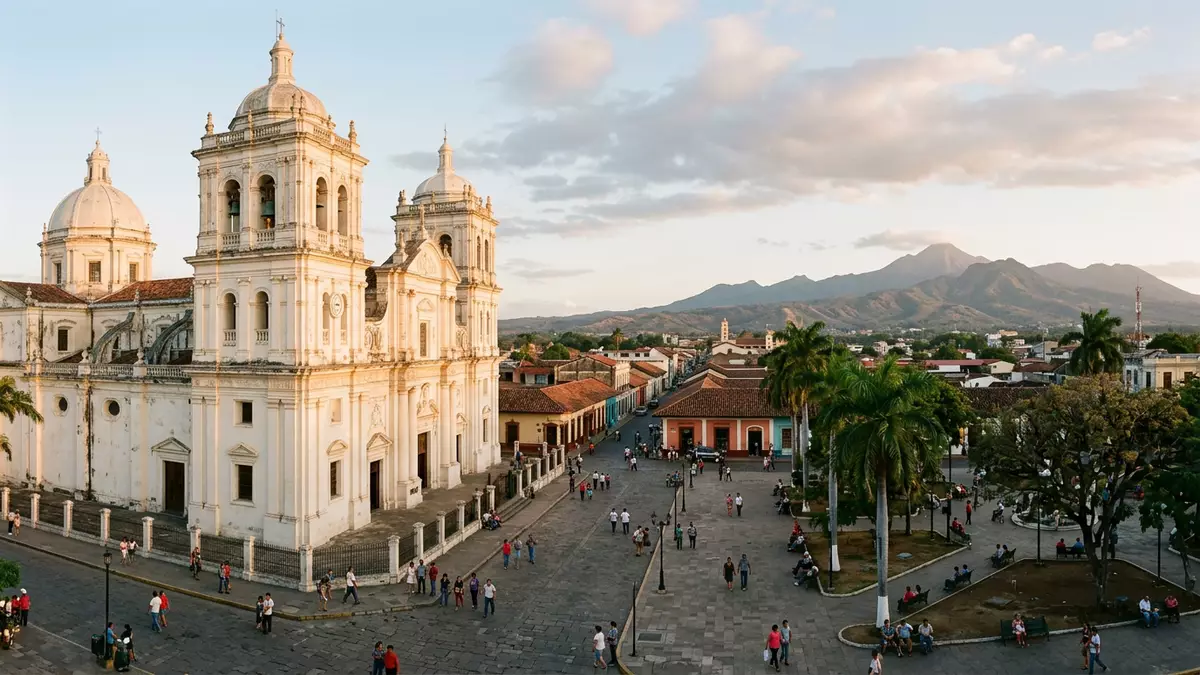
Catedral de Leon in western Nicaragua is a monumental Catholic cathedral that fills an entire urban block in the historic centre of Leon and anchors the city’s main square. Conceived in the eighteenth century and completed in 1814, it reflects a long construction period in which late Baroque forms merge with emerging Neoclassical lines in one vast basilica dedicated to the Assumption of Mary.Constructed between 1747 and the early nineteenth century
A cathedral that occupies an entire city block
The official name of the building is Insigne y Real Basílica Catedral de la Asunción de la Bienaventurada Virgen María, signalling its status as both cathedral and basilica within the Roman Catholic hierarchy.Royal and renowned basilica cathedral of the Assumption The cathedral stands in the historic centre of Leon, facing the Plaza Juan José Quezada, and together with its open parvis it forms an entire urban block set within the colonial grid of streets.The inscribed property covers a full city block including the cathedral and its forecourt
The plan follows a basilica layout of Spanish derivation, with a long rectangular nave flanked by side aisles and chapels and terminated by a raised sanctuary. The structure extends to a length of about 105.8 m (347 ft) and a width of about 57.1 m (187 ft), making it one of the largest churches in Central America in terms of footprint.105.83 m long by 57.13 m wide Massive exterior walls and a series of towers give the building a compact, block-like presence when seen from the surrounding streets.
From Baroque exuberance to Neoclassical restraint
The cathedral was built between 1747 and the early nineteenth century, a period when Spanish colonial architecture in Central America was moving from exuberant Baroque towards a more sober Neoclassical language.Transition from late Baroque to Neo-Classic Its architect is recorded as Diego José de Porres Esquivel, a Guatemalan designer who worked on several significant religious buildings in the region and whose designs show an awareness of changing tastes.Designs of the architect Diego José de Porres Esquivel
On the outside, heavy buttresses, rounded towers and robust cornices evoke Baroque massing, while the main façade and interior altars employ straighter lines and restrained ornament that align with Neoclassical ideals. Inside, the high nave is carried on strong piers and arches, with relatively austere wall surfaces that emphasise the scale of the volume rather than elaborate decoration. This mixture of colonial Baroque structure and Neoclassical detailing is one of the reasons León Cathedral was inscribed on the UNESCO World Heritage List in 2011 under criteria (ii) and (iv).Inscribed as a World Heritage property in 2011
Artworks, burials and the view over Leon
Within its large interior, Catedral de Leon houses significant religious artworks that reflect both European influence and Nicaraguan production. A notable feature is a Flemish altar, an imported work that anchors one of the chapels and links the cathedral to wider artistic networks of the Catholic world.Presence of a Flemish altar inside the cathedral Along the walls, paintings depicting the fourteen stations of the Via Crucis were executed at the turn of the twentieth century by the Nicaraguan artist Antonio Sarria, adding a local artistic layer to the building’s devotional programme.Via Crucis paintings by Antonio Sarria
The cathedral also serves as a place of honour for important figures in Nicaragua’s cultural history. The tomb of the poet Rubén Darío lies within its interior, making the building not only a religious centre but also a site where national memory is physically embedded in stone.Presence of the tomb of Rubén Darío Above the main body of the cathedral, accessible upper levels and terraces offer outward views over the low-rise colonial cityscape of Leon and towards the volcanic landscape that surrounds the region, emphasising the building’s role as a literal and symbolic high point of the city.
Visiting Catedral de Leon: what travellers from Western Europe should know
- Catedral de Leon stands in the historic centre of Leon in western Nicaragua, occupying an entire city block beside the Plaza Juan José Quezada. The city is reached overland from Managua and other Nicaraguan centres.
- The interior covers a large area with wide stone floors and substantial piers; upper levels and rooftop terraces are reached by staircases that can be long and steep.
- Nearby, the Central Market, the Episcopal Palace, the Mausoleum of Heroes and Martyrs, the Museum of the Revolution and the church of La Merced all lie within a short walk of the cathedral.
- The official language is Spanish and the currency is the Nicaraguan córdoba.
- Entry requirements depend on your nationality; UK travellers can check the FCDO travel advice at gov.uk/foreign-travel-advice, Irish travellers the Department of Foreign Affairs at ireland.ie.
Searching for Catedral de Leon on social platforms
These links open searches for Catedral de Leon on each platform.Frequently asked questions about Catedral de Leon
Where is Catedral de Leon located?
Catedral de Leon is located in the historic centre of Leon, a city in western Nicaragua, occupying an entire urban block beside the Plaza Juan José Quezada.
What can visitors expect inside Catedral de Leon?
Visitors encounter a vast basilica interior with high vaults, substantial stone piers, chapels containing artworks such as a Flemish altar and Via Crucis paintings, and the tomb of Rubén Darío.
What makes Catedral de Leon distinctive among Central American churches?
Its scale, the merger of late Baroque structure and Neoclassical detailing, its recognised World Heritage status and its role as both religious centre and cultural monument distinguish León Cathedral within Central America.


