
Catedral de Puebla and its stone towers above the Zócalo
Published on 09/24/2026 at 08:50 | Editorial responsibility: Rafael Müller, Editor-in-Chief AD HOC NEWS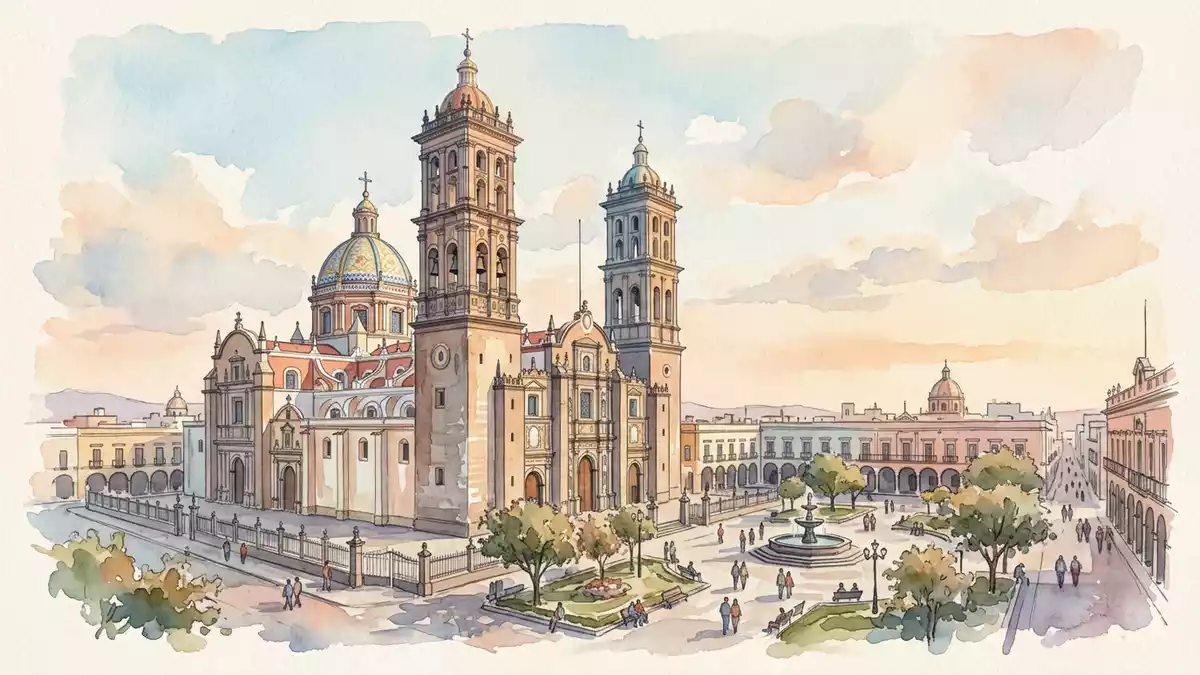
Catedral de Puebla rises beside the Zócalo with a broad stone façade and twin towers that define the city’s central square. Francisco Becerra began the present cathedral in 1575, and Bishop Juan de Palafox y Mendoza consecrated it in 1649. Its long building history remains visible in the meeting of Renaissance planning, later Baroque decoration and eighteenth-century additions.
Catedral de Puebla: a cathedral built across centuries
The cathedral belongs to Puebla’s Historic Centre, a planned colonial city founded in 1531. The World Heritage property includes major religious buildings, civic structures, palaces and tiled houses, with Catedral de Puebla forming its principal religious landmark beside the Zócalo. Puebla’s historic centre entered the World Heritage List in 1987.
Construction began under the Spanish crown during the reign of Philip II. Francisco Becerra served as architect, with Juan de Cigorondo associated with the early work. The building was consecrated on 18 April 1649, while further work continued on the exterior and towers. This sequence gives the cathedral a layered appearance instead of a single-period design.
Stone façades, Renaissance planning and tall towers
The exterior uses a restrained stone vocabulary, with ordered columns, carved portals and a broad front facing the square. Its architectural character is associated with the Herrerian tradition, a late Renaissance language linked to Spanish buildings of the sixteenth and seventeenth centuries.
The cathedral’s plan follows a Latin cross and contains five naves. The north tower was completed in 1678, while the south tower reached completion in 1768. Both towers rise to roughly 70 metres, giving the building a strong vertical profile above Puebla’s lower historic streets. the cathedral’s stone towers belong to the later stages of the complex.
Viewed from the Zócalo, the façade and towers form a single composition, while the construction dates reveal several generations of work. The exterior therefore carries both the order of a Renaissance church and the accumulated detail of a building completed in stages.
Inside Catedral de Puebla: chapels, paintings and El Ciprés
The interior is arranged around a central nave, side aisles and chapels opening from the main body of the church. Fourteen side chapels contain altarpieces, paintings, sculptures and devotional objects. Their different decorations add smaller architectural settings within the larger stone interior.
The principal altar, known as El Ciprés, was designed by Manuel Tolsá at the end of the eighteenth century. Its structure includes columns, sculpture and silver and bronze details. The Altar of the Kings, the sacristy and the Octagonal Chapel are other named features of the interior.
Paintings by Cristóbal de Villalpando form part of the cathedral’s artistic heritage. The choir contains marquetry using precious woods, onyx and ivory, while two historic organs are associated with the cathedral’s musical tradition. the cathedral’s chapels and artworks show how religious architecture and craftsmanship developed together in Puebla.
Visiting Catedral de Puebla: what travellers from Western Europe should know
- Catedral de Puebla stands beside the Zócalo in Puebla’s Centro Histórico, at the intersection of Avenida 16 de Septiembre and Calle 3 Oriente.
- The cathedral is reached through Puebla’s historic central streets. Its setting places the building beside the main square and within walking range of colonial churches, civic buildings and tiled façades.
- The interior contains stone paving, steps, side chapels and a high vaulted central space. Visitors should expect a religious building rather than a single open exhibition hall.
- The official language is Spanish and the currency is the Mexican peso.
- Entry requirements depend on your nationality; UK travellers can check the FCDO travel advice at gov.uk/foreign-travel-advice, Irish travellers the Department of Foreign Affairs at ireland.ie.
Searching for Catedral de Puebla on social platforms
These links open searches for Catedral de Puebla on each platform.Frequently asked questions about Catedral de Puebla
Where is Catedral de Puebla?
Catedral de Puebla stands beside the Zócalo in the Centro Histórico of Puebla, Mexico. Its address is associated with Avenida 16 de Septiembre and Calle 3 Oriente.
What can visitors expect inside?
The interior contains a central nave, side aisles, fourteen chapels, historic organs, paintings and decorated altarpieces. El Ciprés, designed by Manuel Tolsá, forms the principal altar.
What makes the cathedral distinctive?
Its identity comes from the combination of a 1575 foundation, a 1649 consecration, twin towers completed in different centuries and an interior filled with named works of art.


