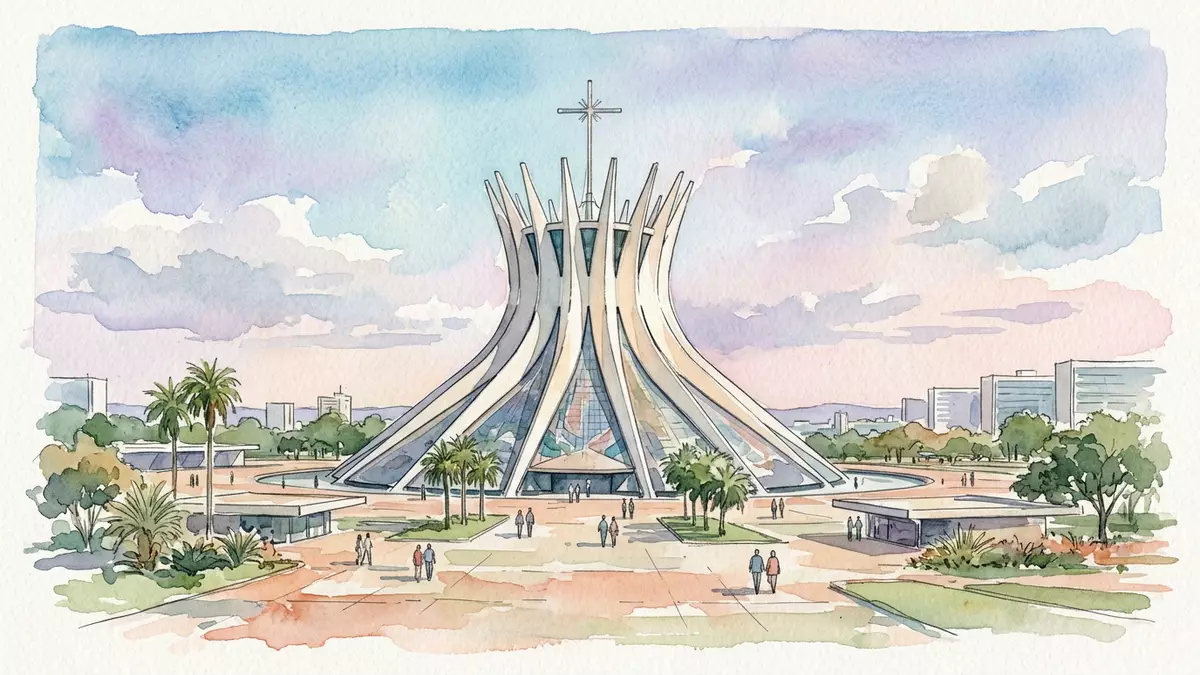
Catedral Metropolitana de Brasilia and its concrete crown
Published on 08/08/2026 at 15:05 | Editorial responsibility: Rafael Müller, Editor-in-Chief AD HOC NEWS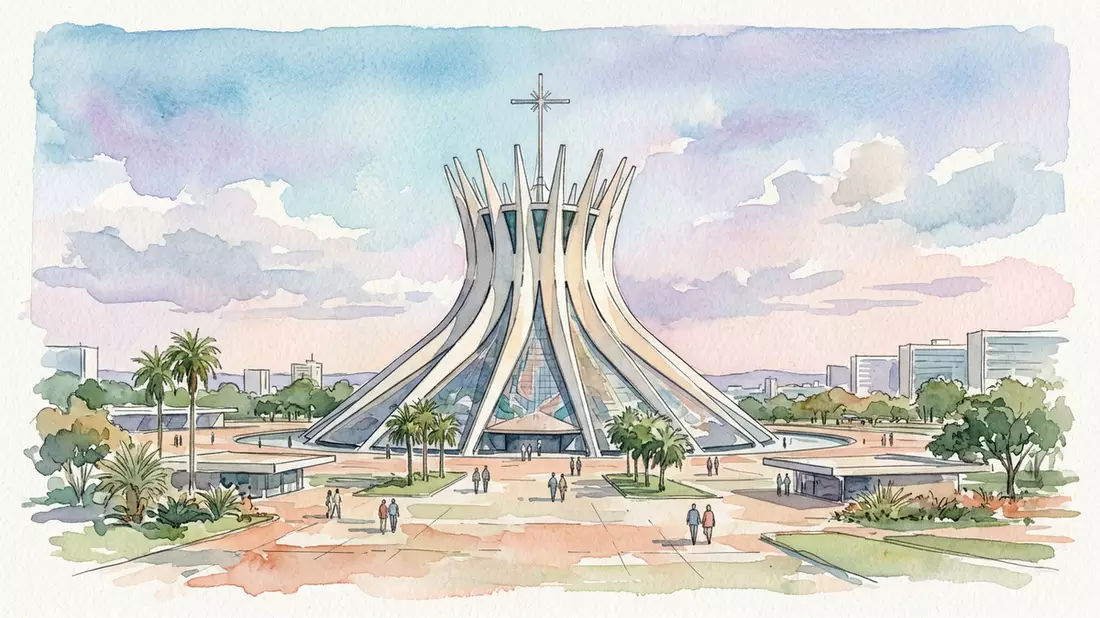
Catedral Metropolitana de Brasilia rises as a concrete ring in the capital of Brazil, with sixteen curved columns leaning together above a glazed nave. Designed by Oscar Niemeyer and opened in 1970, it is one of the clearest expressions of the city’s modernist centre.
Oscar Niemeyer’s concrete ring in Brasilia
The cathedral sits within Brasilia’s planned civic landscape and is one of the city’s best-known modern buildings. Its reinforced-concrete structure forms a low, open crown rather than a conventional towered church.
Four sculptural bronze figures by Dante Croce stand at the entrance, and the building is reached by a submerged access level that leaves the upper structure visually isolated. The effect is architectural rather than decorative: concrete, glass, and a broad surrounding basin dominate the view.
Glass, sculpture and the interior approach
Inside, the nave is lined with stained glass by Marianne Peretti, with blue, green, white, and brown tones spread across the curved enclosure. Three suspended angels by Alfredo Ceschiatti hang above the central space, adding vertical movement to the otherwise low profile of the building.
The altar stands beneath the glazed roof and the interior retains a calm, geometric clarity. The building’s circular plan and sloping supports make the structure legible from almost every angle, from the entrance level to the surrounding plaza.
A modernist landmark in the federal capital
Catedral Metropolitana de Brasilia belongs to the first generation of buildings associated with Brasilia, the new federal capital inaugurated in 1960. Niemeyer’s cathedral sits alongside the city’s broader modernist ensemble and shows the same confidence in concrete, sculptural form, and open space.
The building was consecrated in 1970 and later gained formal heritage recognition as part of the central urban fabric of Brasilia. Its most memorable feature is not size, but the way the structure reads as both church and sculpture from the outside.
Visiting Catedral Metropolitana de Brasilia: what travellers from Western Europe should know
- The cathedral stands in central Brasilia, within the civic axis of the federal capital, and is reached by road and local transport.
- Admission and opening hours are set by the site's operator and change with the season; the official website is the only binding source.
- A visit works well in bright daylight, when the glass and concrete are easiest to read.
- Access involves steps and a lower approach level, so visitors with limited mobility should expect uneven movement between levels.
- Portuguese is the main language on site, and cashless payment is widely used in the city.
- Entry requirements depend on your nationality. UK travellers should check the FCDO travel advice at gov.uk/foreign-travel-advice; Irish travellers the Department of Foreign Affairs at ireland.ie; EU and EEA citizens their own national foreign ministry.
Searching for Catedral Metropolitana de Brasilia on social platforms
These links open searches for Catedral Metropolitana de Brasilia on each platform.
Frequently asked questions about Catedral Metropolitana de Brasilia
Where is Catedral Metropolitana de Brasilia?
It stands in central Brasilia, within the city’s civic core. The cathedral is part of the modernist plan that shapes the federal capital.
What should visitors expect?
Expect concrete, glass, sculpture, and a lower approach level before reaching the nave. The building reads as an architectural space as much as a place of worship.
What makes it distinctive?
Its crown-like concrete structure is the defining feature, along with the stained glass and suspended angels inside. Oscar Niemeyer’s design gives the cathedral its unmistakable modernist profile.