
Centro Historico de Cuenca and its Andean street grid
Published on 09/24/2026 at 04:13 | Editorial responsibility: Rafael Müller, Editor-in-Chief AD HOC NEWS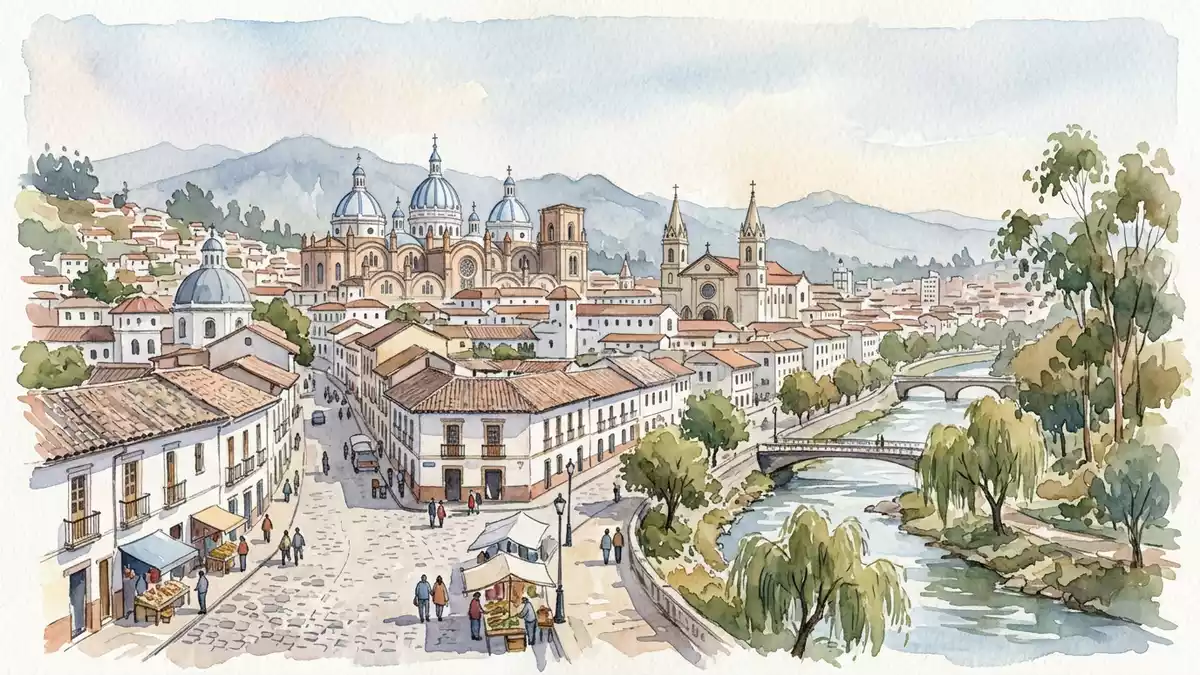
Centro Historico de Cuenca is a planned Andean cityscape where straight streets, riverside terraces and low-rise buildings meet. Founded in 1557, the historic centre preserves an orthogonal street plan alongside churches, civic buildings and houses shaped by colonial and republican periods.
Centro Historico de Cuenca: a grid across the Andes
Cuenca lies in Azuay province, in southern Ecuador, within a valley surrounded by the Andes. Rivers including the Tomebamba, Yanuncay, Tarqui and Machangara cross the wider urban landscape, while the historic centre occupies the plateau and its edges.
The city’s formal name is the Historic Centre of Santa Ana de los Ríos de Cuenca. Its streets meet at regular junctions, forming blocks around squares and public spaces. The plan reflects Renaissance urban principles brought into Spanish colonial towns in the Americas, while the surrounding landscape belongs to an older Andean setting.
UNESCO identifies Cuenca as a planned inland Spanish town with an original orthogonal plan preserved across more than four centuries. The World Heritage listing records the historic centre as a cultural site.
Parque Calderón and the city’s layered architecture
Parque Calderón forms the principal civic square within the historic centre. Municipal buildings, the Governor’s Office, courts and religious buildings occupy the surrounding urban fabric, placing political, judicial and religious architecture close together.
The two cathedrals facing the square express different architectural periods. The Old Cathedral, known as El Sagrario, belongs to Cuenca’s colonial history. The New Cathedral, begun in 1885, introduces a larger nineteenth-century presence with domes, towers and masonry surfaces.
Other significant buildings include the Carmelite Monastery and Santo Domingo Church. Across the streets, rendered façades, timber balconies, carved portals and tiled roofs appear beside courtyards, cloisters and chapels. The centre’s architecture includes baroque and neoclassical details, as well as republican and early modern additions.
Much of Cuenca’s surviving architecture dates from the eighteenth century. During the nineteenth century, prosperity connected with quinine, straw hats and other exports brought changes to houses and civic buildings. A guide to Cuenca architecture sets these buildings within pre-Hispanic, colonial and republican layers.
El Barranco, Pumapungo and the older Andean city
At the southern edge of the historic centre, the ground falls towards the Río Tomebamba. El Barranco occupies this riverside zone, where houses, terraces, retaining walls and paths mark the transition between the urban plateau and the watercourse.
The heritage area also includes Pumapungo, an archaeological site associated with the Inca settlement of Tomebamba. Nearby remains connect Cañari, Inca and Spanish histories within the same urban landscape. These traces are not separate from Cuenca’s identity; they form part of the historical layers represented by the centre.
Cuenca was declared national cultural heritage in 1982. On 1 December 1999, UNESCO inscribed the Historic Centre of Santa Ana de los Ríos de Cuenca on the World Heritage List, recognising its planned urban form and the interaction of Spanish, Cañari and Inca cultural elements.
The designation covers the historic urban fabric, archaeological areas and old access corridors. It also includes a large inventory of heritage buildings, ranging from monumental structures to ordinary houses that complete the character of the streets.
Visiting Centro Historico de Cuenca: what travellers from Western Europe should know
- Centro Historico de Cuenca lies in Cuenca, in Azuay province, southern Ecuador. Road connections and flights through regional airports link the city with other parts of the country.
- Walking involves paved streets, pavements, slopes towards the Río Tomebamba and stairways between El Barranco and lower riverside paths.
- The official language is Spanish and the currency is the US dollar.
- Entry requirements depend on your nationality; UK travellers can check the FCDO travel advice at gov.uk/foreign-travel-advice, Irish travellers the Department of Foreign Affairs at ireland.ie.
Searching for Centro Historico de Cuenca on social platforms
These links open searches for Centro Historico de Cuenca on each platform.
Frequently asked questions about Centro Historico de Cuenca
Where is Centro Historico de Cuenca?
It is the historic centre of Cuenca, in Azuay province in southern Ecuador. The city lies in an Andean valley crossed by several rivers.
What can visitors see there?
The centre contains a planned street grid, Parque Calderón, two cathedrals, monasteries, churches, civic buildings, courtyards and riverside architecture.
What makes the historic centre distinctive?
Its sixteenth-century orthogonal plan remains visible across the city. Colonial, Cañari, Inca, republican and later architectural layers share the same urban setting.


