
Charminar: four soaring minarets at Hyderabad’s historic crossroads
Published on 09/14/2026 at 17:50 | Editorial responsibility: Rafael Müller, Editor-in-Chief AD HOC NEWS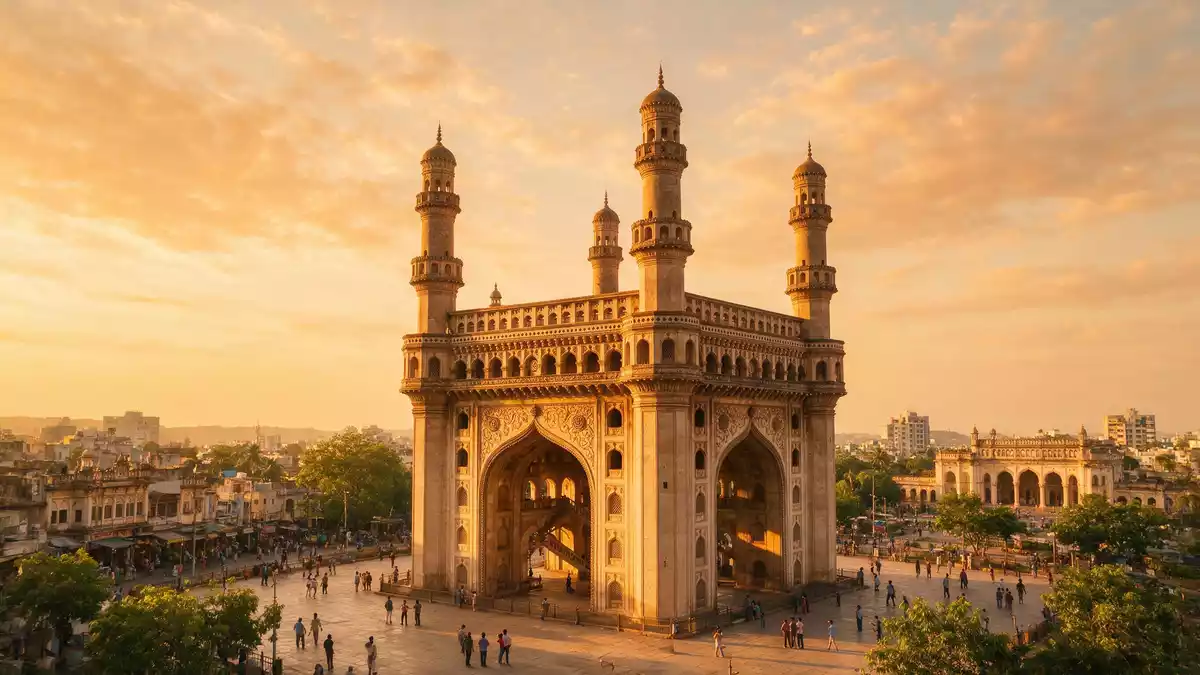
Charminar in Hyderabad is a late sixteenth-century monument where four tall minarets rise from a square base above a bustling crossroads in the old city. Built in 1591 under Sultan Muhammad Quli Qutb Shah of the Qutb Shahi dynasty, it combines monumental arches with an elevated mosque and has become closely associated with Hyderabad’s identity.
Charminar as the heart of a planned Qutb Shahi capital
Charminar stands in the historic core of Hyderabad in the Indian state of Telangana, at the point where the principal streets of the old city intersect. When Muhammad Quli Qutb Shah shifted his capital from the fortress of Golconda to the new city in 1591, Charminar was raised as one of the first major structures at this central crossingin 1591 under Muhammad Quli Qutb Shah. Around it, an orthogonal street layout took shape, with routes radiating in four directions from the arches of the monumentwhere four streets meet beneath its arches.
The structure dates from the period when the Qutb Shahi dynasty ruled the Deccan region from the late sixteenth century, and it is firmly associated with that line of sultans. The monument’s name, combining the Urdu and Persian words for “four” and “minarets”, reflects its defining feature, while its square form and arcades align with Indo-Islamic architecture with strong Persian influencesIndo-Islamic architecture with Persian elements. The square plan and its integration into the street network remain legible when approached from any side through the surrounding markets.
Four minarets, grand arches and an elevated mosque
Charminar’s architectural character centres on a square block pierced by four grand pointed arches, each oriented toward one of the main streets of the old city. From the four corners rise slender minarets divided into storeys by projecting balconies and crowned by domes on petal-like bases, a motif associated with Qutb Shahi buildingsfour minarets with petal bases and balconies. Each minaret is reached by an internal spiral staircase, and together they give the monument its vertical emphasis above the surrounding neighbourhood.
The building is constructed from granite and lime mortar, with plasterwork that carries ornamental detail over its surfacesgranite and limestone mortar with stucco ornament. Above the arches, an arcade wraps around the upper level, where a mosque occupies the western side of the platform. This elevated mosque has a row of prayer niches aligned toward Mecca, making Charminar both a civic landmark and a place of worshipa mosque on the western upper level. The combination of thoroughfare, viewing platform and religious space is a defining aspect of the building’s use.
A monument framed by markets and later city growth
Charminar stands within Ghansi Bazaar and the Char Kaman area of Hyderabad, close to the Musi River and surrounded by tightly packed streets. Its arches frame views into the neighbouring districts, and the elevated galleries offer perspectives over the rooflines of the old citylocation in Char Kaman and Ghansi Bazaar. The monument’s presence has influenced the way commercial streets and residential lanes cluster around its base, creating a dense urban fabric that contrasts with the ordered geometry of the structure itself.
Over the centuries, newer districts of Hyderabad have expanded beyond the original Qutb Shahi core, yet Charminar retains its role as a visual marker for the historic centre. It has been incorporated into emblems for Telangana, and its silhouette with four minarets has become closely linked with the city’s public imagesymbol of Hyderabad and part of the Telangana emblem. Standing on the crossing under its arches gives a clear sense of how this single structure anchors the surrounding neighbourhood and provides a fixed point amid the movement of traffic and pedestrians.
Visiting Charminar: what travellers from Western Europe should know
- Charminar is in the Char Kaman and Ghansi Bazaar area of Hyderabad in Telangana, India, south of the Musi River, reached by city roads converging on Charminar Road.
- The monument rises above a busy street junction, with approaches on foot through narrow lanes and arcades; staircases inside the structure are confined and climb several storeys.
- The surrounding old city streets host markets and dense building fronts, so moving between Charminar and nearby neighbourhoods involves navigating crowded urban terrain rather than wide boulevards.
- The official language is Hindi and Telugu and the currency is the Indian rupee.
- Entry requirements depend on your nationality; UK travellers can check the FCDO travel advice at gov.uk/foreign-travel-advice, Irish travellers the Department of Foreign Affairs at ireland.ie.
Searching for Charminar on social platforms
These links open searches for Charminar on each platform.
Frequently asked questions about Charminar
Where is Charminar located within Hyderabad?
Charminar is in the Char Kaman and Ghansi Bazaar area of Hyderabad, in the Indian state of Telangana, close to the Musi River and surrounded by old-city markets.
What can visitors expect when they reach Charminar?
Visitors encounter a square monument with four tall minarets, grand arches opening onto busy streets and an upper-level arcade, set amid tightly packed lanes and trading streets.
What makes Charminar distinctive among monuments in India?
Charminar is distinctive for combining four soaring minarets, a central street crossing and an elevated mosque in a single late sixteenth-century Indo-Islamic structure linked with the Qutb Shahi dynasty.


