
Chengdu Xiongmao Jidi and the bamboo landscape of panda research
Published on 09/24/2026 at 03:05 | Editorial responsibility: Rafael Müller, Editor-in-Chief AD HOC NEWS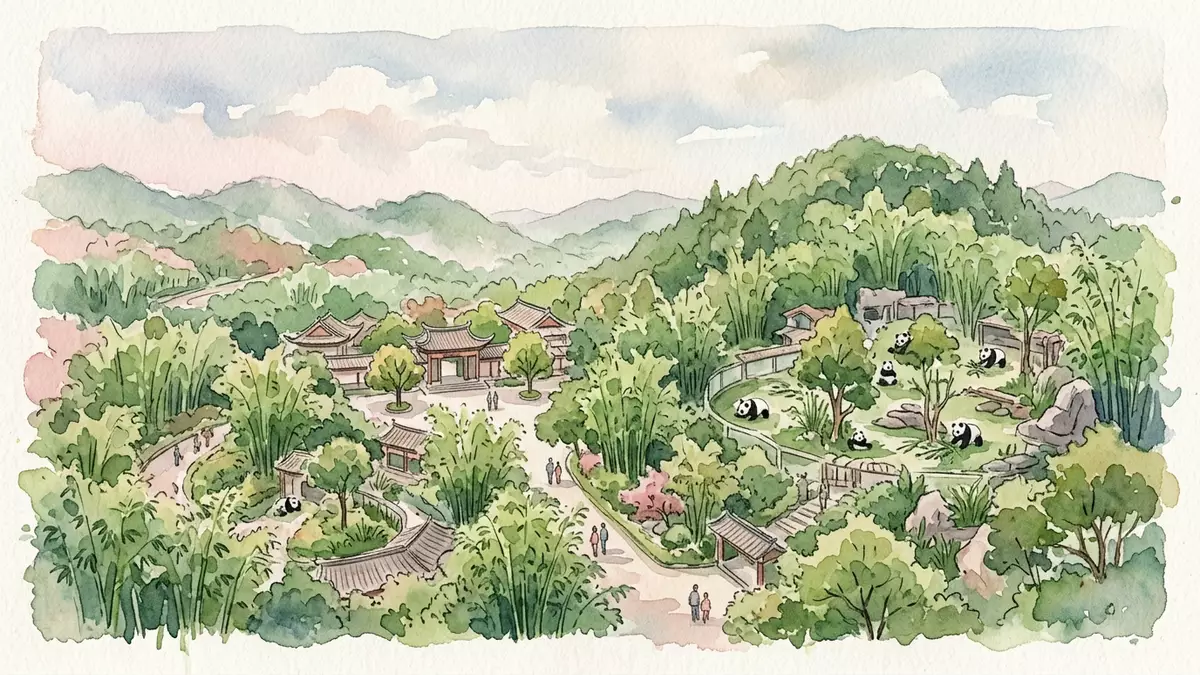
Chengdu Xiongmao Jidi is a giant panda research and conservation campus in northern Chengdu, China. Its defining feature is a landscaped setting where bamboo, ponds, trees and animal enclosures form one visible environment.
Known formally as the Chengdu Research Base of Giant Panda Breeding, the institution was founded in 1987. Research buildings, veterinary facilities, nurseries and public routes occupy a 3.07-square-kilometre site in Chenghua District, beside Panda Avenue.
Bamboo, water and open-air panda enclosures
The base is arranged as a green hillside landscape rather than a single indoor exhibition hall. Giant panda enclosures sit among bamboo groves, planted slopes, trees, rocks and pools, with indoor dens and service buildings nearby.
This setting reflects the difference between an animal display and an ex-situ conservation campus. Ex-situ conservation means caring for a species away from its natural habitat, while research, breeding and veterinary work remain part of the same institution.
The official site describes Chengdu Xiongmao Jidi as an ecological demonstration project for giant panda ex-situ conservation. Its stated work includes scientific research, breeding, nature education and cultural tourism, alongside care for red pandas and other rare animals native to China.
From six rescued pandas to a research institution
The Chengdu Research Base of Giant Panda Breeding began in March 1987 with six giant pandas rescued from the wild. That date remains central to the identity of the Chengdu campus and its development as a specialist institution.
Its work covers feeding and management, reproduction, cub rearing, disease prevention and population genetics. The base also includes a panda hospital and research departments concerned with wildlife conservation, health monitoring and the care of rare species.
Breeding is therefore only one part of Chengdu Xiongmao Jidi. The campus brings together animal care, laboratory research, veterinary medicine, environmental management and public education within a single organisation.
The institution’s full name makes that combination explicit. “Research” and “breeding” appear together because the site functions as a scientific centre as well as a place where visitors can see giant pandas in planted outdoor enclosures.
A city campus linked to Sichuan’s mountain wildlife
Chengdu Xiongmao Jidi lies in Chenghua District, on the northern side of Chengdu, at 1375 Panda Avenue. The city location places a major conservation institution within an urban region of Sichuan, while the vegetation and enclosure design refer to the forested mountain habitats associated with giant pandas.
The campus contains more than panda viewing areas. It has indoor nursery spaces, veterinary facilities, laboratories, ponds, planted paths and work areas. Red panda zones and other wildlife facilities extend the focus beyond a single species.
A separate field research centre connected with the base includes facilities for wild training, reintroduction work, wildlife rescue and nature education. Its enclosures, lakes and education areas show how the institution links captive care with field-oriented conservation.
The result is a place where the visible landscape carries several functions at once. Bamboo and water create the setting for animal care, while buildings and specialist departments support research that visitors cannot see directly.
Visiting Chengdu Xiongmao Jidi: what travellers from Western Europe should know
- Chengdu Xiongmao Jidi is at 1375 Panda Avenue in Chenghua District, north of central Chengdu. Metro Line 3 reaches Panda Avenue Station, with local connections continuing towards the base.
- The site covers 3.07 square kilometres, so a visit involves outdoor routes across planted slopes, enclosure areas, ponds and woodland rather than a single compact building.
- The public landscape includes giant panda enclosures, red panda areas, science-education spaces, lakes and research-related facilities.
- The official language is Mandarin Chinese and the currency is the Chinese yuan.
- Entry requirements depend on your nationality; UK travellers can check the FCDO travel advice at gov.uk/foreign-travel-advice, Irish travellers the Department of Foreign Affairs at ireland.ie.
Searching for Chengdu Xiongmao Jidi on social platforms
These links open searches for Chengdu Xiongmao Jidi on each platform.
Frequently asked questions about Chengdu Xiongmao Jidi
Where is Chengdu Xiongmao Jidi?
It is in Chenghua District on Panda Avenue, on the northern side of Chengdu in Sichuan, China. The address is 1375 Panda Avenue.
What is there to see?
The campus contains giant panda enclosures among bamboo, trees, ponds and planted slopes. It also includes red panda areas, science-education facilities, nurseries and research-related buildings.
What makes the place distinctive?
Chengdu Xiongmao Jidi combines public wildlife viewing with breeding, veterinary care, scientific research and ex-situ conservation. Its 1987 foundation and six rescued pandas form the starting point of that institutional history.


