Coyoacan’s courtyards, churches and colonial streets
Published on 08/20/2026 at 22:33 | Editorial responsibility: Rafael Müller, Editor-in-Chief AD HOC NEWS
Coyoacan in Mexiko-Stadt combines colonial streets, civic buildings and museum houses in a compact urban district. Its core is shaped by the parish church, the old town hall and a network of squares and avenues.
Coyoacan’s colonial core and civic streets
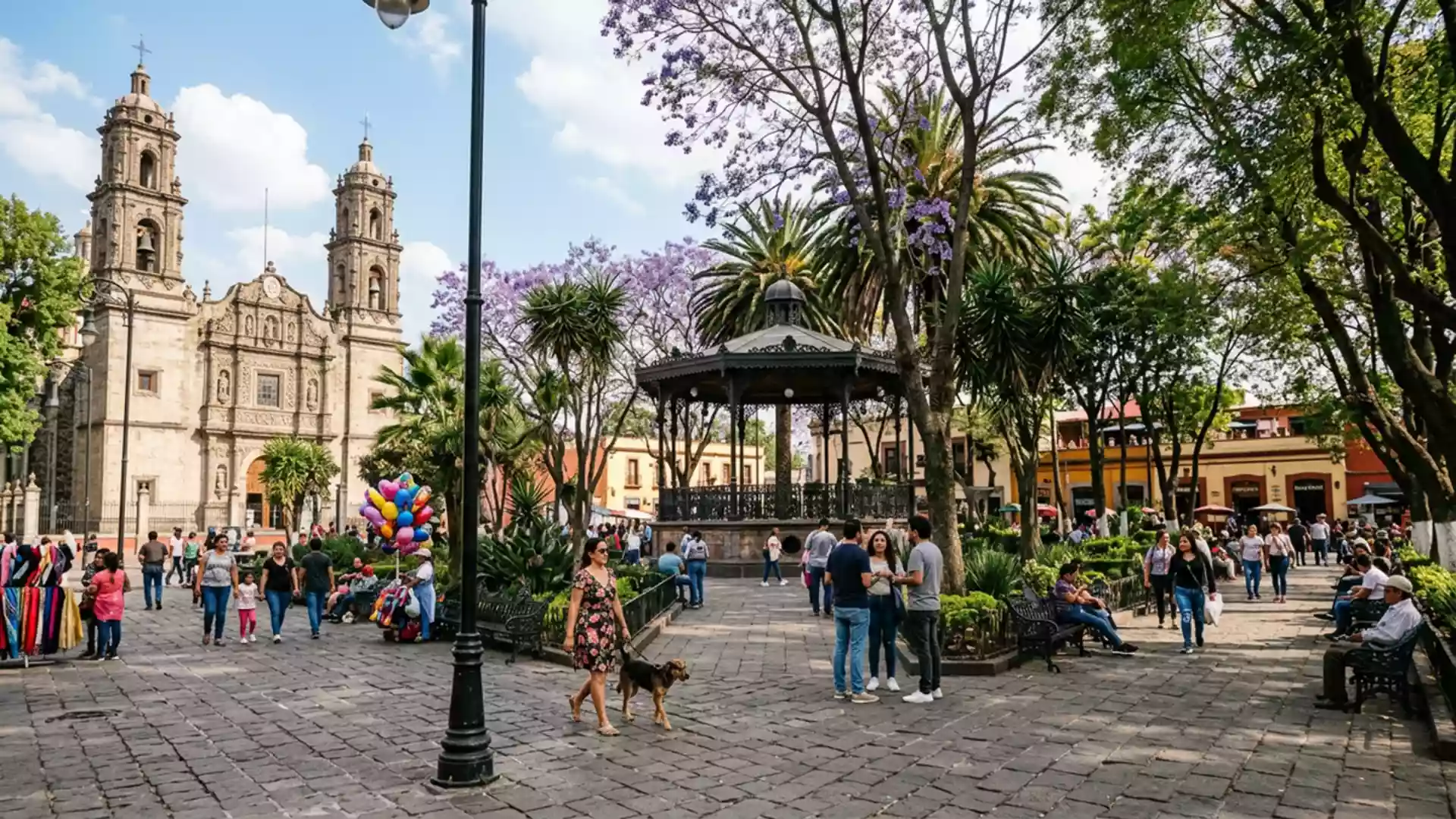
The district’s historical centre is organised around Jardín Hidalgo and Jardín Centenario, where the parish and ex-convent of San Juan Bautista faces the squares. The church’s Renaissance-heritage facade and frescoed interior give the centre a formal, layered character.the parish and ex-convent
Francisco Sosa Avenue runs past viceregal mansions and toward Santa Catarina, where a cobbled square and a chapel frame the street pattern. The area keeps the scale of an older settlement inside a large modern city.large residential area
Frida Kahlo, museums and artistic memory
Coyoacan is closely linked with Frida Kahlo, who was born and died there in 1907 and 1954. Her childhood home, La Casa Azul, is one of the district’s defining addresses, and it anchors Coyoacan’s artistic identity.born and died there
The area also includes the Leon Trotsky House Museum and the National Museum of Popular Cultures. Together with Kahlo’s house, they show how domestic spaces, political memory and public culture sit close together in Coyoacan.León Trotsky House Museum
Older layers beneath the modern borough
Before becoming part of Mexico City’s borough system in 1928, Coyoacan had already played a central role in the city’s early colonial history. Hernán Cortés established his first New Spanish city council there in 1521, and the name comes from Nahuatl, meaning “place of coyotes”.first capital of New Spain
The district also preserves traces of earlier Indigenous and colonial settlement patterns. That long history is visible in the survival of squares, churches and municipal buildings around the old centre.history of 500 years
Visiting Coyoacan: what travellers from Western Europe should know
- Coyoacan lies south of central Mexico City. The district is reached by city transport and by ordinary urban streets linking the centre with surrounding neighbourhoods.
- The historic core is built for walking. Its squares, paved streets and church fronts keep the area compact and easy to read on foot.
- Francisco Sosa Avenue, the parish square and the museum houses form a coherent route. The district is dense with civic, religious and domestic architecture.
- The official language is Spanish and the currency is the Mexican peso.
Searching for Coyoacan on social platforms
These links open searches for Coyoacan on each platform.
Frequently asked questions about Coyoacan
Where is Coyoacan?
Coyoacan is a borough in southern Mexiko-Stadt, south of the central districts. It lies in central Mexico and forms part of the city’s older urban fabric.
What does a visit feel like?
The district combines church squares, municipal buildings, museum houses and tree-lined streets. Much of it can be understood as a compact walk through civic and domestic history.
What makes Coyoacan distinctive?
Its identity comes from the overlap of colonial architecture, Frida Kahlo’s legacy and earlier Indigenous settlement history. The result is a district with a strong historical centre and a recognisable street pattern.