
Death Valley National Park and the desert basin around Furnace Creek
Published on 09/18/2026 at 18:21 | Editorial responsibility: Rafael Müller, Editor-in-Chief AD HOC NEWS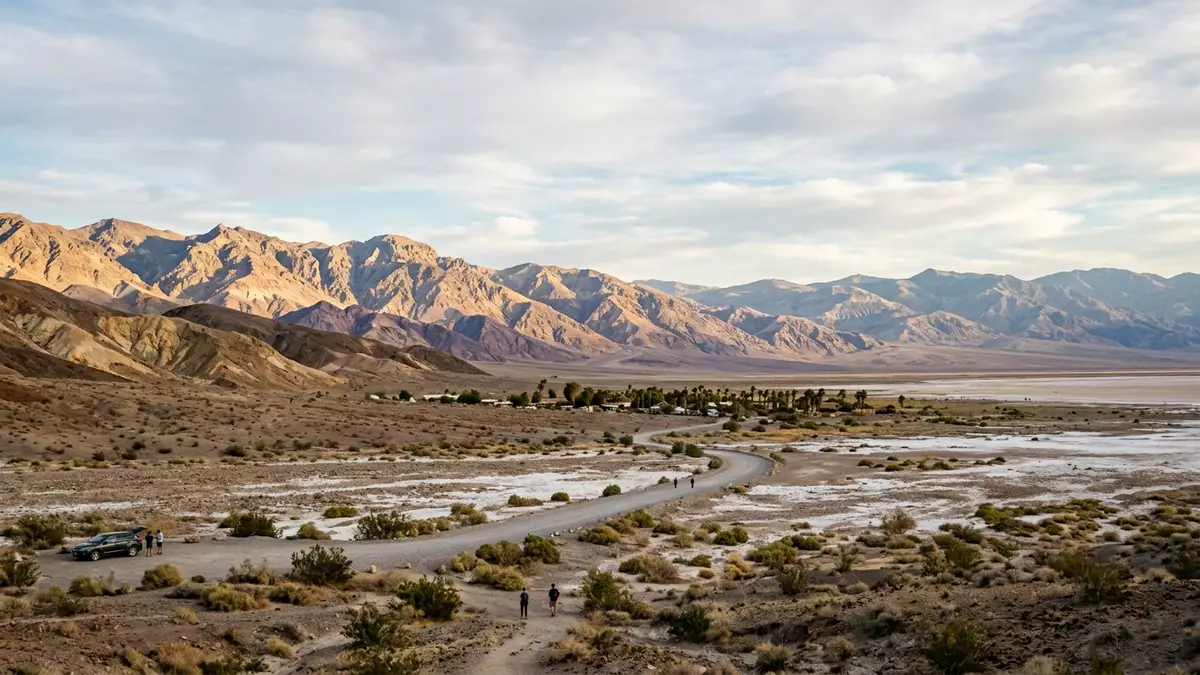
Death Valley National Park in California stretches around the desert basin of Furnace Creek, where the main visitor hub sits below sea level in one of North America’s starkest landscapes.Death Valley National Park The valley’s reputation rests on its extremes of heat, dryness and elevation, all concentrated around the wide floor and surrounding mountain ranges.
A park defined by extremes of height, heat and dryness
The basin around Furnace Creek lies below sea level, with the wider park ranging from deep desert depressions to peaks in the Panamint Mountains above 3,000 m (9,843 ft).extreme range from –86 m to 3,368 m This dramatic relief contributes to a climate that ranks among the hottest and driest recorded on Earth, with summer temperatures reaching well above 50°C at valley-floor stations.one of the world’s most extreme climates Rainfall in the central valley averages only a few centimetres each year, leaving large areas of bare rock, gravel fans and salt flats.
The combination of low elevation and desert air produced a world?record air temperature at Furnace Creek in 1913, a figure that has long anchored the park’s identity as a place of climatic extremes.official National Weather Service weather stations at Greenland Ranch and Furnace Creek For visitors from Western Europe, the most striking first impression is often the sheer brightness and openness of the valley floor, framed by steep desert ranges that rise quickly from the sun?baked flats.
Furnace Creek as the human hub of a harsh landscape
Furnace Creek developed as a settled oasis within Death Valley, first as Greenland Ranch and later as the centre for borax mining, ranching and resort activity.Furnace Creek, formerly Greenland Ranch The settlement lies roughly 190 ft (58 m) below sea level and today brings together the national park’s main visitor centre, museum and administrative headquarters in a single compact area.visitor center, museum, and headquarters of Death Valley National Park are located at Furnace Creek
The surrounding desert landscape also carries the history of industrial extraction. A short distance north of Furnace Creek stand the remains of the Harmony Borax Works, an industrial site where crews scraped borate minerals from the valley floor in the late nineteenth century.ruins of the Harmony Borax Works Across the wider basin, evidence of earlier borax operations survives in the form of processing ruins and traces of routes once used by the famous twenty?mule teams.
Desert geology, wilderness and indigenous homeland
The rocks and sediments that shape Death Valley record millions of years of geological history, including the Furnace Creek Formation, which dates back around four to six million years and is a key source of borate minerals.Furnace Creek Formation is the primary source of borate minerals Tectonic extension and faulting have created a classic basin?and?range landscape, with tilted blocks forming parallel mountain chains and intervening valleys where sediments and salts accumulate.
Death Valley National Park includes a vast area of designated wilderness, giving large parts of the desert, alluvial fans and mountain ridges formal protection from intensive development.largest area of designated National Park wilderness in the contiguous United States Within this protected landscape, the basin around Furnace Creek forms part of the recognised homeland of the Timbisha Shoshone, whose reservation lies inside the park boundary and is acknowledged on park entrance signs.Homeland of the Timbisha Shoshone
Visiting Death Valley National Park: what travellers from Western Europe should know
- Death Valley National Park lies in eastern California, with Furnace Creek reached by road from towns on the fringes of the Mojave Desert and from Las Vegas in neighbouring Nevada.
- The terrain around Furnace Creek is a low desert basin, with short walks on level ground and longer routes that climb steeply onto gravel fans and mountain slopes.
- In the wider park, elevations range from deep depressions below sea level to high summits above 3,000 m (9,843 ft), so approaches can involve significant altitude changes over relatively short horizontal distances.
- The official language is English and the currency is the United States dollar.
- Entry requirements depend on your nationality; UK travellers can check the FCDO travel advice at gov.uk/foreign-travel-advice, Irish travellers the Department of Foreign Affairs at ireland.ie.
Searching for Death Valley National Park on social platforms
These links open searches for Death Valley National Park on each platform.
Frequently asked questions about Death Valley National Park
Where is Death Valley National Park and Furnace Creek located?
Death Valley National Park lies in eastern California in the United States, with Furnace Creek in the central basin below sea level.
What should visitors expect on a trip to Furnace Creek?
Visitors encounter an arid desert basin with very high summer temperatures, sparse vegetation and long views towards surrounding mountain ranges.
What makes Death Valley National Park distinctive within the United States?
The park combines extreme elevations, one of the world’s hottest recorded climates and a large designated wilderness area within a single desert landscape.


