
Dioklecijanova palaca and the Roman city within Split
Published on 09/23/2026 at 13:28 | Editorial responsibility: Rafael Müller, Editor-in-Chief AD HOC NEWS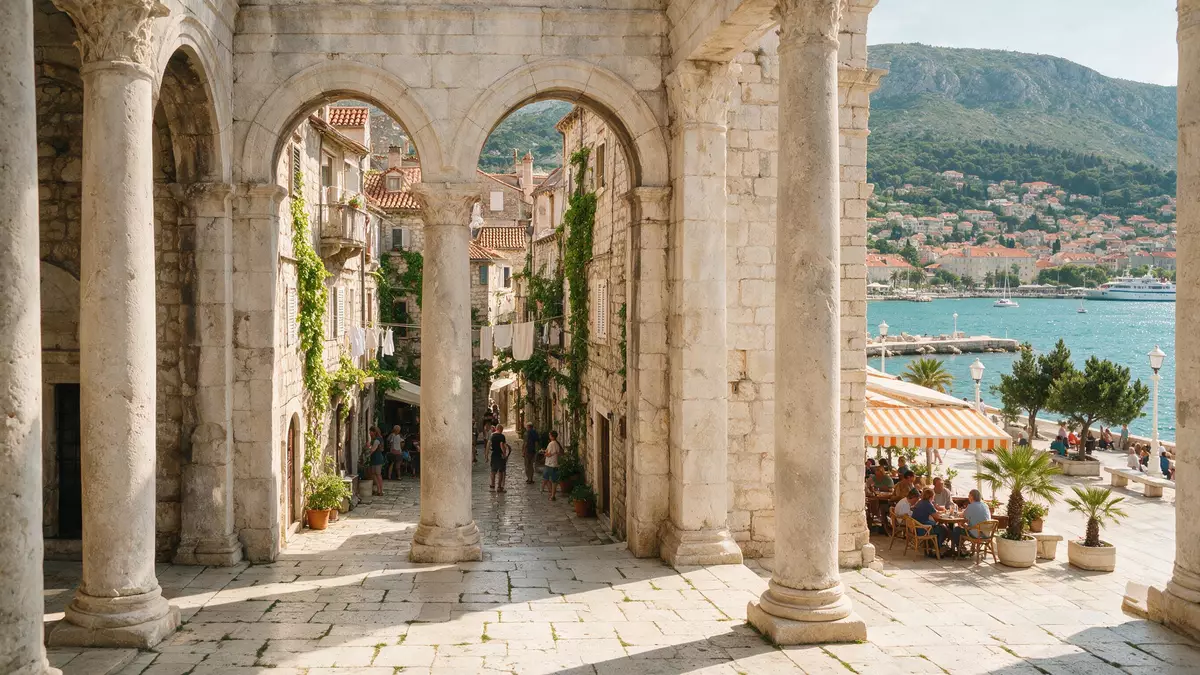
Dioklecijanova palaca is a Roman palace whose walls form part of Split’s urban fabric. Built between 295 and 305 CE for Emperor Diocletian, the complex combines an imperial residence, a fortified enclosure and streets that continue through the historic centre.
Dioklecijanova palaca: a palace built like a fortress
The complex occupies a roughly rectangular plan beside the Adriatic. Its walls extend about 215 metres from north to south, while the eastern and western sides measure less. Stone walls, towers and gates give the palace the character of a fortified town as well as a residence.
Four named gates mark the principal entrances: the Golden Gate to the north, the Silver Gate to the east, the Iron Gate to the west and the Bronze Gate towards the sea. The Roman layout also survives in the main routes, including the Cardo and Decumanus. Roman walls and gates remain visible among later buildings.
From imperial residence to Split’s historic centre
Diocletian was Roman emperor from 284 to 305 CE. He retired from imperial office in 305 and lived in the palace until his death in 316. The complex therefore belongs to the transition from the later Roman Empire to Late Antiquity.
The palace’s southern section contained imperial rooms and religious spaces. Its mausoleum became the Cathedral of Saint Domnius in the seventh century, while the Temple of Jupiter became a baptistery. Medieval houses, churches and civic buildings were added within and around the Roman walls, creating the layered city visible in Split.
Stone, streets and the protected historic complex
Dioklecijanova palaca is built from local limestone and other imported materials. Arcades, columns, carved fragments and vaulted substructures appear beside cafés, shops, homes and narrow lanes. Ancient masonry is not confined to a single isolated monument.
The palace forms the central part of the Historical Complex of Split with the Palace of Diocletian. The protected area includes Roman remains, the medieval cathedral, Romanesque churches, Gothic palaces, Renaissance buildings and Baroque architecture. UNESCO’s protected complex was inscribed on the World Heritage List in 1979.
Visiting Dioklecijanova palaca: what travellers from Western Europe should know
- Dioklecijanova palaca lies in the historic centre of Split, beside the Adriatic waterfront. Split railway station, the intercity bus station and the ferry terminal are close to the southern side.
- The site is an urban archaeological complex, not a single enclosed building. Stone paving, narrow lanes, steps and uneven thresholds appear between the main streets and surviving Roman structures.
- The basement substructures contain vaulted stone spaces beneath the imperial apartments. The Peristyle connects the palace’s principal ceremonial and religious buildings.
- The official language is Croatian and the currency is the euro.
Searching for Dioklecijanova palaca on social platforms
These links open searches for Dioklecijanova palaca on each platform.
Frequently asked questions about Dioklecijanova palaca
Where is Dioklecijanova palaca?
Dioklecijanova palaca is in the historic centre of Split, on Croatia’s Dalmatian coast. Its southern side faces the waterfront.
What can visitors see there?
Visitors encounter Roman gates, walls, courtyards, arcades, vaulted substructures and the Peristyle. The Cathedral of Saint Domnius and the former Temple of Jupiter occupy ancient parts of the complex.
What makes Dioklecijanova palaca distinctive?
Its Roman palace and fortress remain integrated into a living city. Ancient structures stand beside medieval, Renaissance and Baroque buildings within the UNESCO-protected historic complex.


