
Duomo di Siena and its striped marble splendour
Published on 09/02/2026 at 19:39 | Editorial responsibility: Rafael Müller, Editor-in-Chief AD HOC NEWS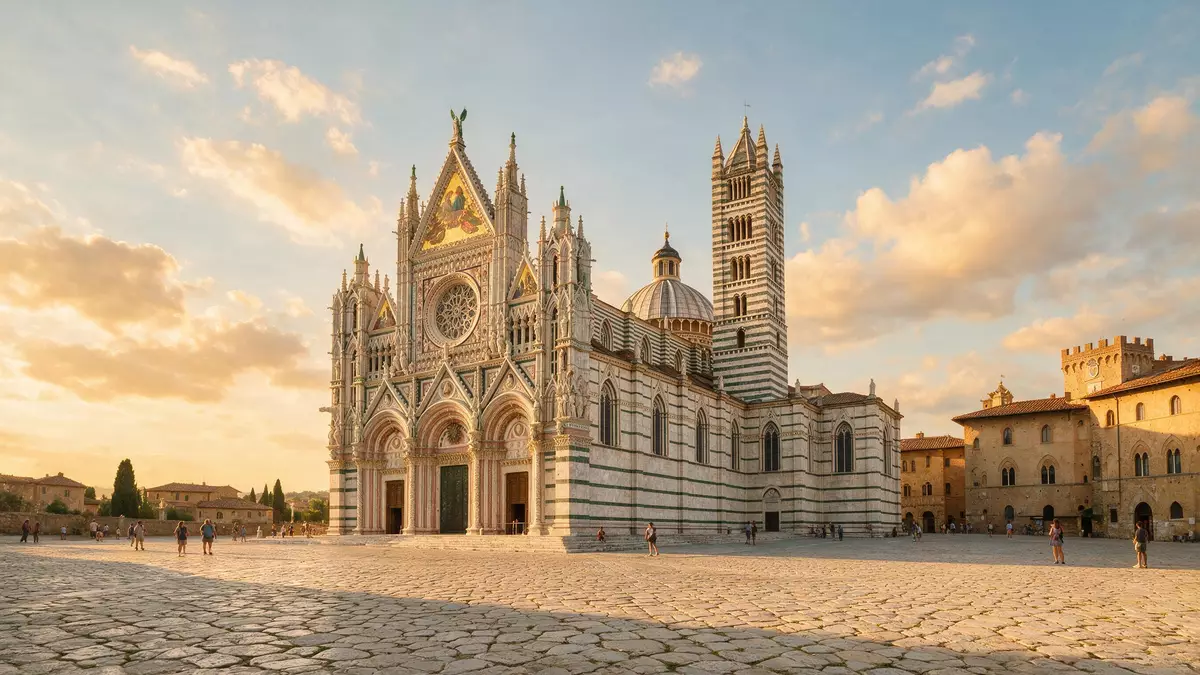
Duomo di Siena, officially the Cathedral of Santa Maria Assunta, rises above Siena with a striking facade of dark and light marble and a richly decorated interior from the Middle Ages. Built in the thirteenth and fourteenth centuries as the seat of the city’s archdiocese, it is part of Siena’s historic centre, which is recognised as a UNESCO World Heritage Site, and it anchors the city’s identity as strongly as Piazza del Campo below.
Striped marble and Italian Gothic architecture
From the piazza, Duomo di Siena presents a powerful composition of horizontal stripes in white and dark marble, a hallmark of the cathedral and of Siena’s civic colours. The exterior belongs to the Romanesque-Gothic tradition of central Italy, blending rounded arches and broad wall surfaces with pointed elements and dense sculptural detail on the west front.Romanesque-Gothic churches in Italy The facade visible today was largely shaped between the late thirteenth and early fourteenth centuries, when sculptors such as Nicola Pisano and his son Giovanni worked on its lower zones and reliefs for the entrance area.treasures by Pisano
The bell tower rises beside the nave, built in the same striped marble pattern and capped well below the height of the dome. Its masonry reaches about 77 m (253 ft), a figure recorded in architectural descriptions of the cathedral and consistent across several sources.bell-tower, at a height of 77 meters In plan, the church takes the form of a Latin cross, with a long nave, transepts and a projecting dome above the crossing, characteristics that place it firmly within the Italian Gothic vocabulary while keeping a compact footprint on the hill.
From medieval construction to Duomo Nuovo
Building Duomo di Siena spanned more than a century, echoing the changing fortunes of the medieval city. Records place substantial construction of the present cathedral between about 1215 and the mid-thirteenth century, with the consecration traditionally given as 1179 for an earlier phase of the church.founded in the 12th century Architects and sculptors from the Pisa and Siena regions contributed to the building, including Giovanni Pisano, who oversaw work on the lower part of the facade in the late thirteenth century.Giovanni Pisano was responsible
In the fourteenth century, at a time when the Republic of Siena held significant regional power, the city embarked on an ambitious project known as the Duomo Nuovo. The plan, begun in 1339, envisaged using the existing cathedral as a transept within a much larger church, with new walls extending towards Via di Città.decided to build a larger cathedral Work on this enlargement halted after the plague of 1348 severely reduced the city’s population, and the walls that were completed remained as unfinished structures. One of them, the Facciatone, still stands as a monumental fragment, giving visitors a sense of the scale that was once planned for the cathedral complex.
Interior floors, sculpture and patterned space
Inside Duomo di Siena, striped marble continues on the columns, framing chapels, frescoes and sculptural works by figures such as Donatello, Michelangelo and Pinturicchio, whose contributions are recorded in inventories of the cathedral’s art.treasures by Donatello and Michelangelo The nave leads the eye towards the dome and high altar, but much of the interest lies underfoot. The marble floor is laid out in a complex programme of panels, crafted over several centuries, depicting biblical scenes, allegories and figures from classical antiquity, all integrated into the geometry of the aisles and transepts.decorated marble inlay floor
The baptistery beneath the eastern end of the cathedral, begun in the early fourteenth century, continues this blend of sculpture and architecture, housing a hexagonal baptismal font with reliefs by Jacopo della Quercia and other Tuscan masters. Together with the cathedral and adjoining structures, it forms part of the larger complex overseen by the Opera della Metropolitana, the historic body that manages the building and its artworks. The combination of striped stone, patterned floors and dense figurative carving makes Duomo di Siena a layered space where construction history, civic identity and religious imagery meet in visible form.
Visiting Duomo di Siena: what travellers from Western Europe should know
- Duomo di Siena stands on Piazza del Duomo, on the hill above Piazza del Campo in central Siena, and is reached on foot along sloping streets from the surrounding districts.
- The approach from Piazza del Campo climbs steadily, with sections of cobbled paving and short flights of steps around the cathedral square.
- Siena lies in Tuscany in central Italy, and the official language is Italian while the currency is the euro.
Searching for Duomo di Siena on social platforms
These links open searches for Duomo di Siena on each platform.Frequently asked questions about Duomo di Siena
Where is Duomo di Siena located within the city?
Duomo di Siena stands on Piazza del Duomo above Piazza del Campo, on one of Siena’s hilltops in the historic centre of the city.
What should visitors expect inside the cathedral?
Visitors encounter striped marble columns, chapels with sculpture and frescoes, and an elaborate marble floor composed of narrative panels laid out across the nave and transepts.
What makes Duomo di Siena distinctive among Italian cathedrals?
The combination of striped exterior stonework, the ambitious but unfinished Duomo Nuovo and the extensive inlaid floor programme gives Duomo di Siena a character closely tied to Siena’s medieval history.


