Emei Shan’s sacred climb above Leshan
Published on 09/01/2026 at 18:31 | Editorial responsibility: Rafael Müller, Editor-in-Chief AD HOC NEWS
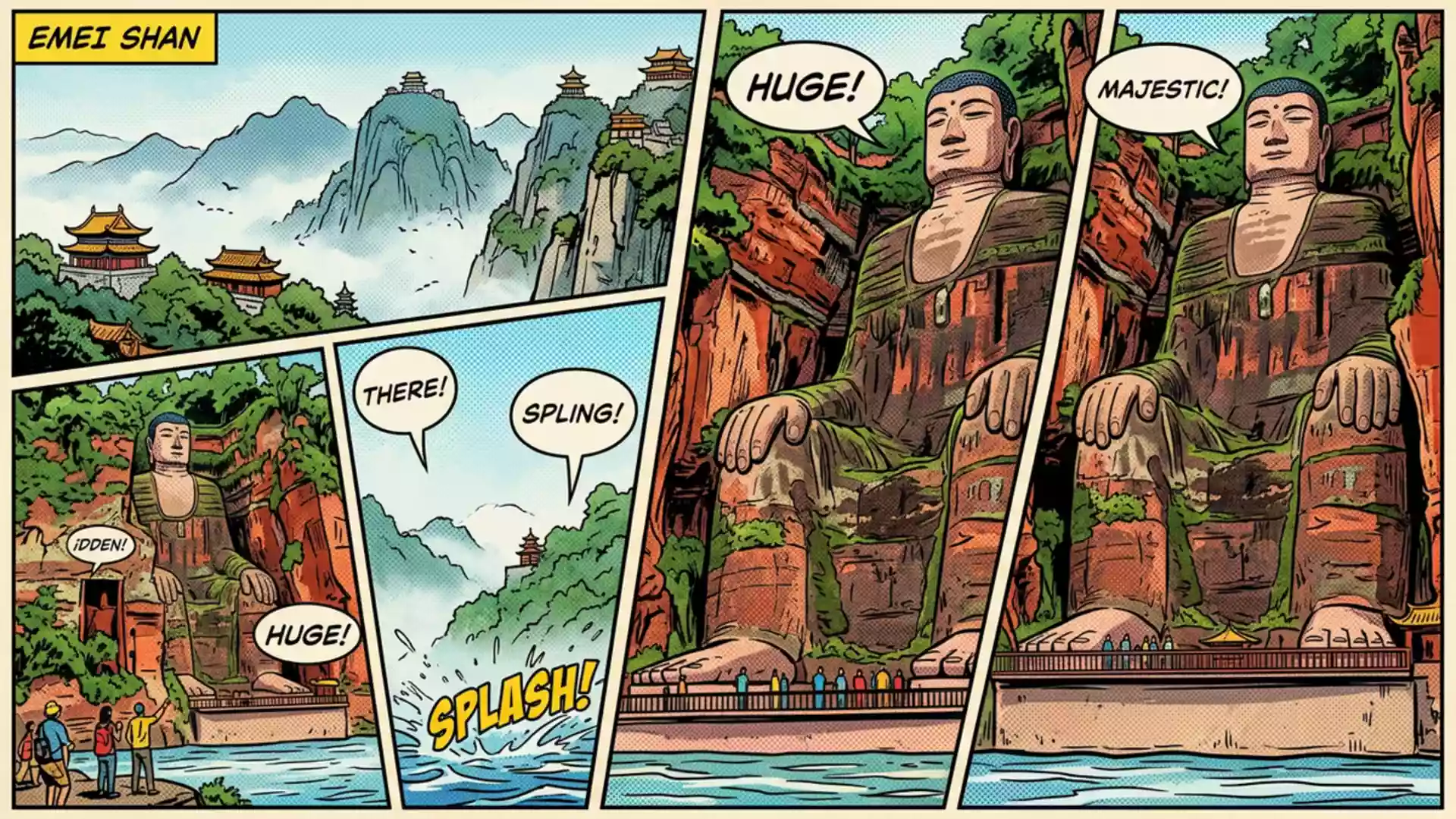
Emei Shan, known in English as Mount Emei, rises above Leshan in Sichuan as a sacred Buddhist mountain where forested slopes, temples and high summits share the same long climb.
A sacred Buddhist mountain in Sichuan
Emei Shan stands in Sichuan Province in south-western China and forms part of Emeishan City, which in turn belongs to the wider Leshan area.Sichuan Province The mountain is recognised as one of the Four Sacred Buddhist Mountains of China, a group of peaks long associated with major centres of Buddhist practice.Four Sacred Buddhist Mountains
The wider Mount Emei Scenic Area, including the nearby Leshan Giant Buddha Scenic Area, was inscribed on the UNESCO World Heritage List in 1996 as a mixed property that combines cultural and natural significance.World Heritage List in 1996 Within this inscription, Mount Emei is described as the place where Buddhism first became firmly established on Chinese territory before spreading more widely through East Asia.place where Buddhism first became established
From forest foot to high summit
The core experience of Emei Shan is the progression from the lower forests at the foot of the mountain to the high summit ridges, with paths and transport routes linking distinct levels of landscape and culture. The main peak, known as Wanfo Ding or Golden Summit, reaches a height of 3,099 m (10,167 ft), placing the upper sections of the mountain well into subalpine terrain above the Sichuan plain.3,099 m (10,167 ft) The mountain forms part of a scenic property that covers 15,400 ha, with a larger buffer zone surrounding it.15,400 ha in two discrete areas
As the route climbs, the vegetation shifts from subtropical forests at lower elevations to mixed woodland and subalpine pine stands higher up, and some trees on the mountain are more than 1,000 years old.trees more than 1,000 years old A number of temples and pavilions stand along this ascent, marking out stages of a pilgrimage that can be undertaken in sections rather than as a single climb. Among the named scenic zones on Emei Shan are areas around Baoguo Temple, Wannian Temple, Qingyin Pavilion and the Golden Summit itself.Baoguo Temple, Wannian Temple, Qingyin Pavilion and Golden Summit
Temples, the Leshan Giant Buddha and cultural layers
Buddhist structures form much of the human presence on Emei Shan, and the mountain carries a sequence of temples dating back many centuries. The first Buddhist temple in China was built on Mount Emei in the first century AD, marking the beginning of an enduring association between the mountain and organised Buddhist practice.first Buddhist temple in China Over the following eras, other temples were added, and Emei Shan became one of the holiest mountain sites within Chinese Buddhism.holiest sites
Beyond the mountain itself, the World Heritage property also includes the Leshan Giant Buddha, carved in the eighth century out of a riverside cliff near Leshan at the confluence of the Minjiang, Dadu and Qingyi rivers.Leshan Giant Buddha carved out of a hillside The statue stands 71 m (233 ft) high and faces the meeting point of the three rivers, linking monumental sculpture and landscape in a single scene.71 m high Although the Buddha is a separate site, it is administratively connected with Emei Shan through the shared Mount Emei Scenic Area, including Leshan Giant Buddha Scenic Area inscription.linked by road and jointly inscribed
Visiting Emei Shan: what travellers from Western Europe should know
- Emei Shan lies in Sichuan Province in south-western China, near Leshan and Emeishan City, with highway access from Chengdu and road links to the Leshan Giant Buddha area.
- The ascent from the lower forested zones to the summit involves sustained gradients, long stairways and mountain paths, and visitors encounter changing altitude and terrain underfoot along the way.
- The wider scenic property brings together mountain landscapes and the cliffside Leshan Giant Buddha, so a visit to Emei Shan can be combined with riverside viewpoints where the Buddha faces the confluence of the Minjiang, Dadu and Qingyi rivers.
- The official language is Chinese and the currency is the renminbi (yuan); entry requirements depend on your nationality, UK travellers can check the FCDO travel advice at gov.uk/foreign-travel-advice, Irish travellers the Department of Foreign Affairs at ireland.ie.
Searching for Emei Shan on social platforms
These links open searches for Emei Shan on each platform.
Frequently asked questions about Emei Shan
Where is Emei Shan located?
Emei Shan is in Sichuan Province in south-western China, within Emeishan City and near Leshan, with the wider scenic area linked to the Leshan Giant Buddha.
What should visitors expect on a visit?
A visit combines forested mountain paths, temples and viewpoints along an ascent that can reach over 3,000 m (9,843 ft), with the option to include the riverside Leshan Giant Buddha.
What makes Emei Shan distinctive among Chinese mountains?
Emei Shan is both a major Buddhist pilgrimage mountain and part of a mixed World Heritage property, where early temples, ancient forests and the Leshan Giant Buddha share one recognised landscape.