
Englischer Garten is a landscape park crossed by the Eisbach
Published on 09/24/2026 at 05:09 | Editorial responsibility: Rafael Müller, Editor-in-Chief AD HOC NEWS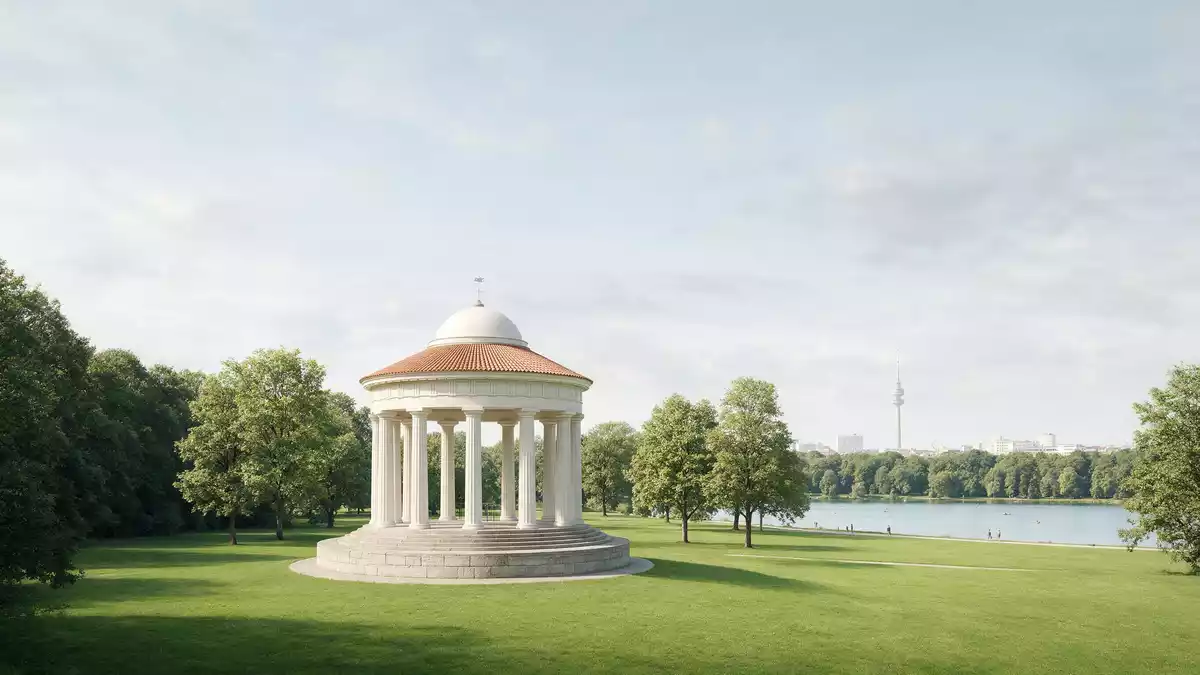
Englischer Garten is a broad landscape park in München, where open meadows, woodland, streams and historic buildings occupy 376 hectares. The Eisbach enters the park as a fast urban watercourse, with a permanent wave beneath the Prinzregentenstrasse bridge that has become part of the city’s public life.
Laid out in 1789 under Elector Karl Theodor, the park carries an unusual combination of formal history and moving water. Its paths, lawns and groves belong to the English landscape-garden tradition, while the Eisbach gives the southern section a sharply engineered presence.
The Eisbach wave and the park’s moving water
The Eisbach is a branch of the Isar that runs through the southern Englischer Garten. At the Eisbachwelle, water pours over a fixed step and forms a standing wave beside the park’s edge. Surfers use the wave throughout the year, with boards and wetsuits visible from the banks.
The scene is unusual within a major urban park because the water is both infrastructure and spectacle. The wave is not a natural break in a coastline. It is a permanent feature of the channel, and its narrow channel places the activity close to roads, footpaths and the Haus der Kunst.
From Karl Theodor to Friedrich Ludwig von Sckell
Elector Karl Theodor ordered the Englischer Garten in 1789. The idea came from Sir Benjamin Thompson, an American-born scientist and administrator who became Count Rumford. The park opened to the public in 1792.
Englischer Garten history is tied to the transition from courtly garden design towards a public landscape park. Friedrich Ludwig von Sckell shaped its design, using winding paths, open lawns, woodland and water instead of a rigid geometric plan.
The Chinese Tower and Rumford House belong to the park’s early buildings, dating from around 1790. Hirschau was added in the north around 1800, while Kleinhesseloher Lake began taking shape in 1804.
Chinese Tower, Monopteros and Kleinhesseloher Lake
The Chinese Tower is a wooden pagoda in the southern park. Its surrounding clearing contains a beer garden and broad lawns, while paths connect the tower with the park’s groves and streams.
Kleinhesseloher Lake occupies a central position in the park and forms the largest lake within Englischer Garten. The Monopteros stands on an artificial hill nearby, presenting a circular classical temple with columns and an open centre.
The northern section, known as Hirschau, extends the park into a quieter arrangement of woodland, meadows and water. The name refers to deer, and this part has a more rural character than the architectural concentration around the Chinese Tower and Monopteros.
Visiting Englischer Garten: what travellers from Western Europe should know
- Englischer Garten stretches north-east from the historic centre of München along the Isar. The U-Bahn stations Universität, Giselastraße and Münchner Freiheit serve the southern and central edges.
- The Eisbachwelle lies beside Prinzregentenstrasse near Haus der Kunst. The wave is visible from the bank, while the water channel remains a specialised setting for experienced surfers.
- The park contains broad lawns, woodland paths, streams and Kleinhesseloher Lake. The terrain is mainly level, but paths vary between paved routes, compacted ground and grass.
- The official language is German and the currency is the euro.
Searching for Englischer Garten on social platforms
These links open searches for Englischer Garten on each platform.
Frequently asked questions about Englischer Garten
Where is Englischer Garten?
Englischer Garten lies in north-eastern München, extending from the historic centre beside the Isar towards Hirschau. Its southern edge is near Haus der Kunst and Prinzregentenstrasse.
What can visitors see there?
The park contains the Eisbachwelle, Chinese Tower, Rumford House, Monopteros, Kleinhesseloher Lake, open meadows, woodland and streams.
What makes Englischer Garten distinctive?
Its distinctive combination is a public eighteenth-century landscape park with an urban standing wave. Historic garden features and active river surfing share the same parkland.


