
Erg Chebbi and the sudden rise of Morocco’s sand sea
Published on 09/24/2026 at 10:37 | Editorial responsibility: Rafael Müller, Editor-in-Chief AD HOC NEWS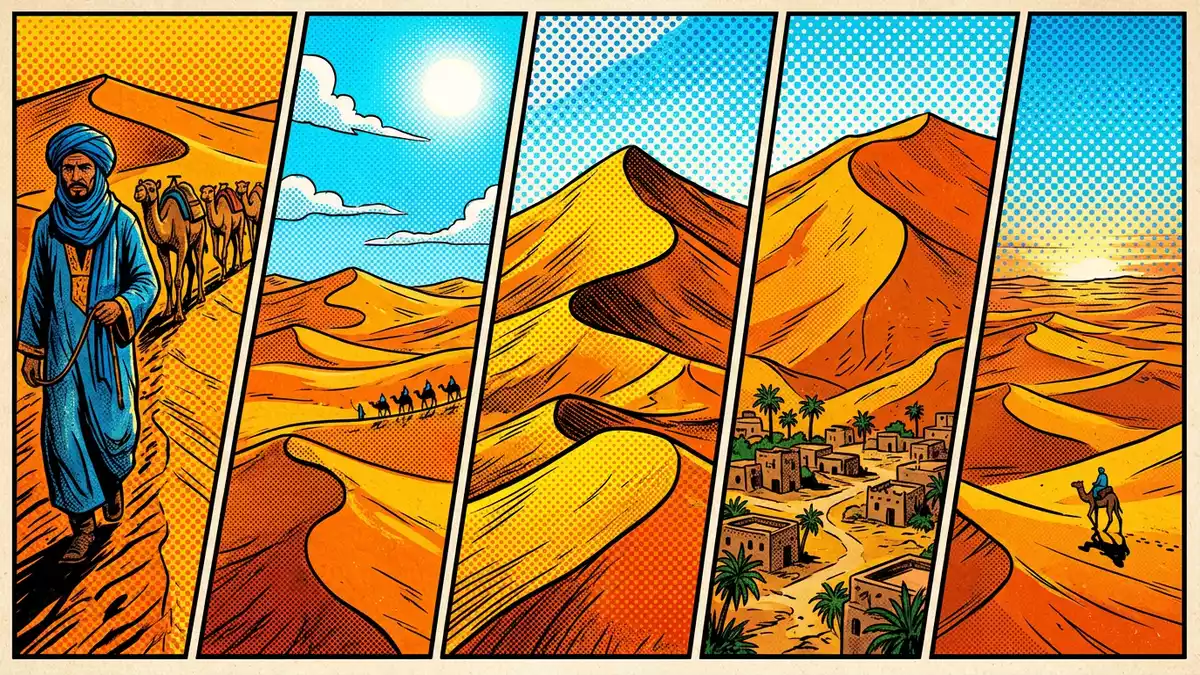
Erg Chebbi is a broad field of Saharan dunes beside Merzouga in south-eastern Morocco. Its sand rises abruptly from the stony hamada, creating a clear meeting point between two desert landscapes. Erg Chebbi’s Saharan setting includes smooth slip faces, sharp ridges and dunes shaped by wind-blown sediment.
Erg Chebbi: sand rising from the hamada
The Arabic word erg refers to a large area covered by wind-formed sand dunes. Erg Chebbi belongs to the north-western Sahara, close to Morocco’s border with Algeria and north-east of the Little Atlas mountain range.
The dunes form a concentrated sandy body beside Merzouga. Around them, the ground changes into hamada, a rocky desert surface with little sand cover. The boundary between the two terrains is one of the defining features of the landscape: pale, stony ground meets dunes coloured by gold, orange and brown tones.
The dune field extends for roughly 28 kilometres from north to south and reaches several kilometres across. Some crests rise to about 150 metres above the surrounding plain. Different published measurements vary, so the broad form matters more than a single outline: Erg Chebbi is a large, elongated mass of dunes rather than an isolated hill.
Wind, slip faces and sculpted ridges
Every dune has a windward slope and a steeper slip face. Wind carries fine grains upwards, while loose sand falls down the sheltered side. This repeated movement produces ridges, slopes and crests that change across the field.
Satellite images show smooth dune surfaces alongside sharp, multidirectional ridges. Some formations are star dunes, also called pyramid dunes, with several arms extending from a central high point. Wind-shaped dune forms appear across the sandy terrain, while sparse vegetation leaves much of the surface open to wind transport.
The colour of Erg Chebbi changes with the angle of the sun. Dawn can reveal pale gold along the upper slopes, while low evening light brings out deeper amber and rust tones. These variations belong to the visible surface of the sand, not to a fixed colour of the entire erg.
Merzouga, the Sahara and the desert edge
Merzouga lies directly beside Erg Chebbi and functions as the principal settlement associated with the dune field. The village belongs to the Drâa-Tafilalet region, a broad area of south-eastern Morocco containing oasis settlements, rocky plateaux and Saharan terrain.
The surrounding desert is not made entirely of sand. Hamada stretches between sandy areas, while palms and cultivated patches appear around oases. Seasonal water bodies can occur in the wider region, including the lake known as Dayet Srji near Merzouga. The contrast between open sand, rock and vegetation gives the area a varied desert geography.
Erg Chebbi is also part of the cultural landscape of Morocco’s south-east. Merzouga and nearby settlements connect the dunes with Amazigh traditions, desert music, oasis agriculture and routes across the Sahara. The dune field is therefore both a geological landform and a setting within a lived regional culture.
The landscape has no monument, wall or single structure at its centre. Its defining form is the meeting of wind-deposited sand with the rocky plain. The dune field near Merzouga includes sandy slopes, hamada, desert vegetation and nearby oasis villages.
Visiting Erg Chebbi: what travellers from Western Europe should know
- Erg Chebbi lies beside Merzouga in south-eastern Morocco, within the Drâa-Tafilalet region. Roads from Erfoud and Rissani connect the settlement with Morocco’s wider desert routes.
- The terrain changes from firm, stony hamada to loose sand. Walking on dune slopes requires repeated ascents and descents across shifting ground.
- The highest dunes rise to about 150 metres above the surrounding plain. Their crests are reached on foot or by desert transport arranged in Merzouga.
- The official language is Arabic and the currency is the Moroccan dirham.
- Entry requirements depend on your nationality; UK travellers can check the FCDO travel advice at gov.uk/foreign-travel-advice, Irish travellers the Department of Foreign Affairs at ireland.ie.
Searching for Erg Chebbi on social platforms
These links open searches for Erg Chebbi on each platform.Frequently asked questions about Erg Chebbi
Where is Erg Chebbi?
Erg Chebbi is beside Merzouga in south-eastern Morocco, within the north-western Sahara. It lies close to the Algerian border and near the Little Atlas mountain range.
What can visitors expect at Erg Chebbi?
The landscape combines loose sand dunes, steep slopes, sharp ridges and surrounding rocky hamada. Walking involves uneven ground, changing gradients and exposed desert terrain.
What makes Erg Chebbi distinctive?
Its dunes rise directly from a stony plain, creating a strong contrast between sand and rock. Some crests reach about 150 metres, while star dunes and smooth slip faces shape the sandy field.


