
Faisal Masjid and Islamabad’s tent-like skyline
Published on 09/24/2026 at 00:42 | Editorial responsibility: Rafael Müller, Editor-in-Chief AD HOC NEWS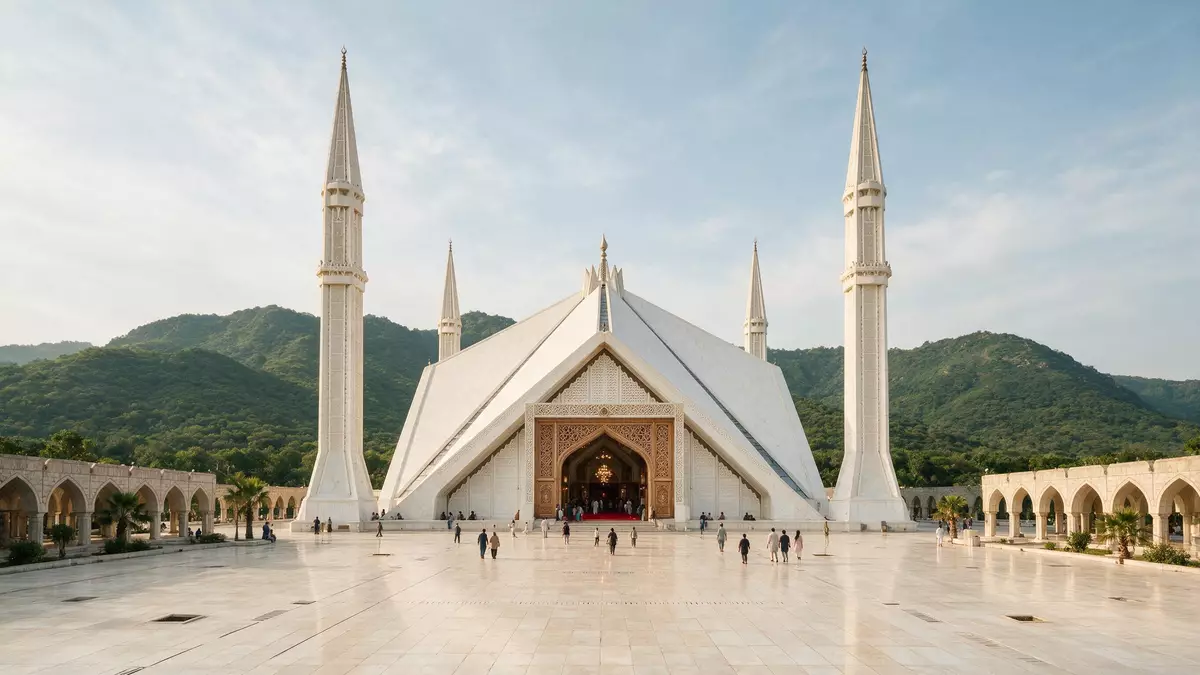
Faisal Masjid rises at the northern edge of Islamabad as a vast white tent-like form framed by the Margalla Hills. Designed by Turkish architect Vedat Dalokay and completed in 1986, the mosque replaces the familiar central dome with an eight-sided concrete shell.
Its four slender minarets, broad terraces and marble surfaces give the complex a distinct silhouette. The result is both a functioning mosque and a major piece of twentieth-century architecture in Pakistan.
Faisal Masjid: a concrete tent beside the Margalla Hills
Faisal Masjid stands at the end of Shaharah-e-Islamabad, against the southern face of the Margalla Hills. The complex occupies elevated terraces, with the mosque, courtyards and covered walkways arranged across a broad platform. From the city, the white structure appears as a sharp geometric volume beneath four tall minarets.
The central prayer hall reaches 40 m (131 ft) in height. Its roof forms an eight-faceted concrete shell, faced with white marble and supported by four large concrete girders. The angular profile recalls a desert tent, while the pointed minarets draw on Turkish architectural forms. The building’s overall language belongs to contemporary Islamic architecture, not to the domed Mughal tradition.
The mosque’s main entrance lies to the east, beyond a courtyard and porticoes. A record of the building’s design identifies the eight-faceted prayer hall as its central architectural feature.
Vedat Dalokay’s modern Islamic landmark
Vedat Dalokay’s proposal emerged from an international design competition held in 1969. The project linked a new national capital with a modern architectural vocabulary, while retaining recognisable references to Islamic religious buildings. The mosque bears the name of King Faisal bin Abdulaziz of Saudi Arabia, whose support helped establish the project.
The foundation stone was laid in October 1976. Construction reached completion in the 1980s, and the first prayer in the sanctuary took place on 18 June 1988. Conflicting published dates surround the completion and inauguration sequence, so the building belongs securely to the period from 1976 to 1988. Its architectural identity is tied to Dalokay, Pakistani construction expertise and Saudi patronage.
The mosque’s surfaces combine concrete, white marble, glass and mosaic decoration. Inside, calligraphic work and coloured mosaics accompany the prayer space, while a large Turkish-style chandelier hangs above the carpeted hall. The restrained exterior geometry contrasts with the richer decorative treatment within.
Dalokay’s design was selected through an international architectural competition, giving the building a clear place within the history of post-war religious architecture.
Courtyards, minarets and a national mosque
Faisal Masjid is more than its central roof. Four minarets rise to about 90 m (295 ft), forming a strong vertical frame around the prayer hall. Their narrow shafts and pointed tops differ from the heavier minarets associated with many historic mosques in South Asia.
The complex includes a large main courtyard, covered porticoes and circulation spaces across the raised platform. The prayer hall can accommodate thousands of worshippers, while the surrounding terraces extend the religious complex beyond the enclosed interior. A women’s prayer area and educational facilities form part of the wider arrangement.
The mosque also contains a mausoleum associated with General Zia-ul-Haq, Pakistan’s president from 1978 to 1988. The funerary space adds another layer to the complex, linking religious use with national political history. Its presence makes Faisal Masjid a place of worship, architectural study and public memory.
The twentieth-century setting matters. Islamabad was planned as Pakistan’s capital, and Faisal Masjid became one of its defining civic buildings. A contemporary architectural record dates the main project to the years 1976 to 1986, placing the mosque within the final phase of the capital’s early development.
Visiting Faisal Masjid: what travellers from Western Europe should know
- Faisal Masjid is in Islamabad’s northern sector, at the end of Shaharah-e-Islamabad and beside the Margalla Hills. Islamabad’s road network provides the main approach.
- The complex spreads across elevated terraces, courtyards and stairways. Visitors encounter broad paved areas, covered porticoes and the large prayer hall beneath the angular roof.
- The mosque is an active place of worship. Modest clothing and respectful behaviour are appropriate within the religious complex.
- The official language is Urdu and the currency is the Pakistani rupee.
- Entry requirements depend on your nationality; UK travellers can check the FCDO travel advice at gov.uk/foreign-travel-advice, Irish travellers the Department of Foreign Affairs at ireland.ie.
Searching for Faisal Masjid on social platforms
These links open searches for Faisal Masjid on each platform.
Frequently asked questions about Faisal Masjid
Where is Faisal Masjid?
Faisal Masjid is in Islamabad, Pakistan, at the northern end of Shaharah-e-Islamabad beside the Margalla Hills.
What can visitors expect at Faisal Masjid?
Visitors encounter an active mosque with a large prayer hall, courtyards, porticoes, terraces and marble-faced architectural details.
What makes Faisal Masjid distinctive?
Its central prayer hall has an eight-sided concrete shell shaped like a desert tent, with four approximately 90 m (295 ft) minarets around it.


