
Gateway of India and Mumbai’s basalt arch
Published on 09/10/2026 at 09:01 | Editorial responsibility: Rafael Müller, Editor-in-Chief AD HOC NEWS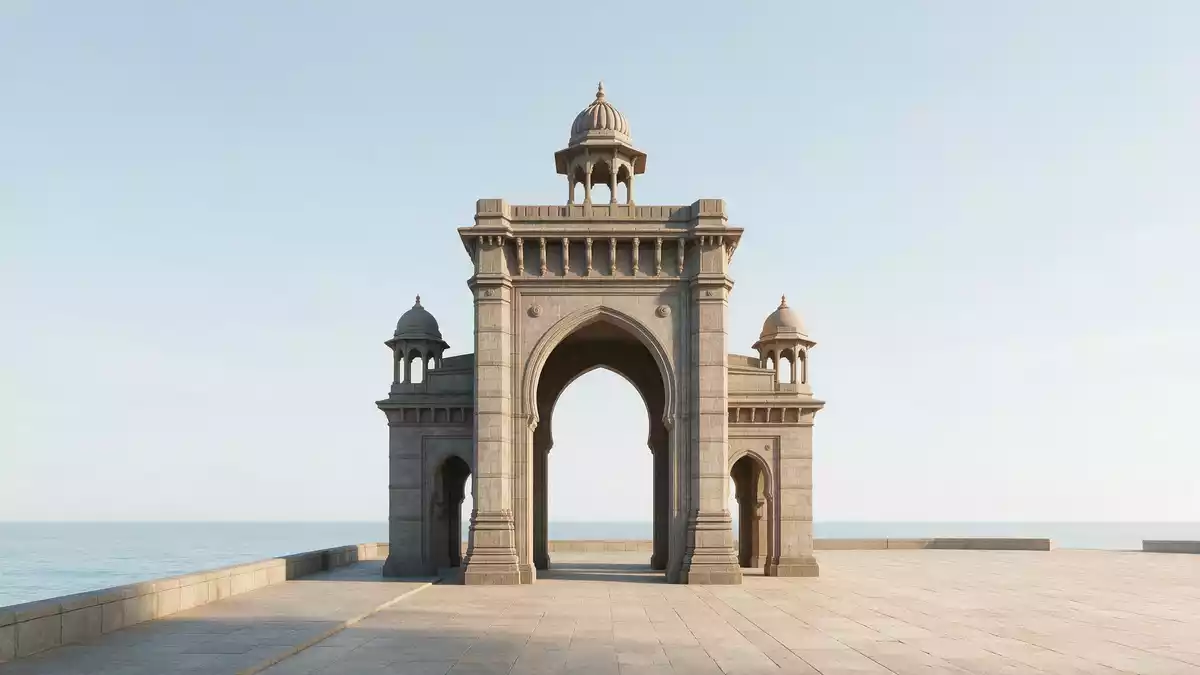
Gateway of India rises on Mumbai’s waterfront as an Indo-Saracenic arch of yellow basalt and reinforced concrete. George Wittet’s design, completed in 1924, gives the monument a clear profile against the harbour.
Yellow basalt on the Mumbai waterfront
The monument stands 26 m (85 ft) high and is built from yellow basalt over reinforced concreteyellow basalt. Its central dome is set between four turrets, and the whole composition follows the Indo-Saracenic vocabulary of the early twentieth century.
Gateway of India faces the Arabian Sea at Apollo Bunder, the harbour edge identified with the 1911 landing of King George V and Queen MaryApollo Bunder. That association places the arch within the closing years of the British imperial period in India.
George Wittet and the colonial phase
George Wittet, a Scottish architect working in Bombay, prepared the final design for Gateway of IndiaGeorge Wittet. The design was approved in August 1914, and the completed structure belongs to the architectural language associated with British rule in India.
The monument is linked to King George V and Queen Mary, who landed in Bombay in December 1911King George V and Queen Mary. Its date of completion, 1924, belongs to the same historical sequence and gives the arch its place in the city’s public memory.
The arch and its carved surfaces
The structure uses a central arch, a dome and flanking turrets, with carved stone latticework known as jalicarved stone latticework. These elements create a layered facade rather than a single flat face.
The monument belongs to the Indo-Saracenic style, which combines Indian and Islamic forms with imperial public architecture. In Mumbai, Gateway of India remains one of the city’s defining harbour landmarks and a familiar meeting point on the waterfront.
Visiting Gateway of India: what travellers from Western Europe should know
- Gateway of India stands at Apollo Bunder in south Mumbai, facing the harbour. Ferries to Elephanta Island leave from this part of the waterfront.
- The monument is set on level ground near the sea wall. The immediate area is open, with space around the arch and its approach.
- The arch’s stonework, dome and turrets are visible from several sides. The yellow basalt stands out against the water and the traffic of the shorefront.
- Gateway of India is a public monument, and the surrounding precinct connects it with the nearby Taj Mahal Palace hotel. The setting places the arch among Mumbai’s most recognisable harbour buildings.
Searching for Gateway of India on social platforms
These links open searches for Gateway of India on each platform.
Frequently asked questions about Gateway of India
Where is Gateway of India?
It stands at Apollo Bunder in Mumbai, on the harbour edge facing the Arabian Sea. The site is closely associated with the city’s historic waterfront.
What does a visit involve?
The experience is mainly architectural and urban: an open waterfront, a basalt arch, and views across the harbour. Ferries and other harbour activity belong to the same setting.
What makes Gateway of India distinctive?
Its yellow basalt, Indo-Saracenic style and George Wittet design give it a layered identity. The 1924 completion fixes it firmly in the colonial history of Mumbai.


