
Griffith Observatory brings Art Deco and astronomy together
Published on 09/24/2026 at 01:03 | Editorial responsibility: Rafael Müller, Editor-in-Chief AD HOC NEWS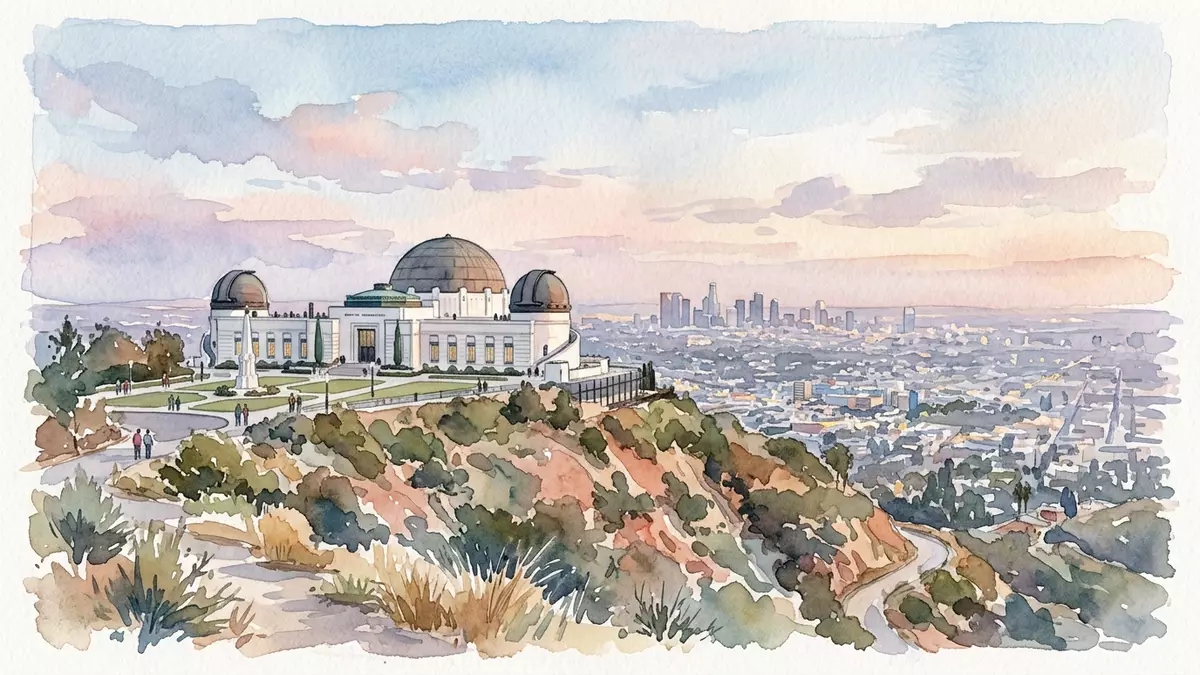
Griffith Observatory stands on the southern slope of Mount Hollywood in Los Angeles, its copper-coloured domes and pale concrete walls forming a visible landmark above Griffith Park. Inside, astronomy occupies an Art Deco building filled with instruments, murals, galleries and a planetarium.
Griffith Observatory’s Art Deco form on Mount Hollywood
The observatory opened on 14 May 1935. John C. Austin and Frederick M. Ashley prepared the final architectural plans, with physicist Edward Kurth directing the project and Russell W. Porter serving as a consultant.
The original building is a cast-in-place concrete structure associated with Art Deco, Moderne and modified Greek influences. Its exterior includes a Greek key pattern in the concrete, bronze and glass entrance doors, decorative metal window grilles and copper-covered domes. Travertine, marble, wood and bronze metalwork continue the material language inside.
The W. M. Keck Foundation Central Rotunda contains murals painted by Hugo Ballin in 1934. The ceiling imagery refers to celestial mythology, while the wall panels present the advancement of science through a sequence of painted scenes.
From public observatory to expanded science centre
Griffith J. Griffith left funds for an observatory, exhibit hall and planetarium in his will. The City of Los Angeles received the building when it opened, and the Department of Recreation and Parks has operated the facility as a public institution.
The building closed on 6 January 2002 for renovation and expansion. It reopened in 2006 with additional galleries, the Samuel Oschin Planetarium, the Leonard Nimoy Event Horizon presentation theatre, classrooms and improved access routes.
The expansion placed much of the new public space beneath the front lawn and west terrace. The enlarged complex contains exhibition areas connected with the original 1935 structure, while the visible exterior retains its historic profile. The resulting arrangement brings astronomy displays, historic architecture and views across Los Angeles into one place.
The Samuel Oschin Planetarium occupies the building’s central dome. When Griffith Observatory opened, its planetarium was the third in the United States and the first on the Pacific Rim. The original Zeiss projector was replaced in 1964, and the planetarium received a digital projection system during the 2002–2006 renewal.
Instruments that turn astronomy into something visible
The W. M. Keck Foundation Central Rotunda contains a Foucault pendulum. Its bronze ball weighs 240 pounds and hangs from a cable 40 feet long. As Earth turns beneath the pendulum, its motion changes in relation to pegs arranged in the pendulum pit.
In the Ahmanson Hall of the Sky, three solar telescopes provide views of the Sun. The observatory also houses the Zeiss telescope, while free-standing telescopes may appear on the front sidewalks for public sky observation.
The Wilder Hall of the Eye contains a Tesla coil with visible electrical discharges. The exhibit places a piece of electrical technology among displays about astronomy, physics and the history of scientific observation.
The Gottlieb Transit Corridor is a glass-walled passage measuring 150 feet in length and 10 feet in width. Its displays present the movements of the Sun, Moon and stars in relation to time and the calendar.
These elements give Griffith Observatory several scales at once. The pendulum presents the rotation of Earth through a moving instrument, the telescopes connect the building with the sky, and the planetarium creates an enclosed model of the universe.
Visiting Griffith Observatory: what travellers from Western Europe should know
- Griffith Observatory is at 2800 East Observatory Road on the southern slope of Mount Hollywood in Griffith Park. Los Angeles public transport, walking, cycling and road access all reach the observatory area.
- The approach rises through Griffith Park, whose landscape includes hills, trails and winding roads. Terraces and exterior paths surround the building on the Mount Hollywood slope.
- The Hollywood Sign lies on Mount Lee in Griffith Park and is visible from the observatory. The two landmarks occupy different hills within the same park.
- The official language is English and the currency is the US dollar.
Searching for Griffith Observatory on social platforms
These links open searches for Griffith Observatory on each platform.
Frequently asked questions about Griffith Observatory
Where is Griffith Observatory?
Griffith Observatory is at 2800 East Observatory Road on Mount Hollywood, within Griffith Park in Los Angeles. The site overlooks the Los Angeles Basin and faces towards the Hollywood Sign.
What can visitors see inside?
The building contains astronomy exhibitions, the Samuel Oschin Planetarium, the Foucault pendulum, solar telescopes, the Zeiss telescope and a Tesla coil. Its historic rooms also contain murals, marble, travertine and bronze details.
What makes the building distinctive?
Its 1935 Art Deco architecture combines copper-covered domes with cast concrete, geometric decoration and celestial murals. The observatory joins a historic public building with working scientific instruments and large-scale astronomy displays.


