
Guoli Gugong Bowuyuan and the palace museum on Taipei’s hillside
Published on 09/04/2026 at 22:39 | Editorial responsibility: Rafael Müller, Editor-in-Chief AD HOC NEWS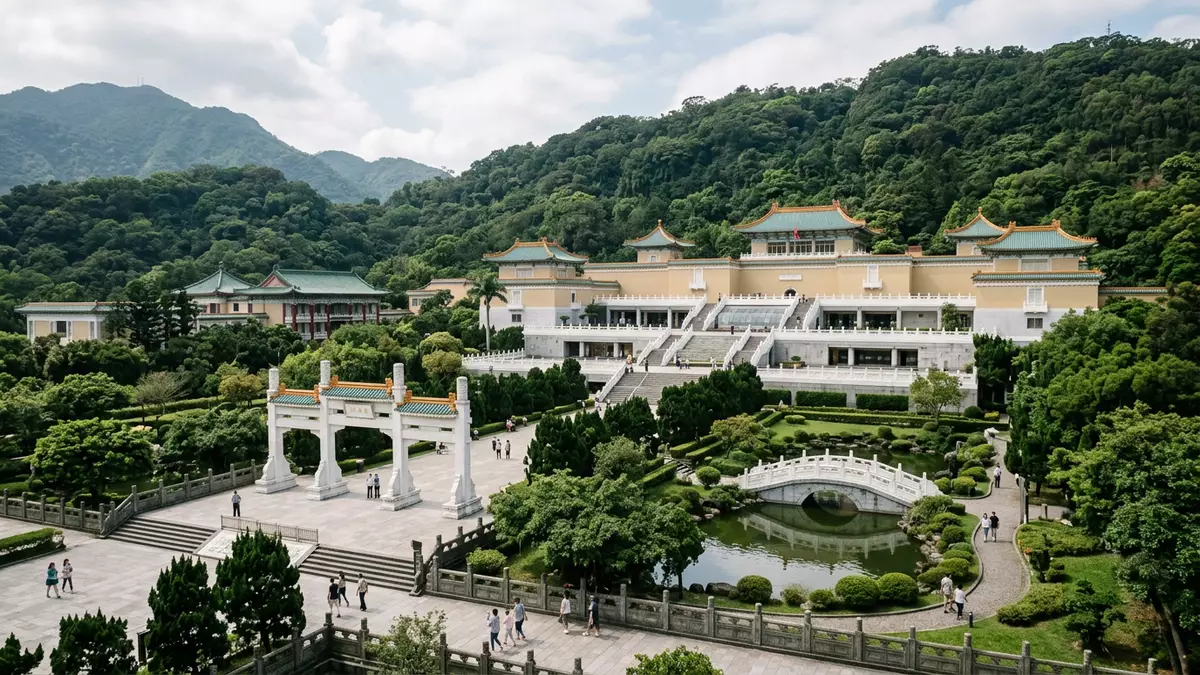
Guoli Gugong Bowuyuan, known internationally as the National Palace Museum, stands on a wooded hillside in the Shilin district of Taipeh and gathers imperial Chinese art into a palace-style museum complex. Founded as an institution in 1925 and opened at its current site in 1965, it presents centuries of court culture in buildings that echo the architecture of traditional Chinese palaces.
A palace-inspired museum above the city
Guoli Gugong Bowuyuan is an art museum and gallery in Taipeh, Taiwan, with its main complex rising above the Waishuangxi area of Shilin on a terraced slope backed by green hills. The museum’s present home was inaugurated in 1965, giving the collection a permanent base in Taiwan in a purpose-built complex on this hillside.Opened in 1965 in Shilin The institutional history reaches further back: the museum is traditionally dated to 1925, when a new museum was founded in Beijing to house imperial objects removed from the palace precinct there.Founded in Beijing in 1925
The complex at Waishuangxi is modelled on traditional Chinese palace architecture, with tiered buildings, rising roofs and decorative details that echo historic imperial compounds. Set against the forested hillside, the buildings frame courtyards and terraces, with the central exhibition hall forming the core of the ensemble. Visitors approaching the museum see a sequence of palace-like structures climbing the slope, with the landscape and architecture interwoven in a way that makes the complex itself part of the experience of the collection.
From imperial palaces to a hillside museum
The origins of Guoli Gugong Bowuyuan’s holdings lie in the imperial palaces of Beijing, where Qing dynasty emperors assembled large collections of ritual bronzes, jades, paintings and archival documents.Imperial holdings in Beijing Much of the material once formed part of the Palace Museum in the Forbidden City, supplemented by works from temporary palaces in places such as Jehol and Shenyang. During the twentieth century, selected pieces were relocated in stages, and the most valuable objects eventually reached Taiwan as political conditions changed.
The museum in Taipei now holds a permanent collection of around 700,000 artefacts and artworks, a scale that makes it one of the largest repositories of Chinese art in the world.Permanent collection of nearly 700,000 pieces These items trace roughly 8,000 years of history, from Neolithic jade objects through Shang and Zhou bronze ritual vessels to Song, Ming and Qing dynasty paintings and decorative arts.Collection spanning 8,000 years The move from Beijing’s palace precincts to the museum’s hillside complex in Shilin turned what were once court treasures into exhibits that can be studied by scholars and viewed by travellers.
Collections that trace Chinese art across millennia
Inside Guoli Gugong Bowuyuan, galleries are arranged to highlight different periods, materials and themes in Chinese art. The museum’s holdings include bronzes, ceramics, jades, lacquer, enamel, textiles, paintings, calligraphy, books and archival documents, grouped to show continuity and change across dynasties.Range of materials in the collection Curatorial teams install rotating displays that can lead from ancient ritual vessels to literati landscapes within a single visit, setting bronze forms alongside ink and colour on silk or paper.
The collection covers major periods of Chinese history, with objects linked to dynasties such as Shang, Zhou, Tang, Song, Yuan, Ming and Qing.Dynastic range of the holdings In one gallery, visitors may encounter handscrolls of landscape painting from the Song era; in another, pieces of fine Ming porcelain whose glazes and forms illustrate developments in ceramic technology. Separate sections highlight calligraphy, imperial edicts and books, giving insight into how written culture operated at court. Across the complex, the arrangement of rooms and display cases allows the museum to bring together works produced centuries apart while still emphasising the specific context of each piece.
Visiting Guoli Gugong Bowuyuan: what travellers from Western Europe should know
- Guoli Gugong Bowuyuan stands in the Shilin district of Taipeh, north of the city centre, and is reached by city transport links that run towards the Waishuangxi hillside.
- The approach to the museum involves outdoor terraces and internal stairways between levels, so visitors should expect corridors, steps and changes in elevation within the palace-style complex.
- The museum complex looks over a green valley, with nearby hills and residential areas forming the wider landscape around the site.
- The official language is Chinese and the currency is the New Taiwan dollar.
- Entry requirements depend on your nationality; UK travellers can check the FCDO travel advice at gov.uk/foreign-travel-advice, Irish travellers the Department of Foreign Affairs at ireland.ie.
Searching for Guoli Gugong Bowuyuan on social platforms
These links open searches for Guoli Gugong Bowuyuan on each platform.
Frequently asked questions about Guoli Gugong Bowuyuan
Where is Guoli Gugong Bowuyuan located?
Guoli Gugong Bowuyuan stands on a hillside in the Shilin district of Taipeh, Taiwan, above the Waishuangxi area on the city’s northern side.
What can visitors expect inside the museum?
Visitors encounter galleries that present bronzes, jades, ceramics, paintings, calligraphy and archival materials arranged to trace Chinese art and court culture across many dynasties.
What makes Guoli Gugong Bowuyuan distinctive among museums?
Its palace-inspired architecture on a forested slope and its collection of around 700,000 imperial artefacts spanning about 8,000 years of Chinese history give the museum its distinctive character.


