
Hakone Chokoku no Mori Bijutsukan, where sculpture meets the Hakone hills
Published on 09/10/2026 at 08:42 | Editorial responsibility: Rafael Müller, Editor-in-Chief AD HOC NEWS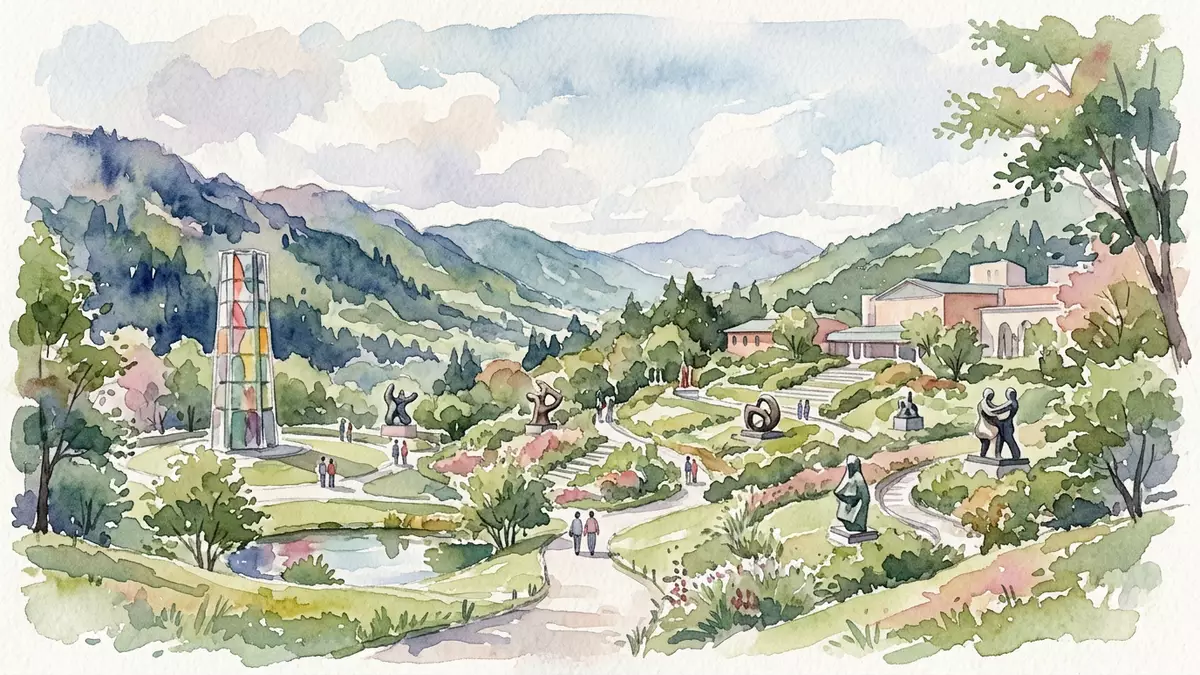
Hakone Chokoku no Mori Bijutsukan is an open-air sculpture museum in Hakone, where modern and contemporary artworks sit across a broad landscape of lawns, terraces and indoor galleries framed by the surrounding hills. Opened in 1969 as Japan’s first outdoor museum dedicated to sculpture, it has grown into an extensive parkland site with a large permanent collection and a series of pavilion-like exhibition buildings.opened in 1969
Sculpture in the landscape at Hakone Chokoku no Mori Bijutsukan
The core experience at Hakone Chokoku no Mori Bijutsukan is the encounter between sculpture and landscape, spread across a garden measuring about 70,000 square metres (roughly 17 acres).70,000 square metres of garden Paths wind through grass, trees and low planting, with abstract and figurative works placed on plinths, set into the ground, or rising directly from the turf. The museum presents around 100 modern and contemporary sculptures in this outdoor area, representing artists from Japan, Europe and the Americas.around 100 sculptures
Well-known sculptors whose work appears in the park include Auguste Rodin, Antoine Bourdelle, Joan Miró and Henry Moore, alongside Japanese sculptors such as Taro Okamoto and Rokuzan Ogiwara.Rodin, Miró and Henry Moore Pieces are arranged with clear sightlines so that multiple works are visible from many points along the routes, creating clusters of bronzes, steel structures and stone forms against the slopes of the Hakone hills. Some sculptures can be viewed at close range from all sides, while others are seen across water or lawn, encouraging longer views across the park.
Indoor galleries and the Picasso pavilion
Although the museum is best known for its outdoor sculpture fields, Hakone Chokoku no Mori Bijutsukan also includes several indoor galleries housing works on paper, ceramics and smaller-scale sculptures. These buildings are conventional museum structures, with stepped approaches and enclosed exhibition rooms that provide controlled conditions for more delicate pieces.
A particular focus is the Picasso Pavilion, which brings together an extensive group of works by Pablo Picasso, including ceramics and prints drawn from the museum’s collection.works by Pablo Picasso The pavilion stands apart from the main outdoor lawns, giving a distinct phase to a visit: time among bronzes and steel in the open air, followed by time with Picasso’s work in a dedicated indoor setting. Other galleries in the complex host changing exhibitions drawn from the museum’s wider holdings and from loans, adding variety alongside the permanent outdoor displays.
Hakone, Fuji-Hakone-Izu National Park and access
Hakone Chokoku no Mori Bijutsukan sits in the town of Hakone in Kanagawa Prefecture, within Fuji-Hakone-Izu National Park, a region known for its volcanic landscape and hot springs.Fuji-Hakone-Izu National Park The museum occupies a site at Ninotaira, a district on the slopes above the valley, with the mountains forming a constant backdrop to the sculpture fields.
The museum’s name is shared with Chokoku-no-Mori Station on the Hakone Tozan Railway, a short walk from the entrance.Chokoku-no-Mori Station on the Hakone Tozan Railway Trains on this line run uphill from Hakone-Yumoto through the valley’s wooded slopes, and the station platforms are within straightforward walking distance of the museum gate. Road access follows the National Route 1 corridor into Hakone, with the museum reached via local roads around Gora.road directions to the museum
Visiting Hakone Chokoku no Mori Bijutsukan: what travellers from Western Europe should know
- Hakone Chokoku no Mori Bijutsukan stands at Ninotaira in Hakone, Kanagawa Prefecture, with Chokoku-no-Mori Station on the Hakone Tozan Railway providing rail access within walking distance.
- The outdoor sculpture areas are spread across sloping ground with lawns, steps and paved paths, so a visit involves walking on gradients and over uneven surfaces.
- Hakone is reached by rail from Odawara and Hakone-Yumoto, with onward connections by the Hakone Tozan Railway and by local roads serving the Gora area.
- The official language is Japanese and the currency is the yen.
- Entry requirements depend on your nationality; UK travellers can check the FCDO travel advice at gov.uk/foreign-travel-advice, Irish travellers the Department of Foreign Affairs at ireland.ie.
Searching for Hakone Chokoku no Mori Bijutsukan on social platforms
These links open searches for Hakone Chokoku no Mori Bijutsukan on each platform.
Frequently asked questions about Hakone Chokoku no Mori Bijutsukan
Where is Hakone Chokoku no Mori Bijutsukan located?
Hakone Chokoku no Mori Bijutsukan is in Ninotaira, Hakone, in Kanagawa Prefecture in eastern Japan, within Fuji-Hakone-Izu National Park.
What can visitors expect during a visit?
Visitors walk through extensive outdoor sculpture gardens, view works by international modern sculptors and explore indoor galleries, including a dedicated Picasso Pavilion.
What makes Hakone Chokoku no Mori Bijutsukan distinctive among museums?
Its combination of a large open-air sculpture park, a permanent modern and contemporary collection and its setting in a mountainous national park gives it a distinctive character.


